
Introduction
Cells are the basic unit of life, cells are the building blocks of all living things. There are 2 types of cells, plant& animal cell. But we will dwell on animal cell
-Just close your eyes and picture a Lego city. What is the building block of that lego city? A single lego of course. Like a lego city, a body is composed of basing building blocks, and those building blocks are the body cells.
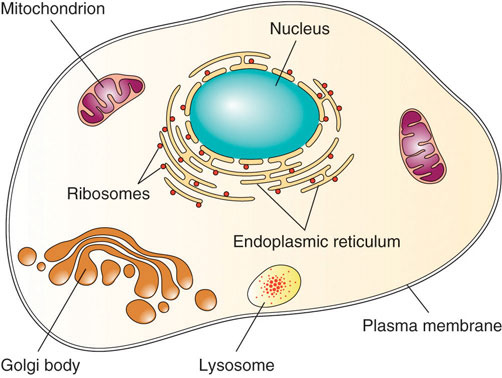
|
Cell is the smallest unit of a living thing. A living thing, whether made of 1 cell (bacteria) or many cells like human, is called organism. Which is why cells are the basic building blocks of all organism. Several cells of one kind that interconnect with each other and perform a shared function they form a tissue.Several tissues combine to form an organ( stomach,heart or brain). Several organs makes up an organ system (digestive system, circulatory system, or nervous system. All the several systems that functions together form an organism (like human being) The body has many kinds of cells, each personalised for a specific purpose. Just as a home is made from variety of building material, the body is made from many cell types. Functions
|
|
|
Task
- Study the two diagrams of plant and animal cells below.
- Draw a table of differences between the two cell types in the space provided. Give your table a suitable heading.
- Also provide labels for the different cell structures and organelles.

A typical animal cell.

A typical plant cell.
In a 3D cell model, we will be making built models out of materials where we will use other objects to represent the actual parts of the cell.
INSTRUCTIONS :
- You must create a 3D model of a cell.
- You may use whatever materials or 'media' you choose to create your cell.
- Your model must clearly show the following:
- cell membrane
- nucleus with nuclear membrane
- cytoplasm
- mitochondria
- vacuoles
- chloroplasts
- Any other organelles that you might have learnt about
Requirements for your cell model:
- Your model and the examples of the organelles need to show some resemblance to the real organelle that we have learnt about so far.
- Your model needs to be clearly marked with a heading and your name.
- Each organelle needs to be clearly labelled and with each label you need to add a description of the function of that particular organelle.
- You also need to make an accompanying drawing (at least the size of an A4 page) including the labels of the structure of a basic plant and animal cell.
- Your teacher will assess your model according to a rubric
Process
able summarising the differences between plant and animal cells
|
Characteristic |
Animal cells |
Plant cells |
|
Shape |
Have an irregular shape |
Have a rigid, regular shape |
|
Cell wall |
Do not have a cell wall, only a cell membrane |
Have both a cell membrane and a cell wall. |
|
Vacuoles |
Have small vacuoles, which are often temporary or absent |
Have large vacuoles |
|
Chloroplasts |
Do not have chloroplasts |
Have chloroplasts to photosynthesise |
Evaluation
| 3D Cell Model Project | ||||
| Poor
1 pts |
Fair
5 pts |
Good
10 pts |
Exceeds
15 pts |
|
| Cell Structure/Cell Type
|
Poor
|
Fair
|
Good
|
Exceeds
|
| Organelle Function
|
Poor
|
Fair
|
Good
|
Exceeds
|
| Cell Details
|
Poor
|
Fair
|
Good
|
Exceeds
|
| Labeled Organelles
|
Poor
|
Fair
|
Good
|
Exceeds
|
| Creativity
|
Poor
|
Fair
|
Good
|
Exceeds
|
| Appearance
|
Poor
|
Fair
|
Good
|
Exceeds
|
| NETS/Common Core Standards | ||||
| NETS Criteria
|
Poor
|
Fair
|
Good
|
Exceeds
|
| Common Core
|
Poor
|
Fair
|
Good
|
Exceeds
|
Conclusion
In this course you have learnt about the subcellular components of cells and how they are studied. Cells in multicellular organisms, particularly in animals, are specialised to perform different functions; the properties, abundance and distribution of the cytoskeleton and organelles allow, and indeed underpin, this functional and structural diversity. Your study of this course has provided you with a general understanding of cellular architecture and its relationship to different processes in the cell. This sets the scene for further studies in cell biology.
Credits
Teacher Page
|
Lesson content(notes& questions) |
Methodology & Time |
LTSM (Resources) |
Teacher Activities |
Learner Activities |
Assessment Method/Strategy |
|
|
INTRODUCTION
Cells are the basic unit of life, cells are the building blocks of all living things. There are 2 types of cells, plant& animal cell. But we will dwell on animal cell
-Just close your eyes and picture a Lego city. What is the building block of that lego city? A single lego of course. Like a lego city, a body is composed of basing building blocks, and those building blocks are the body cells. |
Demonstration for |
|
I will assembly the Legos in a table that is vigilant to all the learners. Then I will form a tree using the legos. By so doing I will be showing the learners how a cell is actually a building block of life.
I will then ask them to take the legos and make a living thing (animal) I will set a timer of 3 mins |
Learners will be paying attention while the teacher is explaining to them how the cell is a basic unit of life.Then they will formulate the model of any type of animal using legos.
Learners will also ask questions.
|
Practical mini task |
|
|
BODY Cell is the smallest unit of a living thing. A living thing, whether made of 1 cell (bacteria) or many cells like human, is called organism. Which is why cells are the basic building blocks of all organism. Several cells of one kind that interconnect with each other and perform a shared function they form a tissue.Several tissues combine to form an organ( stomach,heart or brain). Several organs makes up an organ system (digestive system, c irculatory system, or nervous system. All the several systems that functions together form an organism (like human being) The body has many kinds of cells, each personalised for a specific purpose.Just as a home is made from variety of building material, the body is made from many cell types. Functions
|
Demonstration
|
Data projector.
Textbook
|
I will go into details explaining, how is the cell the building block of life. I will play a Minnie video for them that shows how a lego city is built. This will help them understand the hierarchy of life. I will then ask oral question |
Learners will pay attention and answer the questiong by the show of hands |
Oral questions |
|
|
|
|
|
|
|
|
|
|
Lesson Application
Learners will be given a test to test their knowledge. They will be asked question based on the Hierarchy of life, where they will show the organism is formed. They will also distinguish the animal cell from the plant cell, as they have been thoroughly taught about the animal cell.
|
Question and answer |
Worksheet |
Hand out work sheet |
Answer the questions on the worksheet and hand them back. |
|
|
|
C
|
|
|