
Introduction
Do you know what the water cycle is? Where does water go after it rains? Throughout this WebQuest, we will be able to explore these questions as well as a few additional questions. Complete the WebQuest to learn more about the water cycle! /closeupbrightbluewater-61f0f88d81004729a7385484bcd38998.jpg)
Task
Task 1: Research a brief definition of "the water cycle." Write the definition in your own words!
Task 2: View the slideshow presentation on Water Cycle vocabulary words. Be sure to review them, this will help in the later steps!
Task 3: Grab a card from a bin on the front desk. Your card should have either a word or definition on it. Find the word or definition that matches yours!
Task 4: Watch a short video on The Water Cycle. Upon watching the short clip, choose 2 steps from the cycle, and write 3 facts about each step.
Task 5: Turn and talk to a partner about the facts that you've found. Be sure to share your definitions of "The Water Cycle," too. If you chose the same step(s) as another student in the class, compare the facts that you have found (and add ones that you don't already have)!
Task 6: Take a brain break! Play a fun game about the cycle.
Task 7: For your fifth and final task, draw a picture of one of the steps in the cycle that you have researched. Be sure to label your drawing with the movement of the water. We will be sharing the drawings with the class as well as your favorite fact about the step! 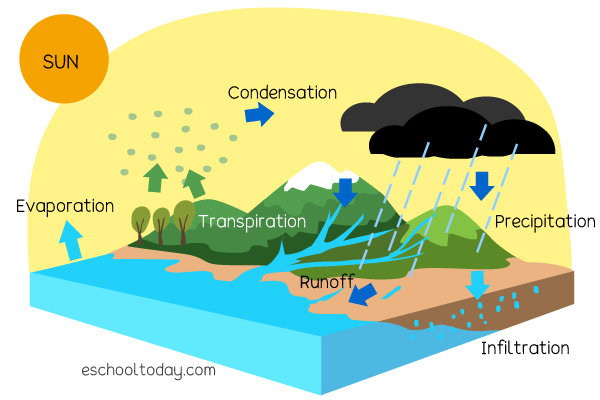
Process
1. Look for the definition of "The Water Cycle."
2. Review the vocabulary slideshow presentation. https://www.kerrvilleisd.net/site/handlers/filedownload.ashx?moduleinstanceid=3070&dataid=2850&FileName=4.8B%20Water%20Cycle%20vocab.pdf.pdf
3. Write 5 sentences using 5 vocabulary words (one word in each sentence). If you're up for a challenge, use 2 words in one sentence!
4. Watch the video about The Water Cycle. Remember to write 3 facts about your favorite steps of the cycle (2 of them!) https://oceantoday.noaa.gov/watercycle/
5. Turn and talk to a partner about the facts and the definition that you've found. Jot down a few more facts from another student, too!
6. Play a fun game about the cycle! https://www.educationsoutheastwater.com.au/resources/natural-water-cycle-game
7. Draw a picture of your favorite step that you have researched. (be sure to label your drawing)! Be prepared to present your drawing and your favorite fact with the class!
Evaluation
| 4 | 3 | 2 | 1 | |
| Vocabulary |
I used 5 or more vocabulary words. |
I used 3 or 4 vocabulary words. |
I used 2 vocabulary words. |
I used 1 vocabulary word. |
| Accuracy |
I labeled each part of my drawing correctly. |
I labeled 3 or 4 parts of my drawing correctly. |
I labeled 2 parts of my drawing correctly. |
I labeled 1 part of my drawing correctly. |
|
Completed Webquest |
I completed all 6 tasks to the best of my ability. |
I completed 4 or 5 tasks to the best of my ability. |
I completed 2 or 3 tasks to the best of my ability. |
I completed 1 task to the best of my ability. |
| Final Score |
Conclusion
Please take a moment to fill out this Google Form to let me know how to improve the WebQuest! Thank you!
Credits
All of the websites listed were especially helpful when creating this WebQuest, thank you!
Teacher Page
Hi! I am a sophomore Early Childhood Education major at Waynesburg University. This was a project for one of my classes, and I really enjoyed making it!
Learners:
- This WebQuest is geared toward third or fourth grade students.
Standards:
- Standard - 3.2.4.A1: Identify and classify objects based on their observable and measurable physical properties. Compare and contrast solids, liquids, and gases based on their properties.
-
Standard - 3.2.4.A5: MODELS: Use models to demonstrate the physical change as water goes from liquid to ice and from liquid to vapor.
Teacher Process:
- This WebQuest is designed to take 2 days. Students may need additional time to work on their drawings and facts outside of class to ensure that they are perfect before presenting to the class.
- Students who may experience difficulty with the vocabulary words or the labeling may be given pre-made sentences and pictures as well as a word bank.
Resources: I've included a few books as well as helpful videos for students!
- The Water Cycle at Work (Water in our World) by Rebecca Jean Olien
- The Great Big Water Cycle Adventure (Look and Wonder Books) by Kay Barnham
- The Water Cycle: Wyatt the Water Drop by Zack Phillips
- The Water Cycle (3-5 Version) https://www.generationgenius.com/videolessons/water-cycle-video-for-kids/
- Parts of Water Cycle
https://www.youtube.com/watch?v=r-_MYNnurlQ