
Introduction
WebQuest Made By Michaela Stevenson
In this WebQuest, I will teach students how to count dollars and coins. The students will be able to apply what they have learned in this WebQuest to help them with the group activity.

Introduction:
Today, we will learn about the value of dollars and coins when we are counting money and apply what we have learned in the group activity later on in the lesson. You will use basic math skills- which include both addition and subtraction- to count the dollars and coins during this lesson. By the end of this activity, students should understand the importance of counting money as well as enhance their addition and subtraction skills.
Important Questions to Think About...
1) Why is counting money very important?
2) What is the value of each coin and each dollar?
3) What items can I buy with money?
4) How can I save money?
Task
Task

First: The teacher will review with the students the values of different coins (i.e., pennies, nickles, dimes, and quarters) and dollar bills using a handout.
Second: The students will break off into groups and each student will be given a certain amount of money, that will be used to buy certain items at a grocery store. For the activity, each student will have to choose an item, or a few items, within the grocery store to buy and provide the correct amount of coins and dollar bills to buy it/them.
Third: The students will then return to their own desks, and they will add up the amount of money they've spent in the grocery store then subtract that amount from their original amount to see how much money they have left after their shopping experiences.
Special Note***: Those students who are ELL (Levels 1-5) will have extra time and assistance during this activity.
Process
Process
Review: Take time to review the values of different coins and dollar bills using the handout and the coin value song, and then apply it to the activity later.
Click Below to Hear the Coin Value Song!!!

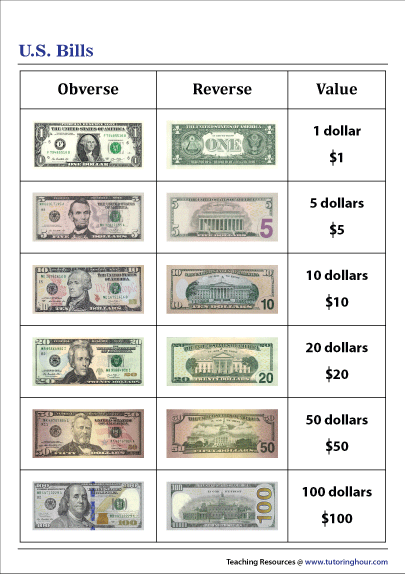
Review: Take time to review how to count coins and dollar bills, and then apply it to the activity later.
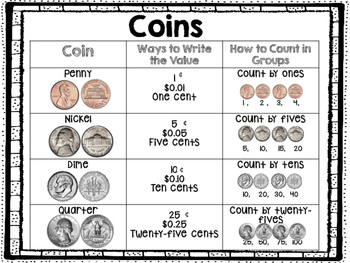
Group Activity:
Step 1: Students will go into their assigned groups to begin the activity.
Step 2: Each student will record the original amount of cash that he/she is starting with before he/she begins the grocery shopping experience.
Step 3: The students will begin to shop in the "grocery store" for items they would like to purchase, and they will have to use their addition and subtraction skills to generate the correct amount of coins and dollar bills to buy the items that they want.
Step 4: Once every student has finished shopping for the items that they want, they will return to their groups and begin discussing what they bought, how much they bought it for, and how they added and/or subtracted their coins and dollars to come up with the correct amount due to purchase their items.
Step 5: Each student will then return to his/her original desk and begin adding up how much he/she spent on his/her items then subtract that amount from his/her original amount of cash in the beginning to reveal how much money he/she has left after his/her shopping trip.
Step 6: Each student will then be given a jar to represent his/her "saving's account," so that he/she can store his/her remaining coins and dollar bills for his/her's next shopping trip.
Evaluation
Evaluation:
|
|
Beginning 1 |
Developing 2 |
Qualified 3 |
Exemplary 4 |
Score |
|
Identifying the value of coins |
Can identify the value of less than 2 coins |
Can identify the value of 2 coins |
Can identify the value of 3 coins |
Can identify the value of all 4 coins |
|
|
Identifying the value of dollar bills |
Can identify the value of less than 2 dollar bills |
Can identify the value of 2-3 dollar bills |
Can identify the value of 4-5 dollar bills |
Can identify the value of all 6 dollar bills |
|
|
Shows knowledge of how to count dollar bills and coins |
Shows little to no knowledge of how to count dollar bills and coins |
Shows intermediate knowledge of how to count dollar bills and coins |
Shows advanced knowledge of how to count dollar bills and coins |
Shows proficient knowledge of how to count dollar bills and coins |
|
|
Using addition and/or subtraction skills to count money |
Shows little to no knowledge of using addition/subtraction skills to count money |
Shows intermediate knowledge of using addition/subtraction skills to count money |
Shows advanced knowledge of using addition/subtraction skills to count money |
Shows proficient knowledge of using addition/subtraction skills to count money |
|
|
Using addition/subtraction skills to count remaining balance |
Shows little to no knowledge of using addition/subtraction skulls to count remaining balance |
Shows intermediate knowledge of using addition/subtraction skills to count remaining balance |
Shows advanced knowledge of using addition/subtraction skills to count remaining balance |
Shows proficient knowledge of using addition/subtraction skills to count remaining balance |
|
|
Participation in the group activity |
Did not participate in the group activity |
Participated a little in the group activity |
Showed interest in the group activity and discussed a little with the group |
Fully participated in the group activity, showed interest in the activity, and fully participated in the group discussion |
|
Conclusion
Conclusion
What we've learned in this lesson:
- We've learned the value of coins and dollar bills
- We've learned how to count money as well as how to count our remaining balance
- We've learned how to use money in a real life experience (grocery shopping)

Counting money is a hectic job! But, with the great skills that you've obtained from this activity, it should make your next shopping trip a lot easier! Let's reflect on what we've learned from this lesson. Why do you think counting money is so important? How does counting money help you when you are shopping for certain things? Can you apply this lesson in your every day life and if so, how?
Credits
Teacher Page
Teacher Page
This WebQuest is designed to teach students the values of different coins and dollar bills, so that they may be able to use what they've acquired during the lesson in the real world. Students will participate in a group activity, where they will do a mock grocery shopping trip and utilize their knowledge of adding and subtracting coin and dollar bill values to purchase their items as well as saving some of their cash in the process. The lesson is designed to be implemented in a 2nd grade math class that is discussing the importance of money and how to count it. This activity is designed to be taught in groups and as individual work, but can be modified to fit the teacher's specific classroom needs.
Subject Area: Math
Grade Level: K-2
Body of Knowledge: Money
Standards:
MAFS.2.MD.3.8: Solve one- and two-step word problems involving dollar bills (singles, fives, tens, twenties, and hundreds) or coins (quarters, dimes, nickels, and pennies) using $ and ¢ symbols appropriately. Word problems may involve addition, subtraction, and equal groups situations1. Example: The cash register shows that the total for your purchase is 59¢. You gave the cashier three quarters. How much change should you receive from the cashier?
a. Identify the value of coins and paper currency.
b. Compute the value of any combination of coins within one dollar.
c. Compute the value of any combinations of dollars (e.g., If you have three ten-dollar bills, one five-dollar bill, and two one- dollar bills, how much money do you have?).
d. Relate the value of pennies, nickels, dimes, and quarters to other coins and to the dollar (e.g., There are five nickels in one quarter. There are two nickels in one dime. There are two and a half dimes in one quarter. There are twenty nickels in one dollar).
Related Access Points:
MAFS.2.MD.3.AP.8a: Solve word problems using dollar bills, quarters, dimes, nickles, or pennies up to $50.
ELD.K12.ELL.MA.1: English language learners communicate information, ideas, and concepts necessary for academic success in the content area of Mathematics.
For ELL students in levels 1-2, the teacher should utilize extra time explaining the value of coins and dollar bills as well as counting money to the students to help these students understand the concept better. The students may also need extra time to complete the assignment and orally present their work to the teacher.
For ELL students levels 3-5, the teacher should arrange these students either in pairs, small groups, or individually for this assignment. These students may need extra assistance in completing the activity and they may need extra time ( not as much as those who are levels 1-2) to complete the assignment.