
Introduction
Photorespiration is a wasteful pathway that occurs when the Calvin cycle enzyme rubisco acts on oxygen rather than carbon dioxide
C4 plants minimize photorespiration by separating initial CO2 fixation and the Calvin cycle in space, performing these steps in different cell types.
C3 photosynthetic mechanisms: Most plants are C3 with no specific features to combat photorespiration, a wasteful process which uses up ATP and NADPH to synthesis carbohydrates. Photorespiration occurs when the rubisco enzyme uses oxygen rather than carbon dioxide. Photorespiration is more common when plants close their stomata to prevent water loss along with higher temperatures. A plant that does not have adaptations to prevent photorespiration is classified as a C3 plant.
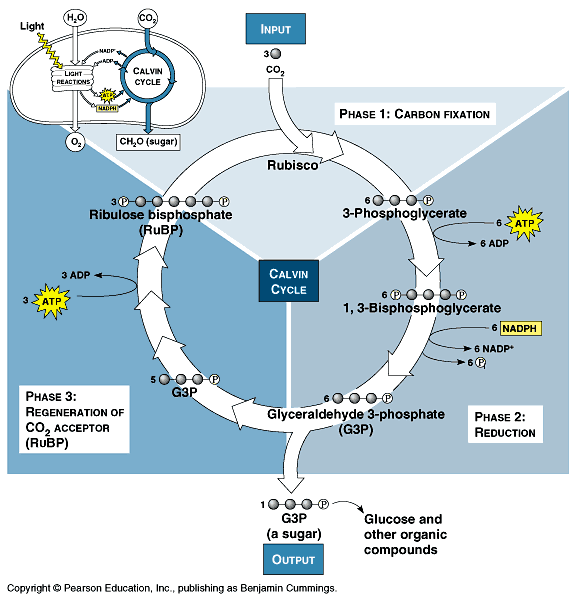
The calvin cycle is a light-independent reaction, it functions without the presence of solar energy, instead using ATP and NADPH from light-dependent reactions. The calvin cycle starts by using ATP and NADPH from light-dependent reactions to fuel carbon dioxide fixation by rubisco, which is used to build 3-carbon sugars. The calvin cycle takes place in the stroma. Ribulose-1,5-bisphosphate, otherwise known as RuBP, combines with CO2 to create an unstable 6-carbon compound that immediately splits into two 3-carbon compounds, 3-phosphoglyceric acid (3-PGA).
NADPH and ATP are used to convert 3-PGA into a 3-carbon sugar glyceraldehyde-3-phosphate, or G3P. G3P molecules make glucose as well as being recycled back into RuBP. The calvin cycle must happen three times for one G3P molecule to be made.
C4 photosynthetic mechanisms: Plants that have expanded to warmer climates and tropical areas have developed a form of carbon fixation that largely limits photorespiration. This is C4 photosynthesis. The anatomy of C4 plant leaves allows for carbon dioxide to concentrate in 'bundle sheath' cells around Rubisco. This structure delivers carbon dioxide straight to the Rubisco, removing its contact with oxygen and the need for photorespiration. This also allows the plant to fix carbon with its stomata closed, greatly reducing water loss.
C4 plants use an enzyme called PEP in the first step of carbon-fixation. PEP is much more reactive and attracted to carbon molecules, so it rarely goes towards the oxygen molecules. PEP fixes carbon dioxide into a four-carbon molecule, named malate, that is then transported to the deeper bundle sheath cells that contain more Rubisco. The malate is then broken down into a compound that is recycled back into PEP and carbon dioxide that Rubisco fixes into sugars like glucose and sucrose.
Task
Diagrams showing the proccesses of C3 and C4 plants

Process
Examples of plants that undergo C3 photosynthesis: Barely, oats, rice, wheat, cotton, potatoes, tobacco

Examples of plants that undetgo C4 photosynthesis: Sugarcane, millet, corn, switchgrass, sorghum, pineapple, daisies

Evaluation
A vast majority of plants humans rely on for food and energy are C3 pathway plants. Even in enviroments dominated by C4 plants, animals will most often rely on C3 plants to eat. They are usually grain products, vegetbles, and trees, and can be found around the world in multiple enviroments. They are not fixated to a certain type of enviorment, nor do they have specific adaptations for those enviroments.
While C4 plants only make up about 3% of the worlds plants, they dominate in the tropics, subtropics, and warm areas of Earth. They are very efficient plants in terms of photosyntehsis. They tend to live in aareas with high light intensity and temperatures where C3 plants would struggle to live, allowing it to exhbit higher photosynthetic abilities due to their adaptations for less water.
Conclusion
Comparison of C3 and C4 plants photosynthetic mechanisms:
The main difference between C4 and C3 plants are the ways they conduct photosynthesis and their photosynthetic mechanisms. C3 plants use the Calvin-Benson cycle to convert CO2 into glucose using photorespiration. C4 plants have evolved in a way to where they no longer need the photorespiration part and can retain water easier than C3 plants, allowing them to live in warmer environments. C3 plants live in cooler climates while C4 plants live in warmer climates and need to conserve water.
C3 and C4 plants use their stomata to regulate gas exchange, however C4 plants keep their stomata closed far more often to preserve water in warm climates. C4 plants can fix carbon without using the oxygen part of CO2 as well, allowing for the process to go by quicker and more efficiently. They use an enzyme called PEP that is more attracted to carbon molecules than oxygen. C3 plants do not have this enzyme.