
Introduction
One of my favorite animals is a wolf. I love that they travel in packs because it reminds me of my family. My family is my pack and we protect each other at all costs. Today we are going to learn why some animals form groups. Once you've learned why some animals form groups, you are going to pick an animal that forms a group and create an argument on why that animal forms a group.
Complete the graphic organizer on animals that form groups as you go through each task.
Task
With your partner, you will learn more about animals that form groups. As you read more about animals that form groups, you and your partner will complete a graphic organizer. Pay attention to any information you might find useful. Once your graphic organizer is finished, you're going to answer some questions to test your knowledge.
After you have researched animals that form groups, you are going to pick an animal that forms a group and construct an argument that supports how that animal's group helps them.
Process
Why do animals form groups?
Some animals form groups to help them survive. There are several ways that an animal's group can help them survive.
Here is a video of a kid professor explaining why some animals live in groups. Watch this video with your partner to learn more about animals that form groups. Pay attention because you will need this information later when answering questions.
Animals that form groups do so for a reason. Different animal groups have different reasons for forming groups. They may form groups to hunt together, protect themselves against predators together, help each other gather food, or cope with changes. When animals cope with changes, they are adapting to their environment. Wolves gather in packs to hunt for food together. Larger animals that form groups, like zebras in a herd, will protect themselves or their babies by gathering around each other to defend themselves against lions, for example. Orca whales gather in groups to find food together. Look at these pictures and read them with your partner to learn more about animal group behavior.
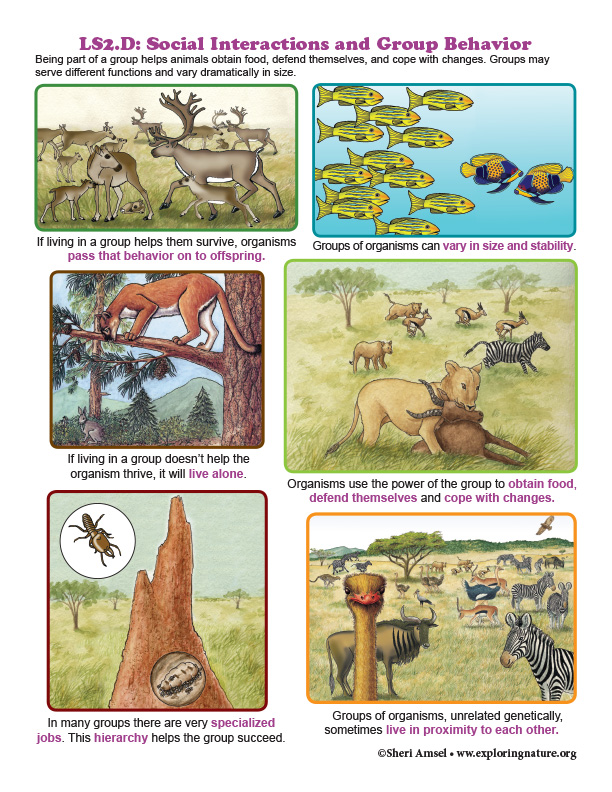
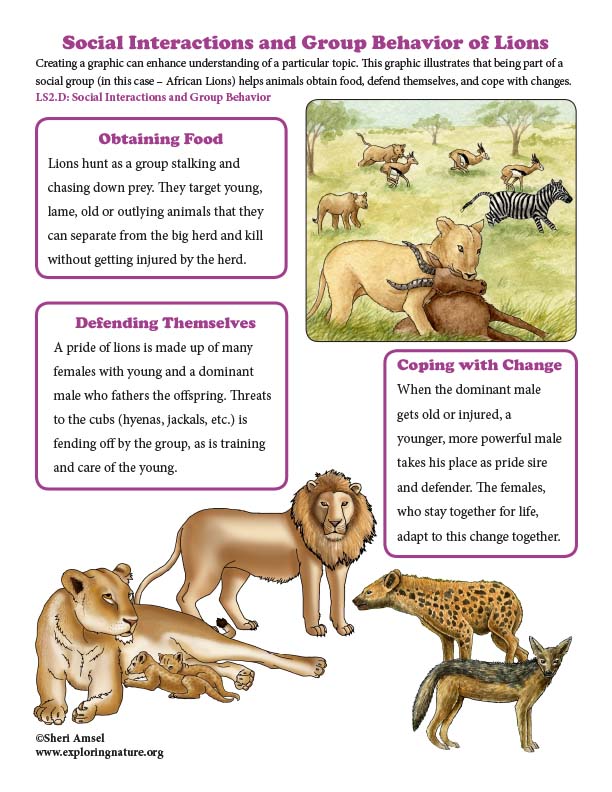
When you're done looking at these pictures, explore this website to learn more about animals that form groups. Another animal that forms a group to help members survive is the meerkat. If a group of meerkats is confronted, the meerkats will stand together, arching their backs, raising their hair, and hissing, which can trick an attacker into thinking they are a single large, vicious animal. This is an example of forming groups to protect against predators.
Find out more about animal group behavior by reading this article and watching this video here.
Now that you've learned about animals that form groups and why they do so, answer these questions.
Animals that Form Groups
-
What’s the main reason why animals form groups? ______________________________________________________________________
-
One animal that forms a group to help members survive is____________________
-
What does being part of a group help animals do?
-
Obtain food
-
Defend themselves
-
Cope with changes
-
All of the above
-
-
What’s the definition of animal group behavior? ______________________________________________________________________
-
How do meerkats help each other survive? ____________________________________________________________________________________________________________________________________________
-
Circle true or false. If living in a group doesn’t help the organisms thrive, they would not be found in a group together. True False
-
Give an example of an animal that uses their numbers as a defense. ___________________
-
What are two animals that form groups to gather food? ________________________ ___________________________
-
Circle true or false. Animal group behavior can involve a few animals or thousands. True False
-
When animals form groups to cope with changes, they are ___________________ to their environment.
https://docs.google.com/document/d/1gN0iRIevojAi109f2Z53Ak8OPpBqvWzHoIzFj9mpoTs/edit?usp=sharing
Evaluation
With the knowledge you've gained throughout this lesson, it's time to construct and support an argument that animals form groups to help members survive. Pretend you're the President and you're giving a speech. You want to convince people to support your views, so try to back up your argument with facts. The students that you're giving a speech to will then "vote" for you by giving you a thumbs up if they agree with your argument.
Good luck!
Conclusion
Congratulations! You've learned so much about animals that form groups and their behaviors that help them survive. I can't wait to hear everybody's speech!
Credits
Animal Group Behavior. (n.d.). Retrieved from https://www.generationgenius.com/animal-group-behavior-lesson-for-kids/.
Ecosystems: Interactions, Energy, and Dynamics. (n.d.). Retrieved from https://www.exploringnature.org/db/view/Grade-3-3-LS2-Ecosystems-Interactions-Energy-and-Dynamics.
Social Interactions and Group Behavior. (n.d.). Retrieved from https://www.exploringnature.org/db/view/Social-Interactions-and-Group-Behavior.
Teacher Page
3-LS2-1
Performance Expectation: Construct and support an argument that some animals form groups that help members survive.
Clarification Statement: Arguments could include examples of group behavior such as division of labor in a bee colony, flocks of birds staying together to confuse or intimidate predators, or wolves hunting in packs to more efficiently catch and kill prey.
Disciplinary Core Ideas: Being part of a group helps animals obtain food, defend themselves, and cope with changes. Groups may serve different functions and vary dramatically in size. (UE.LS2D.a)