
Introduction
❌ Photo unavailable
A short introduction to Cell Biology
Cell Biology's concern is the physiological properties, the metabolic process, signaling pathways, life cycle, chemical composition and interactions of the cell with respect to their environment. These can be done through microscopic and molecular level as it encompasses prokaryotic and eukaryotic cells. Knowing its the cell components and and how its works is the fundamental study to all Biological Sciences. It can also aid several researches in bio-medical fields to find cure for cancers and other diseases.
Cell: A complex miniature universe
A cell or a network of cells is a living creature as long as the physiological relay within it is continuously functioning. If one considers the components, processes, and characteristics of a cell, then it is comparable to the Universe regarding complexity and organization. Furthermore, since biochemical reactions in the cell occur at hyper speed, the cellular universe appears more "alive and dynamic" than the physical universe.
Additional Information:
Cytology is the most detailed study or investigation of cell.
Task


For your first activity. Try this one!
Activity 1: My Label
Direction: Identify structures in the link provided. Be able to type your answer/s after the first url given.
https://o.quizlet.com/hvGpksuQ69DZ8NYUv5V9nA.jpg
Activity 2: Knowledge Understanding
Direction: Print the pdf file below. Answer carefully the given task. Capture your answer and paste in a word file. Submit your file below the given url.
https://www.lincnet.org/cms/lib05/MA01001239/Centricity/Domain/108/cells_exploration_activities.pdf
Activity 3: Extending Scientific Learning
Direction: Make a historic timeline of the history of cell biology and its valuable contribution to society. Upload your output below this section.
Activity 4: Learning Check
Direction: Read the following questions. Encode your answer on the space provided
___1. What cellular structure separates the inner environment of the cell from its external environment?
___2. Which organelle in the cell is responsible for the overall control of the entire cell?
___3. Which organelle is the site for production of proteins in the cells?
___4. Which organelle contain digestive enzymes and act as suicide bags of the cell?
___5. Which organelles is the powerhouse of the cell since it is capable of producing energy molecules from glucose?
___6. Which secretory granules serve as the site for RNA degradation?
___7. What term refers to the circular DNA of bacteria?
___8. Which molecule carries the information for the sequence of amino acids that assembles into proteins?
___9. Which term refers to the DNA wrapped around histone proteins?
___10. Bonus point:)
Activity 5: Learning Check 2
Direction: On the space provided, answer the following questions:
- Discuss the specific differences between prokaryotic and Eukaryotic cells.
- Enumerate the different organelles of cells. Explain each in 2-3 sentences.
Activity 6: Science Progress (Transport Mechanism)
Direction: Analyze the following statements and determine if they are true(T) or False(F). Type your answer on the space provide in each number, then, save your work.
|
_____________ |
1.The cell membrane is a selectively permeable or semi-permeable structure. |
|
_____________ |
2.Different proteins found in membrane play specific roles in transport. |
|
_____________ |
3.The lipid bilayer prevents polar molecules from easily passing through. |
|
_____________ |
4.Water molecules cannot pass through the lipid bilayer of the cell membrane. |
|
_____________ |
5.Ions require special channels composed of phospholipids to pass through. |
|
_____________ |
6.In active transport, the source of energy is the molecule called NADPH. |
|
_____________ |
7.Diffusion is passive because no energy is required in moving substances. |
|
_____________ |
8.Active transport works against the concentration gradient. |
|
_____________ |
9.Sodium ions are moved across the membrane by transport proteins. |
|
_____________ |
10.Bonus point😊 |
Activity 7: Learning Check 3
Direction: Answer the following questions by typing it on the space provided.
1.Differentiate Active and Passive Transport.
2.Conduct a research on three (3) diseases that are related to or caused by problems in the cell transport.
Process

Here are some important directions that student should follow on this webquest:
1. Read and understand each material uploaded in this site. It can be very helpful in fulfilling your tasks.
2. Finish the required tasks in this site and always look into the rubrics provided in the evaluation section in order for you to be guided.
3. Use the hyperlink provided in other sections of this site. It can add up into your learnings and vocabulary.
4. Ensure that the submitted files here are in pdf form.
5. Make sure that the directions given in every tasks were read before answering.
6. No required due dates for the tasks but always manage time very well and complete the tasks.
7. Be participative and polite.
Best luck and God bless.
Evaluation
❌ Photo unavailable
Rubric for the Online Participation.
Note: Whole throughout the semester, you will be evaluated using the rubrics provided in the link. Make it as a guide on almost of your activity.
Conclusion
❌ Photo unavailable
Summary:
The Cell
- All living organisms are made of cells.
- Cells are very small therefore magnifying instruments such as lenses and microscopes are used to view them.
Cell Structure and Function
- All cells have the same basic structure. They are all surrounded by a cell membrane and contain cytoplasm and organelles
- Cells have different sizes, shapes and structures in order to carry out specialised functions.
- The cell membrane is made of phospholipids and proteins and controls substances which move in and out of the cell.
- The structure of the cell membrane is referred to as the Fluid Mosaic Model.
- The nucleus is made up of a nuclear membrane with nucleopores, chromatin material and the nucleolus inside the nucleoplasm.
- Mitochondria release chemical potential energy (ATP) for the cell during cellular respiration.
- Ribosomes are important for protein production.
- Cytoplasm is used for storage and circulation of various materials.
- Endoplasmic reticulum transports substances from one part of the cell to another.
- The Golgi body modifies, secretes, packages and distributes various organic molecules (proteins and lipids) around the cell.
- Vacuoles are used for storage. In plant cells these are large, whilst in animal cells, if present, are very small.
- Lysosomes are mainly found in animal cells.
- Centrioles are only found in animal cells.
- The cell wall is found only in plant cells and is made up of cellulose. The cell wall gives the plants shape, support and protection.
- Plastids are found only in plant cells. There are three types of plastids:
- Chloroplasts contain chlorophyll and their function is the production of food by photosynthesis
- Chromoplasts give color to fruits and flowers
- Leucoplasts are white and are used mainly for starch storage
Cell Transport Mechanism
- Controlling the movement of things in and out of the cell is an important role of the plasma membrane. There are two basic ways that substances can cross the plasma membrane: passive transport, which requires no energy; and active transport, which requires energy.
- No energy is needed for passive transport because it occurs when substances move naturally from an area of higher
- concentration to an area of lower concentration.
- Simple diffusion is the movement of a substance due to differences in concentration without any help from other molecules.
- This is how very small, hydrophobic molecules, such as oxygen and carbon dioxide, enter and leave the cell.
- Osmosis is the diffusion of water molecules across a membrane. Water moves in or out of a cell by osmosis until its
- Concentration is the same on both sides of the plasma membrane.
- Facilitated diffusion is the movement of a substance across a membrane due to differences in concentration but only occurs with the help of transport proteins, such as channel proteins or carrier proteins, in the membrane. This is how large or hydrophilic molecules and charged ions enter and leave the cell.
Credits
References:
Online Rubrics. Retrieved from. https://cpb-us-w2.wpmucdn.com/u.osu.edu/dist/0/249/files/2014/11/Screen-Shot-2014-11-06-at-1.05.56-PM-212uqqz.png
Quizlet jpeg. Retrieved from. https://o.quizlet.com/hvGpksuQ69DZ8NYUv5V9nA.jpg
Exploratory Activity for Cell. Retrieved from.
https://www.lincnet.org/cms/lib05/MA01001239/Centricity/Domain/108/cells_exploration_activities.pdf
De la Pena, R. et.al. (2016). General Biology 1&2. JFS Publishing Services. Manila, Philippines.
Teacher Page
Lesson I. Introduction to Cell Biology
Scientific Targets:
1. Define Cell
2.Recognize the two types of cell- Prokaryotic and Eukaryotic cell
All living organisms here on Earth share some common features, which are necessary for their continuous existence including growth, maturation, and reproduction. The cell is the basic unit of life that helps attain the functions and structures of different organisms.
In a straightforward manner, the cell is the basic unit of a living organism. Nevertheless, allowing for an expansion of the definition, the cell is the anatomical and physiological unit of a living thing.
Two types of cell:
The Scientific community accepts two types of cells: the prokaryotic and the eukaryotic cell. Bacteria and archaea are examples of prokaryotic cells, which are always a single-celled organism. Based on their general characteristics, prokaryotes lack on nuclear envelope resulting in the absence of a true nucleus and membrane bound organelles. Animals, plants, protists and fungi exemplifies the eukaryotic cells, which are multicellular organism. Eukaryotes have nuclear envelope, hence, a true nucleus. However, they can be unicellular or multicellular. Also, they are larger than prokaryotes and contain membrane bound organelles.
Click the link below for the Prokaryotic and Eukaryotic image difference.
https://www.jagranjosh.com/imported/images/E/Articles/What-are-Eukaryotic-and-Prokaryotic-cell.webp
Extending Science Learning:
The cell theory at http://ed.ted.com/lessons/the-wacky-history-of-cell-theory
Lesson II. Cellular Structure and Function
Scientific Target:
1. To describe the structure and function of major cell parts and its subcellular organelles.
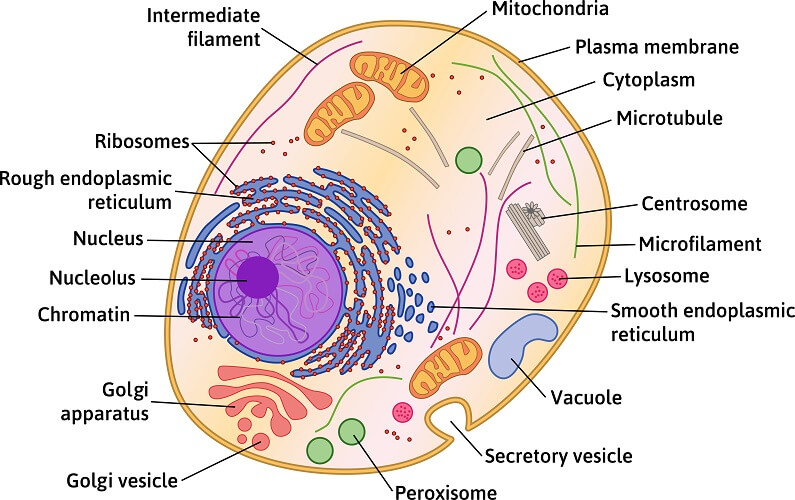
The study of cellular structure (cell anatomy) is always accompanied by the study of its functions and processes (cell physiology), which is mediated by different organelles at the cellular level. Each organelles plays an important role, which eventually contributes importantly to general functioning of the cell.
Structure and Functions of Cells
Structure and functions of different cell inclusions are as follows
|
Cell Organelle |
Occurrence/ Characteristic & Structure |
Function |
|
Cell Membrane/ Plasma Membrane |
|
|
|
Cell Wall |
|
|
|
Cytoplasm |
|
|
|
Nucleus (Director/ Brain of the Cell)
|
|
|


|
Mitochondria (The Power House of The Cell / Storage Batteries) |
|
|
|
Golgi Bodies (Shipping Department of Cell) |
|
|
|
Endoplasmic Reticulum (Framework of Cell) |
|
|
|
Vacuole |
|
|
|
Lysosomes (Suicidal bags of Cell, natural scavenger, cellular housekeeper) |
|
|
|
Ribosomes (Protein Factories) |
|
|
|
Plastids |
Types-
|
|


Extending Science Learning:
The cell: High School Biology at https://www.youtube.com/watch?v=URUJD5NEXC8
The Plasma membrane at https://www.youtube.com/watch?v=moPjkCbKjsBs
https://www.youtube.com/watch?v=FzcTqrxMzZk
Lesson III: Cellular Transport Mechanism
Scientific Target:
Relate the structure and composition of the cell membrane to its function
Explain transport mechanism in the cells
Transport Across Membranes
If a cell were a house, the plasma membrane would be walls with windows and doors. Moving things in and out of the cell is an important role of the plasma membrane. It controls everything that enters and leaves the cell. There are two basic ways that substances can cross the plasma membrane: passive transport, which requires no energy; and active transport, which requires energy. Passive transport is explained in this section and Active transport is explained in the next section, Active Transport and Homeostasis. Various types of cell transport are summarized in the concept map in Figure 3.7.23.7.2.
Transport Without Energy
Passive transport occurs when substances cross the plasma membrane without any input of energy from the cell. No energy is needed because the substances are moving from an area where they have a higher concentration to an area where they have a lower concentration. Water solutions are very important in biology. When water is mixed with other molecules this mixture is called a solution. Water is the solvent and the dissolved substance is the solute. A solution is characterized by the solute. For example, water and sugar would be characterized as a sugar solution. More the particles of a solute in a given volume, the higher the concentration. The particles of solute always move from an area where it is more concentrated to an area where it is less concentrated. It’s a little like a ball rolling down a hill. It goes by itself without any input of extra energy.
There are two types of passive transport, including simple diffusion, such as osmosis, and facilitated diffusion. Each type is described next.

Figure 3.7.23.7.2: The Cell Transport Concept Map illustrates various types of cell transports that happen at the plasma membrane (CC BY-NC 3.0; Mandeep Grewal; PowerPoint)
Simple Diffusion
Diffusion Although you may not know what diffusion is, you have experienced the process. Can you remember walking into the front door of your home and smelling a pleasant aroma coming from the kitchen? It was diffusion of molecules from the kitchen to the front door of the house that allowed you to detect the odors. Diffusion is defined as the net movement of molecules from an area of greater concentration to an area of lesser concentration.

Figure 3.7.33.7.3. Simple diffusion, the movement of particles from an area where their concentration is high to an area that has low concentration. one of the different ways in which molecules move in cells.
The molecules in a gas, a liquid or a solid are in constant motion due to their kinetic energy. Molecules are in constant movement and collide with each other. These collisions cause the molecules to move in random directions. Over time, however, more molecules will be propelled into the less concentrated area. Thus, the net movement of molecules is always from more tightly packed areas to less tightly packed areas. Many things can diffuse. Odors diffuse through the air, salt diffuses through water and nutrients diffuse from the blood to the body tissues. This spread of particles through the random motion from an area of high concentration to an area of lower concentration is known as diffusion. This unequal distribution of molecules is called a concentration gradient. Once the molecules become uniformly distributed, a dynamic equilibrium exists. The equilibrium is said to be dynamic because molecules continue to move, but despite this change, there is no net change in concentration over time. Both living and nonliving systems experience the process of diffusion. In living systems, diffusion is responsible for the movement of a large number of substances, such as gases and small uncharged molecules, into and out of cells.
Osmosis
Osmosis is a specific type of diffusion; it is the passage of water from a region of high water concentration through a semi-permeable membrane to a region of low water concentration. Water moves in or out of a cell until its concentration is the same on both sides of the plasma membrane.
Semi-permeable membranes are very thin layers of material that allow some things to pass through them but prevent other things from passing through. Cell membranes are an example of semi-permeable membranes. Cell membranes allow small molecules such as oxygen, water carbon dioxide, and oxygen to pass through but do not allow larger molecules like glucose, sucrose, proteins, and starch to enter the cell directly.

Figure 3.7.43.7.4: Osmosis through the semi-permeable membrane of the cells.
The classic example used to demonstrate osmosis and osmotic pressure is to immerse red blood cells into sugar solutions of various concentrations. There are three possible relationships that cells can encounter when placed into a sugar solution.
- The concentration of solute in the solution can be equal to the concentration of solute in cells. In this situation, the cell is in an isotonic solution (iso = equal or the same as normal). A red blood cell will retain its normal shape in this environment as the amount of water entering the cell is the same as the amount leaving the cell.
- The concentration of solute in the solution can be greater than the concentration of solute in the cells. This cell is described as being in a hypertonic solution (hyper = greater than normal). In this situation, the red blood cell will appear to shrink as the water flows out of the cell and into the surrounding environment.
- The concentration of solute in the solution can be less than the concentration of solute in the cells. This cell is in a hypotonic solution (hypo = less than normal). A red blood cell in this environment will become visibly swollen and potentially rupture as water rushes into the cell.
Osmosis demonstration with Red Blood cells places in a hypertonic, isotonic, and hypotonic solution.
Facilitated Diffusion
Water and many other substances cannot simply diffuse across a membrane. Hydrophilic molecules, charged ions, and relatively large molecules such as glucose all need help with diffusion. The help comes from special proteins in the membrane known as transport proteins. Diffusion with the help of transport proteins is called facilitated diffusion. There are several types of transport proteins, including channel proteins and carrier proteins (Figure 3.7.63.7.6)
- Channel proteins form pores, or tiny holes, in the membrane. This allows water molecules and small ions to pass through the membrane without coming into contact with the hydrophobic tails of the lipid molecules in the interior of the membrane.
 Carrier proteins bind with specific ions or molecules, and in doing so, they change shape. As carrier proteins change shape, they carry the ions or molecules across the membrane.
Figure 3.7.63.7.6: Facilitated Diffusion Across a Cell Membrane. Channel proteins and carrier proteins help substances diffuse across a cell membrane. In this diagram, the channel and carrier proteins are helping substances move into the cell (from the extracellular space to the intracellular space).
Extending Science Learning
View the following link for a video on Active vs. Passive Transport
https://www.youtube.com/watch?v=kfy92hdaAH0
https://www.youtube.com/watch?v=U2Sb9cvluSQ