
Introduction
Science / English Language Arts / Technology / Writing Webquest
4th grade
by: Team B
RDG/420
Instructor: Kristen Ream
You see them in movies, on the news, and even in books, but what are they really like? Are volcanoes as dramatic as the movies portray them to be? What causes some of them to erupt and others to stay dormant? What is lava? All of these questions will be answered and more on your quest for knowledge. You will become a volcanologist for the day and set out to discover the many wonders that are......volcanoes!
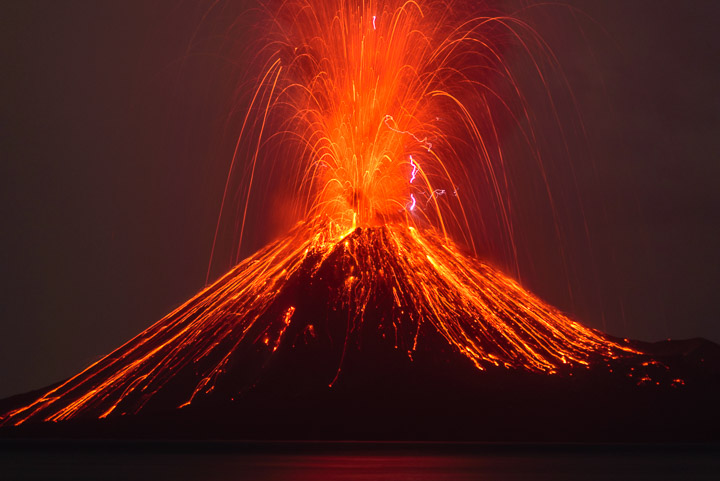
Vulcanian eruption at Krakatau on the evening of 13 Oct 2018 (image: Tom Pfeiffer / VolcanoDiscovery)
Objective:
To compare and contrast active and dormant volcanoes
Task
As a volcanologist, you have been hired to give a presentation to a group of students, on volcanoes.
Your job is to research volcanoes, locate different volcanoes found around the world (at least 4), provide details about them (i.e., size, age, status, location, the composition of the lava), compare and contrast between active and dormant volcanoes, and include a short essay using proper grammar, punctuation, and spelling.
You will create your presentation using PowerPoint and present it to the class.

Boutique Publicity (2019) [digital image]
Process
1) You will individually complete a KWL chart
2) You will be divided into groups of four
3) You will start by gathering information about volcanoes: http://www.weatherwizkids.com/weather-volcano.htm
4) You will divide the information needed to be collected between your group:
- Four volcanoes (two active and two dormant)
- Size
- Age
- Status
- Location
- Type of lava
- Compare active to dormant
- Contrast active to dormant
5) Work together to collect all the necessary information
6) Once all information has been collected, begin working on your PowerPoint presentation
7) The presentation should include:
- Title page
- Introduction
- Conclusion
- Short essay
- 8 - 10 slides
- Cited work
- 3 - 6 images
- Reference page
8) Once the PowerPoint is completed, you will present it to the class
Websites to help with your research:
http://www.weatherwizkids.com/weather-volcano.htm
https://www.volcanodiscovery.com/volcanoes/alphabetical-list/a-z.html
https://www.more.com/lifestyle/culture-causes/sleeping-giants-10-worlds-dormant-volcanoes
http://volcano.oregonstate.edu/how-lava-formed
https://www.britannica.com/science/lava-volcanic-ejecta
https://www.universetoday.com/31654/difference-between-active-and-dormant-volcanoes/
Evaluation
Students will fill out a KWL chart prior to beginning their presentations. They will then complete the KWL chart once they have finished their presentations.
There will also be an evaluation based on the PowerPoint, presentation, and short essay following the guidelines of a rubric.
| Category |
Excellent 4 |
Satisfactory
3 |
Needs Improvement
2 |
Unsatisfactory
1 |
Score |
| Content knowledge of the volcanoes being researched | Covers all topics with extensive detail and knows the information well. | Includes information on all topics but does not give any extra details other than what was required. | Touches on the topics but some is confusing or incorrect. | Does not cover all of the topics and much of the information presented is confusing and/or incorrect. | |
| Mechanics (PowerPoint) | The presentation has no grammatical, punctuation, capitalization, or spelling errors. | The presentation has fewer than 2 grammatical, punctuation, capitalization, or spelling errors. | The presentation has 3-4 grammatical, punctuation, capitalization, or spelling errors. | The presentation has 5-6 grammatical, punctuation, capitalization, or spelling errors. | |
| Oral Presentation | Well rehearsed, makes eye contact with the audience, is organized, and prepared. | 3 of the 4 points described are covered. | 2 of the 4 points described are covered. | 1 of the 4 points described is covered. | |
| PowerPoint Presentation | Has title slide, Introduction and conclusion, a short essay, 8-10 slides, cited work, 3-6 images, and a reference slide. Transitions are used appropriately. Content layout is pleasing to the eye. | Missing 1 - 2 aspects described in the excellent category. | Missing 3 - 4 aspects described in the excellent category | Missing 5 - 6 aspects described in the excellent category | |
| Mechanics (Short Essay) |
The short essay has no grammatical, punctuation, capitalization, or spelling errors. | The short essay has fewer than 2 grammatical, punctuation, capitalization, or spelling errors. | The short essay has 3-4 grammatical, punctuation, capitalization, or spelling errors. | The short essay has 5-6 grammatical, punctuation, capitalization, or spelling errors. | |
| Short Essay Content | The short essay includes an introduction, all required content, and a conclusion. | The short essay includes an introduction, some of the required content, and a conclusion. | The short essay includes an introduction, some of the required content, and no conclusion. | The short essay includes some or all of the required content. but no introduction or conclusion. | |
| Teamwork | The work was evenly divided between the group and each person participated equally in the presentation. | Team members provided work to the presentation, powerpoint, and short essay | Team members provided work towards the project, but one did considerably more work than the other. | The work was not divided equally and one person did more than his or her fair share of the assignment. | |
Conclusion
The job you were hired for has now come to an end. You have explored and researched the different volcanoes that exist today and how they compare or differ from each other. You were able to experience what volcanoes are really like and how they can come in many different shapes and sizes. You successfully put together an informational and visually pleasing presentation; sharing your research with your class. The research uncovered the difference between active and dormant volcanoes and where to find each of them.
Did becoming a volcanologist change your perspective of volcanoes?
If you were given an opportunity to visit a volcano in person, what part would you be most interested in studying?

Macaraci, S. (2015). [digital image]
Credits
This WebQuest was assigned by The University of Phoenix, course RDG/420. The instructor is Kristen Ream.
The WebQuest was created by Team B:
Kami Smith: I am a single mother of two beautiful boys and currently in my senior year of college. I attend the University of Phoenix and am working toward my Bachelors in Education.
Resources:
http://www.weatherwizkids.com/weather-volcano.htm
https://www.volcanodiscovery.com/volcanoes/alphabetical-list/a-z.html
https://www.more.com/lifestyle/culture-causes/sleeping-giants-10-worlds-dormant-volcanoes
http://volcano.oregonstate.edu/how-lava-formed
https://www.britannica.com/science/lava-volcanic-ejecta
https://www.universetoday.com/31654/difference-between-active-and-dormant-volcanoes/
Images:
Boutique Publicity. “Volcano.” Park Labrea News Beverly Press, 17 Jan. 2019, beverlypress.com/2019/01/explore-volcanoes-
around-the-world-at-the-science-center/.
Macaraci, S. “Volcano Collage.” Earth Changes and the Pole Shift, 5 Jan. 2015, poleshift.ning.com/profiles/blogs/volcano-watch.
Vulcanian eruption at Krakatau on the evening of 13 Oct 2018 (image: Tom Pfeiffer / VolcanoDiscovery)
References:
Common core state standards initiative (2019). Retrieved from http://www.corestandards.org
Teacher Page
Introduction:
This WebQuest is designed to engage and encourage students to investigate the workings of natures wonder...the volcano. The WebQuest is for 4th-grade students and set up for web-based research. Students will use their acquired skills to research, record information, and create a presentation on active and dormant volcanoes. Students will use learned writing skills to develop a short essay that includes all the appropriate components and relevant information.
Standards:
RI.4.7 "Interpret information presented visually, orally, or quantitatively and explain how the information contributes to an understanding of the text in which it appears"
RI.4.9 "Integrate information from two texts on the same topic in order to write or speak about the subject knowledgeably"
W.4.4 "Produce clear and coherent writing in which the development and organization are appropriate to task, purpose, and audience"
W.4.7 "Conduct short research projects that build knowledge through investigation of different aspects of a topic"
SL.4.4 "Report on a topic or text, tell a story, or recount an experience in an organized manner using appropriate facts and relevant, descriptive details to support main ideas or themes, speak clearly at an understandable pace"
("Common Core Standards Initiative", 2019)
Objectives:
Students will be able to explain how information contributes to an understanding of a topic
Students will be able to write and speak about a given topic
Students will be able to create clear, coherent, organized, and appropriate writing
Students will be able to complete a research project and use research to build upon their knowledge
Students will be able to present their findings in an organized, clear, and coherent manner
Process:
Students will be placed in groups of four based on their current academic levels.
Students will conduct internet searches on appropriate websites to gather and record information on volcanoes.
Students will work together to create a PowerPoint presentation and a short essay to demonstrate an understanding of what they learned.
Students will present their findings to the class.
Differentiated Learning:
Tasks:
Students with learning challenges will be given a graphic organizer, PowerPoint template, and an example of what is expected, for additional support.
Advanced students will be placed in groups that will benefit from their assistance.
Students will be placed in groups based on current academic levels in order to support others on in their group who may need some guidance.
Students who need additional assistance will be given an opportunity to work with the teacher for support and guidance.
Resources:
http://www.weatherwizkids.com/weather-volcano.htm
https://www.volcanodiscovery.com/volcanoes/alphabetical-list/a-z.html
https://www.more.com/lifestyle/culture-causes/sleeping-giants-10-worlds-dormant-volcanoes
http://volcano.oregonstate.edu/how-lava-formed
https://www.britannica.com/science/lava-volcanic-ejecta
https://www.universetoday.com/31654/difference-between-active-and-dormant-volcanoes/