
Introduction

Discuss the following questions among your group, and jot down, as bullet points or phrases, a few of your groups' thoughts about these questions at the top of a page of notebook paper (yes, you must hand-write this information). Only take a few minutes to complete this step.
- When you hear a rumor, how do you check to see if it's true? Do you ask other people if they heard the same information? Do you ask the person who told you to tell you more? Do you go to the person the rumor is about and ask that person if it is true?
- How important is it to you that the information you hear is true? Why is that the case? Why is it important to get the truth? How do you decide who to rely on to tell you the truth?
- Why do you think it might be important to get correct information for your papers?
Photo credit: http://tx.english-ch.com/teacher/mar/home/gossip-is-good-for-you-study-…
Task

Today, your job is to go on the hunt for credible sources.
You need to think critically about information. Why is it important that information in an essay or letter is correct? Is your reputation as a writer and student at stake?
Assuming that correct information is important, use a concept map (example here) and brainstorm on paper some ways to figure out whether the information you find on the internet is true. Here are some questions to think about: Should you check information against several websites to be sure all of them have the same information (e.g.: to make sure that if one site says 78% of sophomores are awesome, another couple of websites ALSO say 78% of sophomores are awesome, rather than have 3 different sites giving 3 different statistics)?
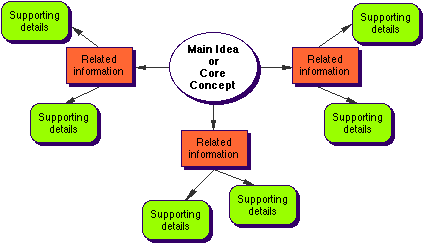
Then, you will each do individual work on separate websites before sharing with each other the steps you followed to determine the veracity of the websites. As a group, you will decide which websites would be acceptable to use in a paper.
Photo credit: http://www.brisbanegrammar.com/blogs/library/?p=290
Process

Photo Credit: http://csbsjulibrary.blogspot.com/2012/02/do-you-know_20.html
Pretend you are writing a report on dogs, the various breeds and which ones make the best pets for different kinds of people.
Go to the following website as a group: https://en.wikipedia.org/wiki/The_dog_ate_my_homework
Assign a group member to complete each of steps 1 through 5. If you have less than five members in your group, someone will have to complete another step. To answer the questions in your section, open the Google Document on Google Classroom called "Credible Sources Webquest Questions," and type your answers on the doc. You must turn in these documents on Classroom.
After you have finished your sections, get together and complete step 6. Remember, you are essentially teaching your classmates. You are responsible for their learning the necessary information to evaluate sources. They will be very upset with you if they do not understand the process and fail a paper because they have not used credible sources! It is VERY important that you do not skip steps when explaining and that you check with your classmates that they understand what to do.
STEP 1: Currency
The timeliness of the information.
Answer the following questions about the currency of the article on the Google doc:
- When was the information published or posted?
- Has the information been revised or updated?
- Does your topic require current information, or will older sources work as well?
- Are the links functional?
- How and where did you find this information on the website?
- Why is this important when thinking about the credibility of a source?
STEP 2: Relevance
The importance of the information for your needs.
Answer the following questions about the relevance of the article on the Google doc:
- Does the information relate to your topic or answer your question?
- Who is the intended audience?
- Is the information at an appropriate level (i.e. not too elementary or advanced for your needs)?
- Have you looked at a variety of sources before determining this is one you will use?
- Would you be comfortable citing this source in your research paper?
- How did you determine if this information was relevant or not to your topic?
- Why is this important when thinking about the credibility of a source?
STEP 3: Authority
The source of the information.
Answer the following questions about the authority of the article on the Google doc:
- Who is the author/publisher/source/sponsor?
- What are the author's credentials or organizational affiliations?
- Is the author qualified to write on the topic?
- Is there contact information, such as a publisher or email address?
- Does the URL reveal anything about the author or source? examples: .com .edu .gov .org .net
- How did you find the author and information on him/her?
- Why is this important when thinking about the credibility of a source?
STEP 4: Accuracy
The reliability, truthfulness, and correctness of the content.
Answer the following questions about the accuracy of the article on the Google doc:
- Where does the information come from?
- Is the information supported by evidence?
- Has the information been reviewed or refereed?
- Can you verify any of the information in another source or from personal knowledge?
- Does the language or tone seem unbiased and free of emotion?
- Are there spelling, grammar or typographical errors?
- How did you find this information?
- Why is this important when thinking about the credibility of a source?
STEP 5: Purpose
The reason the information exists.
Answer the following questions about the purpose of the article on the Google doc:
- What is the purpose of the information? Is it to inform, teach, sell, entertain or persuade?
- Do the authors/sponsors make their intentions or purpose clear?
- Is the information fact, opinion or propaganda?
- Does the point of view appear objective and impartial?
- Are there political, ideological, cultural, religious, institutional or personal biases?
- How did you determine the purpose and any biases of the website?
- Why is this important when thinking about the credibility of a source?
STEP 6:
When everyone is finished with their individual steps, get together and share whether or not you felt the website passed each part of the credibility test and why. Discuss the highlighted questions from your section, and make sure everyone takes notes on these questions so that they have notes for later when you will be required to check the credibility of sources for your letter. Also discuss and record why Wikipedia.org, quora.com, and debate.org will never be an acceptable source in any of my classes.
Evaluation
This assignment is not graded; however, the sources you choose to use as part of your letter will have an impact on how seriously the congressperson or President takes your argument, so it is important to understand how to evaluate the credibility of a source so you are using only the best information available.
Conclusion

Photo Credit: https://guides.library.duq.edu/informationevaluation/CRAAP
When evaluating a source for its credibility, use the CRAAP test: currency, relevance, authority, accuracy, and purpose. If a source doesn't pass the test, then look for a new source.
Discuss with your group: Why is it so important that you get your information from credible sources? What effect does it have on your ethos?