
Introduction
Animal Anatomy
Teacher: Natalie Klimovich
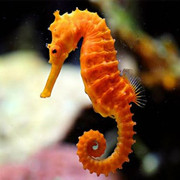
Vertebrae or no vertebrae?
Legs or no legs?
Let's find out, and much more!
What are the body parts of these animals, and how do these parts help them survive in their environment?
How has the animal evolved over time to adapt to its environment?
Task
For each question, investigate by clicking the links and then answer by writing in your observation journal that is provided here: https://documentcloud.adobe.com/link/track?uri=urn%3Aaaid%3Ascds%3AUS%3Aacfe7bc0-f439-46a4-8893-69f746627b84
Have fun!!!
Process
For each question, investigate by clicking the links and then answer by writing in your observation journal that is provided here: https://documentcloud.adobe.com/link/track?uri=urn%3Aaaid%3Ascds%3AUS%3Aacfe7bc0-f439-46a4-8893-69f746627b84
1. What's their name? Study these three animals using the links provided: a sloth, a seahorse, or a luna moth. Fill out the linked journal with their common names as well as their scientific names!
Sloth: https://kids.nationalgeographic.com/animals/sloth/#sloth-beach-upside-down.jpg

Seahorse: https://www.natgeokids.com/uk/discover/animals/sea-life/seahorse-facts/
Luna Moth: https://kids.nationalgeographic.com/animals/luna-moth/#luna-moth-wings.jpg

2. Where do these 3 animals live on a map? Shade in the attached map of where the animals live in three different shades- one for each animal. Be sure to create a key so we know which color stands for which animal.
3. In what habitat do they live? State what type of environment each animal lives in. Do they live in the, ocean, dessert, mountains, flatland, lake, river, woodlands, swamp, rain forest, estuary, stream, the sea. Is it hot or cold there, wet or dry?
Seahorse Habitat: http://bioweb.uwlax.edu/bio203/2011/kovac_jenn/habitat.htm
Sloth Habitat: http://www.srl.caltech.edu/personnel/krubal/rainforest/Edit560s6/www/animals/slothpage.html
Luna Moth Habitat: https://nature.mdc.mo.gov/discover-nature/field-guide/luna-moth
4. What are their favorite foods? Hint- one of these animals does not eat!
5. How many legs do they have?
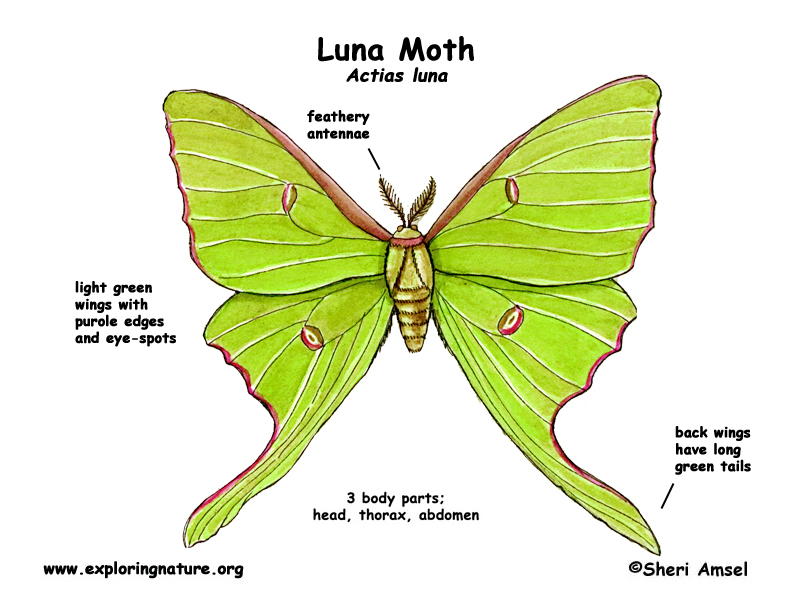

6. Do they have a vertebrae?
7. Are they awake in the day or night?
8. Do they eat meat, vegetables and plants, or both?
9. How long do they live?
10. Where do they sleep?
Have FUN learning about ANIMAL ANATOMY!
Evaluation
After gathering all this information, we will get into 3 groups. Each group will discuss one of the animals researched and write down how they think the animals features help it survive in its environment.
Conclusion
How does all of this information come together? Students will get into 3 groups. Each group will make a poster board to present one of the researched animals based on the information you have gathered and include reasons why their features and anatomy has changed to fit in their environment to survive.
Credits
Seahorse Habitat: http://bioweb.uwlax.edu/bio203/2011/kovac_jenn/habitat.htm
Sloth Habitat: http://www.srl.caltech.edu/personnel/krubal/rainforest/Edit560s6/www/animals/slothpage.html
Luna Moth Habitat: https://nature.mdc.mo.gov/discover-nature/field-guide/luna-moth
Sloth: https://kids.nationalgeographic.com/animals/sloth/#sloth-beach-upside-down.jpg
Seahorse: https://www.natgeokids.com/uk/discover/animals/sea-life/seahorse-facts/
Luna Moth: https://kids.nationalgeographic.com/animals/luna-moth/#luna-moth-wings.jpg
Sloth anatomy image: https://www.enchantedlearning.com/subjects/mammals/sloth/
Seahorse anatomy image: http://www.oocities.org/tompowers64/seahorse.htm
Seahorse photo: https://www.shalomadventure.com/god-s-world/genesis-beginnings-creation-nature-etc/2753-seahorse
Moth photo: https://www.exploringnature.org/db/view/Moth-Luna
Teacher Page
B-5.3 Explain how diversity within a species increases the chances of its survival.
B-5.4 Explain how genetic variability and environmental factors lead to biological evolution.
1d- Students understand the fundamental concepts of technology operations, demonstrate the ability to choose, use and troubleshoot current technologies and are able to transfertheir knowledge to explore emerging technologies.