
Introduction
What is Poetry?
- Poetry is literature, or artistic writing, that attempts to stir a reader's imagination or emotions.
Do you know how many different styles of poetry there are in the world?
- There are well over 50 styles of poetry. How many styles have you heard of?
In this WebQuest, you will learn about some of the most famous types of poetry that are all around us!

Task
Your job is to explore some of the most popular styles of poetry! You will learn about each style and how it is constructed. After learning about all the different styles, you will construct some of your own poems and create your own book to take home and share with your friends and families!
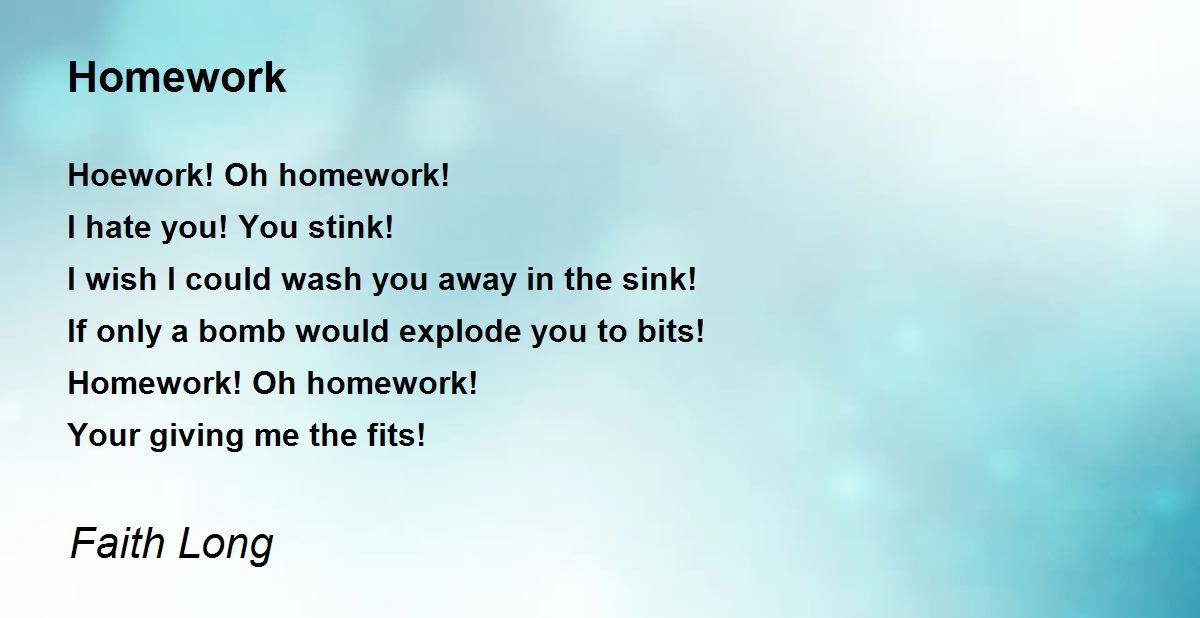
Here is one poem written by a student that you all may enjoy:
Process
1.) Explore the different styles of poetry below:
| Style | Description |
| Sonnet |
a poem that contains fourteen lines (ten syllables per line), is written in iambic pentameter, and uses the rhyme scheme ABAB CDCD EFEF GG |
| Haiku |
a very short poem that contains 3 lines with 17 total syllables; originated in Japan and is usually about nature |
| Free Verse |
poetry that has no regular rhythm, meter, rhyme, or structure |
| Lyric Poem |
a poem that expresses the thoughts and feelings of the writer; has a song-like quality |
| Narrative Poem | a poem that tells a story and has characters, a setting, and a plot |
| Ballad |
a poem that is meant to be sung and usually tells a sad story; most have refrains |
| Limerick |
a silly poem that tells a story in five lines with the rhyme scheme AABBA; |
| Concrete | a poem that is written so that the shape of the words on the page matches the subject of the poem |
| Cinquain |
a poem that has five lines, but they do not rhyme and each line has a set number of syllables: Line 1-2 syllables (one word) |
2.) After spending some time learning about each style, click on the poem style to view an example!
3.) Now pick your five favorite styles!
4.) Now, visit the back table where you pick up your planning sheets. Please only take one sheet for each of the FIVE poems you are wanting to construct. That means there is no need for you to pick up a haiku planning sheet if you are wanting to write an ode, sonnet, free verse, and lyric poem.
5.) Spend some time brainstorming and planning out your poems. After you think you have written a strong poem and are ready to create your final copy, come see me, your teacher!
6.) I will give you all the supplies you need to create your final drafts and you may also refer to the example on the board or ask me any questions! :)
Evaluation
RUBRIC FOR POETRY
Name:
|
CATEGORY |
Excellent - 4 |
Good - 3 |
Satisfactory - 2 |
Needs Improvement - 1 |
|
THE WRITING PROCESS /
EFFORT |
Student devoted a lot of time and effort to the writing process and worked hard to make the poem a good read. The poem has no errors. |
Student devoted adequate time and effort to the writing process and worked to get the job done. The poem may have one or two errors. |
Student devoted some time and effort to the writing process but was not very thorough. Does enough to get by. There are several errors. |
Student devoted little time and effort to the writing process. It appears that the student does not care about the assignment. The poem has many errors. |
|
TITLE
|
The poem has a title that clearly relates to the poem and adds interest to the theme or message of the poem |
The poem has a title that relates to the poem |
The poem has a title |
The poem has no title |
|
NEATNESS |
The final draft of the poem is readable, clean, neat and attractive. It is free of erasures and crossed-out words. It looks like the author took great pride in it. |
The final draft of the poem is readable, neat and attractive. It may have one or two erasures, but they are not distracting. It looks like the author took some pride in it. |
The final draft of the poem is readable and some of the pages are attractive. It looks like parts of it might have been done in a hurry. |
The final draft is not neat or attractive. It looks like the student just wanted to get it done and didn’t care what it looked like. |
|
STYLE |
The poem is written with a great sense of style. The poem has been well thought out and makes sense to the reader. |
The poem is written with a defined with style. Thoughts are clear to read and understandable. |
The poem is written somewhat with style. Thoughts are clear to a degree. |
The poem lacks style and the thoughts did not come out clearly on paper. |
|
VOCABULARY |
The poem is filled with descriptive vocabulary that appeals to the reader. |
The poem includes many descriptive elements and is appealing. |
The poem includes some descriptive words and phrases. |
The poem lacks description and does not allow the reader to visualize the poem. |
TOTAL SCORE: __________________________________
Conclusion
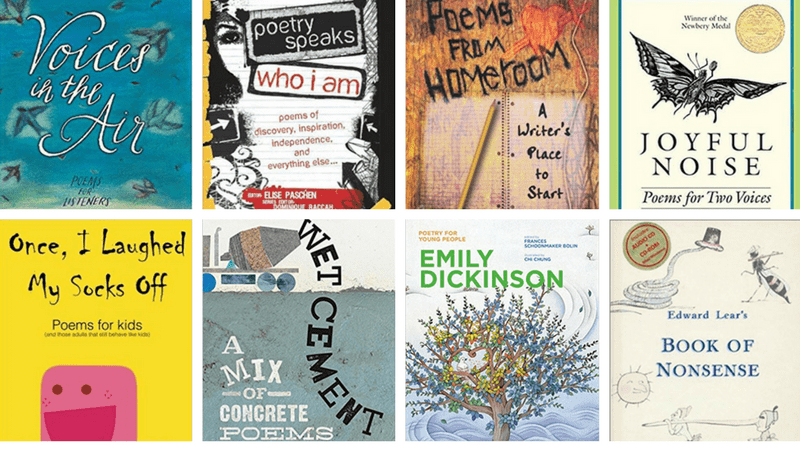
Poetry is all around us, and most the time we do not even notice it! Writing poetry can be so much fun because it allows us to use our imaginations and creativity! Poetry can be used in many different ways as well. Some enjoy reading reading poetry to relax or calm down, others enjoy poetry because it gives them a feeling on uneasiness and inspires them to make change, and other people enjoy poetry for the simplicity of it. I challenge you all to at least look at a poetry book (brownie points if you check one out) the next time we visit the library!
Credits
Images obtained from:
- Poem Hunter
- Teachers Pay Teachers
- WeAreTeachers
Rubric obtained from:
Permission is granted for others to use and modify this WebQuest for educational, non-commercial purposes as long as the original authorship is credited. The modified WebQuest may be shared only under the same conditions.