
Introduction
I. Objectives:
a. To identify the connection between Principles of art and Elements of art.
b. To Enumerate the 8 principles of Art.
c. Create and explain an artwork using the Principles of art.
II. Introduction:
The principles of art represent how the artist uses the elements of art to create an effect and to help convey the artist's intent. The principles of art and design are balance, contrast, emphasis, movement, pattern, rhythm, and unity/variety. The use of these principles can help determine whether a painting is successful, and whether or not the painting is finished.
The artist decides what principles of art he or she wants to use in a painting. While an artist might not use all the principles of design in one piece, the principles are intertwined and the use of one will often depend on another. For example, when creating emphasis, the artist might also be using contrast or vice versa. It is generally agreed that a successful painting is unified, while also having some variety created by areas of contrast and emphasis; is visually balanced; and moves the viewer's eye around the composition. Thus it is that one principle of art can influence the effect and impact of another. The artist decides what principles of art he or she wants to use in a painting. While an artist might not use all the principles of design in one piece, the principles are intertwined and the use of one will often depend on another.
Task
1. They will know the connection between the principles of art and the elements of art.
2. They will be able to enumerate the 8 principles of art and give examples for each principles.
3. They will learn how to create their own artwork using the principles of art and the elements of art.
4. They will be able to value the importance of each principles of art in making an artwork.
Process
Process:
A. The Learners will know the connection between the principles of art and the elements of art.
- The Principles of art are used to organize the basic elements of art. Sometimes referred to as principles of organization or design principles.
B. The learners will enumerate the Principles of Art.
- Rhythm- repeating an element to make work seem active. An artist create rhythm by repeating not just one element but also the same exact object the form pattern.
- Movement- the visual flow of an artwork. It is the path that you intend your viewers eye to follow. You can create this by purposefully placing art elements in a way that creates this path.
- Balance- concerned with arranging elements so no one part of a work overpowers or seem heavier that the other.
-
- balance is seen or felt by the viewer.
-3 types
a. formal or symmetrical- balance the two halves are mirror images.
b. informal or asymmetrical- balance two unlike elements seem to carry equal weight.
c. radial- A form of balance than is even,
radiating out from a central point to all four
quadrants of the shape’s constraining plane.

-
Emphasis - When one element of an artwork stands out more than another. This creates a sense of importance and is intentionally used to communicate a message or feeling. Emphasis creates variety in your artwork.

-
Harmony - blending elements to create a more calm, respectful appearance. Harmony in art and design is the visually satisfying effect of combining similar, related elements. For instance: adjacent colors on the color wheel, similar shapes etc.
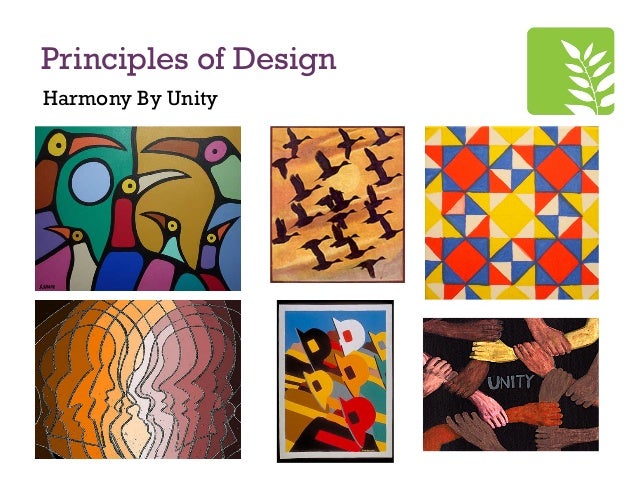
- Unity - arrangement of elements and principles with media to create a feeling of completeness or wholeness.

-
Variety - combining one or more elements to create interest by adding slight changes. (visual appeal of work). The counterweight to harmony and creates visual interest by slightly changing or using different elements together in a composition. It can be created with contrast, change, elaboration, or diversifying elements. With variety, it is important to consider how the elements are working together so that you still have harmony and unity within a composition.

-
Proportion
- Relationship of one part to another and to the whole.
-The principle proportion is not limited in size.
-It is important to keep in mind the relationship between different elements of the composition so that the scale of your artwork always makes visual sense. For example, if you were drawing your best friend sitting in a chair, the size of the chair should be in proportion to the size of your friend.

C. Give an example of an artwork that has the 8 Principles of Art.
D. They will create their own artwork using the 8 Principles of Art.
Evaluation
Create own artwork using the principles of art.
| Criteria | Score: /40 | |
| Creativity |
How the artists convey his/her ideas, message or thought in an imaginative way through an artwork. |
/10 |
| Originality |
How the artists convey his/her ideas and thought in an original way, without copying an artwork of the other artist. |
/10 |
| Explanation |
The artist were able to explain the meaning of his/her artwork. |
/10 |
| Completeness of the 8 principles | The artist were able to use the 8 principles of art in his/her artwork. | /10 |
Conclusion
The Principles of Art is used to create an artwork specially in paintings, drawings, posters, etc. Without this principles one cannot create an artwork that is beautiful and pleasing to the eye of the viewers.
At the end of the lesson and the activity, the student/artist were be able to discuss the connection/relationship between the Elements of Art and the Principles of Art, and discuss the 8 principles of Art while giving an example.In the task and evaluation that were given to the student/artist, they were able to create an artwork with they own, and connect it to their life and experiences, and by doing this, the teacher determined the students who has a talent in art and the students who are interested in learning art.