
Introduction
Have you ever thought of asking yourself, where did cities began to emerge or where did civilization began? The answer to that question is to identify what was the first civilization that first existed in the world. Ancient Mesopotamia was the first civilization to have existed in the world and also known as the Fertile Crescent because it was good for agriculture
Task
Read through the given text then complete what is being asked in the evaluation.
Process
Mesopotamia was discovered at 5000 B.C., located at present day Iraq and surrounded by the rivers,Tigris and Euphrates, hence, historians call it the land between two rivers. It was also known as the Fertile Crescent mainly because of the silt that resulted that came out from the flooding of the rivers Tigris and Euphrates which has unpredictable flooding.

The Sumerians
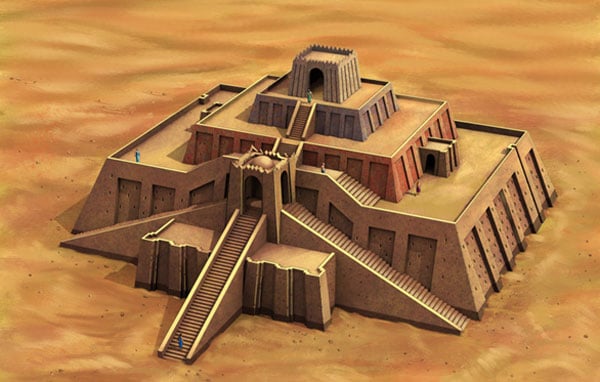
Around 5000 B.C., the first people to settle in Mesopotamia are the Sumerians, people who came from other lands and settled within the south Fertile Crescent. At 3500 B.C., the Sumerians invented the first writing system, Cuneiform, which was used to record the amount of goods traded such as the quantity of corn exchanged with quantity of goats because trading was the way of living in Mesopotamia. Three-hundred years after the establishment of the Cuneiform, the Sumerians invented the plow and wheel, an ancient technology used for agricultural purposes. Also, it was establishment of the first city-states, thus, creating the first civilization that existed in the world and in Mesopotamia. City-states had their own laws, education, and division of labor such as farmers, traders, priests, builders, and priest-king. They had no established military units such as captains and soldiers. Also, city-states had fortified walls, crafting of weapons, and large buildings. The tallest building within the city-state is the Ziggurat, the place where their priest stays, a place where they can worship their god. However, city-states are always in conflict with each other, thus, they had no unity and when war comes the farmers will become the soldiers because of their strength and the farmers themselves will assign their captain in war. After the war, the soldiers will return to farming.

Images: Cuneiform (right)
Ziggurat (left)
The Akkadian Empire
In 2300-2200 B.C., Sargon the Great (see picture on the right), king of the Akkadians conquered the area and established the first empire, the Akkadian Empire (see picture on the left). Thus, he is the first Semitic Emperor to establish an empire in the world and in Mesopotamia. His successors were known to have been weak in leadership, thus, a possible reason for their fall to the Babylonians.


The Babylonian Empire
In 1792-1749 B.C., King Hammurabi of Babylonia (see picture left), conquered the Akkadians and established the Babylonian Empire (see picture lower left). Under his leadership, he made the first written law in the existence of man, known as the Code of Hammurabi (see picture right), this code follows the principle of "an eye for an eye". Hence, when a man had his sheep stolen he may steal the burglar's goat.


The Assyrians
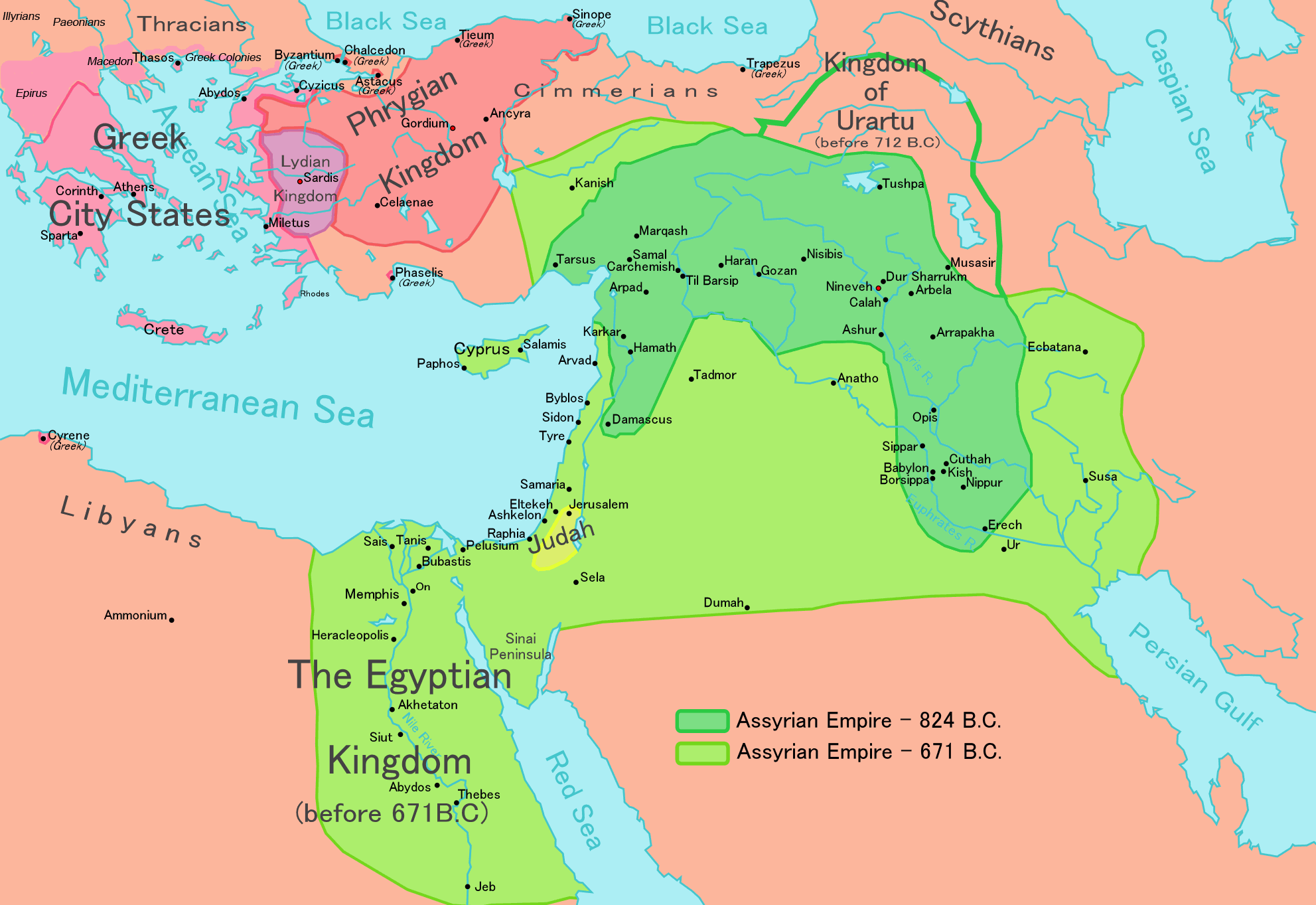
In 2900 B.C., another Semitic people known as Assyrians went to Mesopotamia and inhabited the north of Babylonia even before the latter became an empire. They derived their name from their capital city Assyr which was named after their war god. They were the first people to craft weapons out of iron (see picture on the lower left below) which was stronger than bronze weapons used by the former empires, war chariots (see picture on the right below), and battering ram (see picture on the left below) and also the first empire that used meritocratic system in ranking their generals which is according to skills not by passing it to their sons, thus, they had the most advanced military at that time. Since they had the most advanced military, they were able to extend their territory by conquering Babylonia, Phoenicia, and Syria in 1115 B.C., therefore, becoming an empire (see picture of Assyrian empire above). Around 744-727 B.C., they were able to extend their empire to Armenia, Egypt, and other nearby lands. Hence, they were not only the most military advanced but also the largest empire to have existed in the whole world.


The Chaldean Empire/ Neo-Babylonian Empire
When the Assyrian empire was established, fifteen years later, another Semitic group of people from the Arabian Desert known as the Chaldeans conquered north Babylonia. Like the Assyrians, they also used iron weapons and were able to conquer the Assyrians in 612 B.C. because the Assyrians were in conflict with each other.


Their famous king Nebuchadnezzar (see picture on the left) was their greatest ruler. He changed the name of Chaldea to Babylonia in honor to the Babylonian empire, thus, Chaldea was known as the Neo-Babylonian empire. Nebuchadnezzar II was able to extend his empire towards Egypt and Jerusalem. One of his contributions was the Hanging Gardens of Babylon (see picture below), one of the seven wonders of the world, so beautiful that it covers the balconies of Chaldea and waters were able to be raised for the garden's irrigation.

Evaluation
| No. of correct answers | |
| 18-20 | Excellent |
| 15-17 | Very Good |
| 10-14 | Good |
| 9 and below | Needs Improvement |
Timeline and Location:
- The two rivers that surround Mesopotamia. a) __________ b) ____________
- A country in the Middle East where Mesopotamia was located. __________
- List the three empires within Mesopotamia in chronological order: a)_____________ b)___________ c)_____________ d)_________________
- They were the first people in Mesopotamia. ________
- An ancient technology invented in 3200 B.C. for agricultural purposes.____________
Contributions and key people:
- It was a law that principle of "an eye for an eye". ___________
- He was the first Semitic emperor and made the first empire. ___________
- An Assyrian idea of ranking their generals. ____________
- He was the king of Babylonia who wrote the first written law. __________
- It was the first written language used in Mesopotamia that was used to record the amount of goods being traded. ______________
- It is a system invented in Mesopotamia still in practice today where citizens should give a portion of their goods to their king in exchange for their protection. _____________
- Monumental temples in city-states to worship gods. _____________
- A way of living in Mesopotamia. __________
- Two highly advanced weapons invented by Assyrians. a)_____________ b)_____________
- It was one of the Ancient Seven Wonders.__________________
Conclusion
Although ancient Mesopotamia began 5000 B.C., it still had contributed to our social development such as social-order through laws and social hierarchy, taxation, fair military ranking, literacy, and many more that were not mentioned. Besides possessing city-states, without the mentioned attributes, historians may not be able to classify Mesopotamia as a civilization.
Credits
Teacher Page
Ishmael Wanawan