
Introduction
Succession in biology is when the structure of a community evolves throughout time. The land changes as more life grows into the land. There are 2 different types of succession which include primary and secondary.
Task
Primary succession occurs when a new lifeless environment which used to have lots of life change over time. This occurs when there is a volcano eruption that destroys forests and other land areasor when a glacier recedes. Lava will flow out of the volcano and through land, destroying everything in its path and turning it into molten rock. The lava will pile up on the ocean floor possibly, making it new land. Animals have to evacuate their homes and find somewhere else to live. Plants are destroyed by the lava as well as manmade structures. Over time, as the lava cools off into normal rock, new plants start growing and their is finally new growth. Lichens will cover the rocks and they will start to break down. They will help make soil for the new plants to grow. Years later, the environment will be in a mid growth state where very small animals will start to move in. During the high growth phase, more larger animals such as mammals will start to move into the environment. In the picture below, you can see that this part of the big island, Hawaii is in a new growth state. There are small plants next to the street and lava rock all over the place. The other picture below shows the phases of primary succession.


Process
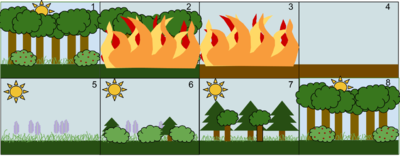
Secondary Succession is when a community is destroyed, but the soil isn't that affected. This happens when a forest is cleared or is on fire. The soil won't be affected so plants can regrow much faster than how they would in primary succession. Areas in the new growth state will not be affected at all while mid growth areas will be possibly affects. Fires have the greatest affect on high growth areas with massive amounts of plants and animals. The species that are better adapted to these environments will be able to reproduce many more of their kind. The picture below shows the steps of secondary succession and the cycle of it over a course of time.
Conclusion
Succession is a huge part of our earth, and has changed many environments over the course of Earth's long history. Many species have changed because of it, and the environments are slowly changing over time because of succession.