
Introduction
Have you ever wondered how your state became a state? How about how your state flag became the state flag? What about how many people it took to make all these things happen?
Jump on board because your about to go back in time to find all these answers and much more about the state of Indiana!

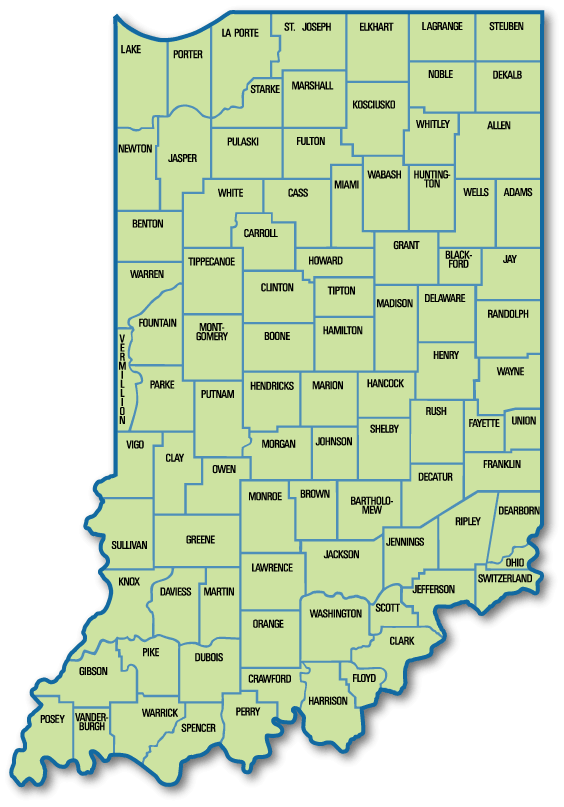
http://www.in.gov/dnr/naturepreserve/images/np-speciesmap.gif
Task
As you travel back in time you will have to.....
- Find out who Jonathan Jennings was and what he did for the state of Indiana.
- Where the state capital has been located over the years and the significance of these places as well as the difficulties they went through moving the capitals.
- Who Paul Hadley was and what he did for Indiana and the process of making our state flag and what the symbolic meaning is behind all these features.
NOTE: All of this information will be typed up in a word document using full sentences to answer each question numbered 1-9 following the format of the next slide.
3, 2, 1 BACK IN TIME
https://media4.s-nbcnews.com/j/newscms/2017_19/1994846/170510-time-trav…;

Process
Indiana became the 19th state on December 11, 1816. However, it was a lengthy process before this could happen.
1) Clink on the link to figure out who Jonathan Jennings was and what he did for the state of Indiana.
https://www.nga.org/files/live/sites/NGA/files/images/govportraits/PGJENNINGSIN.jpg

Next, you will learn that the state capital of Indiana has moved 3 times. Every location had some advantage at that particular time.
2) Clink on the link to figure out where the first location was of the "territorial capital" of Indiana.
*Will be found under the paragraph titled About Corydon Capital State Historic Site*
https://www.bestplaces.net/images/city/Vincennes_IN.gif

Shortly after, the state capital was moved to a more central location for Indiana's population.
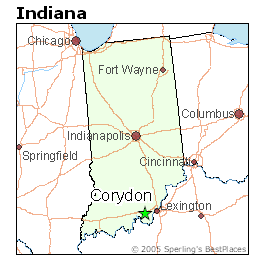
3) Clink on the link to figure out where this location was and read some interesting facts about the town.
http://www.bestplaces.net/images/city/Corydon_IN.gif
Some interesting facts to look for:
- Elm tree later knowns as the state tree Sycamore
- Problems of having the state capital here.
Committee members soon realized this location wasn't the best place, so four years later it moved to another location.
4) Clink on the link to figure out the difficulties they had moving the capital in regards to:
- transporting money
- traveling conditions
http://www.keywestshrimphouse.com/images/historicbuildings/madisonroad.JPG

*Red line is the Mauxferry road and the green line is the Madison State road*
https://www.in.gov/history/images/intimprov.gif
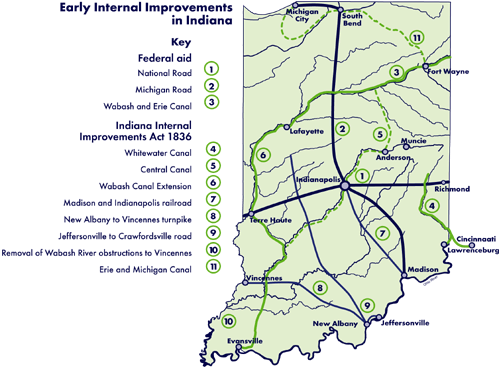
*Michigan road is labeled as number 2*
5) Clink on the link to discover who specifically transfered the money.
- Owner of the team of horses that took everyone
- Person who provided written details about the trip
- Person in charge of transporting the state's funds and property
Moving the state capital this last time had major advantages specifically in the economy of the state.
6) Clink on the link below to find out how the economy improved from this change in location.
- 3 different roads used (One became the other)
- Type of transportation that was created, but then failed
- Type of transportation that was very successful to everyone
- Agricultural advancements
- Benefits of railroad access
- Other town advancements
Every state today has their own state flag. However, Indiana didn't have a state flag until 100 years after it officially became a state.
7) Clink on the link to figure out who Paul Hadley was and what he did for Indiana.
https://i.ytimg.com/vi/Lndlx6HpIeo/hqdefault.jpg

https://cloudfront.zoro.com/product/full/Z-935yfo_oy.JPG

Every flag has some kind of symbolic meaning with the features or colors.
8) With the same link, find out what symbolic features are present on our state flag and what they all mean.
- Rays
- Stars
- Torch
- Largest Star
9) Finally, you will be required to make your own flag based on your own life. You will use the information you learned about Indiana to help you make your own as well as the information below.
- Use materials provided to you
- Have at least 5 symbols and have a written document explaining the symbolic meaning behind those symbols.
- Use at least 3 colors and have a written document explaining the symbolic meaning behind those colors.
Evaluation
| 1 | 2 | 3 | 4 | |
| Internet Use | Needs assistance or supervision to use suggested internet links and/ or navigate within these sights. | Occasionally able to use suggested internet links to find information and navigates within these sites sometimes without assistance. | Usually able to use suggested internet links to find information and navigates within these sites easily without assistance. | Successfully uses suggested internet links to find information and navigates within these sites easily without assistance. |
| Follows Directions | Not able to follow step by step instructions. Easily distracted during research. | Somewhat able to follow step by step instructions. Easily distracted during research. | Somewhat able to follow step by step directions. Is focused and stays on task. | Successfully follows step by step instructions. Is fully focused and stays on tasks the entire time. |
| Sentence Structure | Does not use appropriate language or sentence structure for a 4th grader. Never uses correct punctuation or grammar. | Somewhat uses appropriate language and sentence structure for a 4th grader. Never uses correct punctuation and grammar. | Uses appropriate language and sentence structure for a 4th grader. Somewhat applies correct punctuation and grammar. | Uses appropriate language and sentence structure for a 4th grader. Applies correct punctuation and grammar. |
| Creating your own flag | Does not use appropriate materials provided to make flag. Provides less than 3 features and does not explain meaning behind them. Provides no color. | Somewhat uses appropriate materials provided to make flag. Provides less than 3 features and somewhat explains the meaning behind them. Provides 1 color and somewhat explains the meaning behind it. | Uses appropriate materials provided to make flag. Provides 4+ features to flag and explains the meaning behind them. Provides 2+ colors and explains the meaning behind them. | Uses appropriate materials provided to make flag. Provides 5+ features to flag and explains the meaning behind them. Provides 3+ colors and explains the meaning behind them. |
Conclusion
Congratulations! You've finished your time travel and will now be transported back to reality!

After completing this assignment you will have learned:
- Who Jonathan Jennings was and what he did for the state of Indiana.
- Where the state capital has been located and the significance of these places as well as the difficulty of moving three times.
- Who Paul Hadley was and what he did for Indiana as well as what the process was of making our state flag and the meaning behind it.
All of these are very important facts to learn and remember as a 4th grader in Indiana as you will have to write a report on Indiana here in the future. Your research on this project has helped you start this learning activity!
Credits
Resources
“Capital at the Crossroads of America--Indianapolis: A Discover Our Shared Heritage Travel Itinerary.” National Parks Service, U.S. Department of the Interior, www.nps.gov/nr/travel/indianapolis/introessay.htm.
“Capital Move from Corydon to Indy and Early Roads.” Hoosier History Live! Features Host Nelson Price, Saturdays Noon to 1 P.m. on WICR 88.7 FM in Indianapolis., 29 Oct. 2016, hoosierhistorylive.org/mail/2016-10-29.html.
“Corydon Capitol.” Corydon Capitol State Historic Site | Corydon, IN, www.indianamuseum.org/corydon-capitol-state-historic-site.
Ksander, Yaël. “Moving the State Capital to Indianapolis.” Moment of Indiana History - Indiana Public Media, indianapublicmedia.org/momentofindianahistory/moving-state-capital-indianapolis/.
Poletika, Author Nicole. “Tag: Paul Hadley.” Indiana Historical Bureau, blog.history.in.gov/?tag=paul-hadley.
“Town History.” Town of Corydon Indiana, townofcorydon.com/town-history/.
637-9078, Dan Carden dan.carden@nwi.com (317). “Jonathan Jennings.”Nwitimes.com, 18 Feb. 2016, www.nwitimes.com/news/history/famous-hoosiers/jonathan-jennings/article….
Teacher Page
**This project is a very fun activity that will help you learn more about our state. I wish you all will have just as much fun as I had making it and learn some new things!**
Standards
4.3.3 Locate Indiana on a map as one of the 50 States. Identify and describe the location of the state capital, major cities and rives in Indiana.
4.4.2 Define productivity and provide examples of how productivity has changed in Indiana during the past 100 years.
4.1.4 Summarize and explain the significance of key documents in Indiana's development from a United States territory to statehood.
4.1.6 Explain how key individuals and events influenced the early growth and development of Indiana.
4.3.9 Explain the importance of major transportation routes, including rivers, in the exploration, settlement and growth of Indiana and in the state's location as a crossroad of America.
4.1.9 Give examples of Indiana's increasing agricultural, industrial, political and business development in the nineteenth century.
This project is a very fun activity that will help you learn more about our state. I wish you all will have just as much fun as I had making it and learn some new things!