
Introduction
Welcome students today our topic is Angles. We will be looking at the different types of angles. Please pay attention and follow all the rules and instruction to make this lession easy ad effective
LETS BEGIN
SHELL WE
Click on task to continue.
Task

Our task today is to;
- Define what is an angle
- Describe different types of angle {acute, obtuse straight and right angle}
- Identify different types of angles {acute, obtuse straight and right angle}
- Build and draw the different angles {acute, obtuse straight and right angle}
Lets start have fun!!
Process
Good day students before we dive in our topic for the day lets watch a video.
Click the link below to watch the video.
https://www.youtube.com/watch?v=mKSLU31K8HQv
v
Each type of angles of angles measurements are different and are made differently.
Names one angle you have observed when watching the video.
Can you state its features?
Looks look at the chart below.

Please take notes as we go.
Let’s see if you can fill in the blank below.
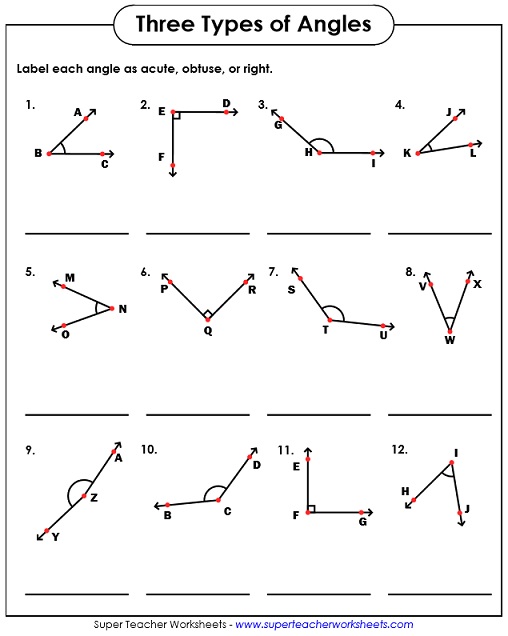
Click evaluation to continue
Evaluation
Below is a link to a quiz please click the link and complete the quiz, this is to test you understanding based on what you have learn
http://www.softschools.com/quizzes/math/decimals/quiz3206.html
After you have finish your quiz please copy and paste your result.
Below is and example
|
||||||
|
||||||
|
||||||
|
||||||
|
||||||
|
||||||
|
||||||
|
||||||
|
||||||
|
||||||
|
||||||
|
||||||
|
||||||
|

Conclusion
Today we have learnt about different types of angles.
We looked at their measurements and how they have formed.
Can you recall the types of angles we looked at and their measurements?
What is an angle?
What is an Angle?
An angle is formed by ''two rays that share the same vertex(corner).'' On a clock, an angle is formed when the long hand and the short hand meet. Angles are measured in degrees. As the degrees in an angle increase or decrease, the name of the angle changes. That is why there are different types of angles.
Types of Angles
The types of angles are:
- Straight
- Obtuse
- Acute
- Right
Each time in Natalie's school schedule actually creates one of these angles.
When Natalie wakes up for school at 6:00 am, this forms a straight angle.
 |
A straight angle looks like a straight line and measures exactly 180 degrees.
 |
For Natalie, school starts at 8:00 am.
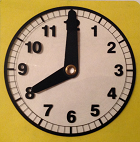 |
On a clock, this time represents an obtuse angle.
 |
obtuse angle
One of the smallest angles is the acute angle. This angle measures less than 90 degrees. If Natalie looks at the clock at 11:00 am, when it is time to go outside for recess, she would see an acute angle.
 |
HOPE YOU LEARN A LOT
Credits
My information was gathered from;
- Youtube this where i got my video
- softschool.com- all my activities and pictures
- Study.com
Teacher Page
My objectives in which i used to complete these task were based on worth while meaningful learning.
My objective is as followed;
- Define what is an angle
- Describe different types of angle {acute, obtuse straight and right angle}
- Identify different types of angles {acute, obtuse straight and right angle}
- Build and draw the different angles {acute, obtuse straight and right angle}