
Introduction
By Mr. Woodley
Introduction to the Topic: The goal of this WebQuest will be to introduce students to the first seven presidents of the United States. Students will notice what policies they backed, and other political shifts that occurred under their presidency. Students will be able to consider how the first presidents of the United States steered the country to where it is today.
Task
Task
The task will ask students to follow the process of this WebQuest all the way to the end. Students will learn who the first seven presidents of the United States were. Students will learn what key events took place from the years 1789-1837. Students gain an understanding on how to answer the question, "How did presidential policy and political view form the United States as a young nation?"
Process
George Washington 1789-1797: Trek 1

Precedent: This can be defined as an earlier event or action that is regarded as an example or guide to be considered in subsequent similar circumstances. In this circumstance, George Washington is the first president of the United States. So, he is the precedent by setting the example for presidents to come.
Ratifying the Constitution and the Bill of Rights: Remember, the American leaders were committing treason against themselves by drafting a new form of government under the constitution. To enable the power of the constitution, all of the states would eventually need to ratify or approve it. Some people were supporters of the stronger central government under the constitution. Others were afraid of it. Those that were against the drafting of the constitution came up with a compromise by drafting the Bill of Rights. The Bill of Rights would make sure that the government did not take away too much power from the states. Click here if you would like to refresh your memory on the Bill of Rights. The constitution was ratified in 1790 and the Bill of Rights was ratified 1791.
Rising Political Ideas and the Formation of Political Parties: This was an adventurous time for the leaders of the new government. They began to realize they were never all going to agree on one thing! This is where the political parties of the Federalist's and Democratic-Republicans formed their arguments, and they didn't seem to agree on anything. The first time these differences appeared was the debate over the First National Bank. Federalist leader Alexander Hamilton believed that the central government had the power to create a national bank under the necessary and proper clause in the constitution. Since Congress had the right to tax and borrow money, a national bank would help speed up the process of paying back government debt. Democratic-Republican leader Thomas Jefferson believed that creating a national bank did not fit under the necessary and proper clause. He believed it gave too much power to the central government when it came to controlling money. This was not the only place of debate for these two forming political parties. Click here for more practice on which party supported which viewpoint.
Naturalization Act of 1790: During this time period the American people were curious what made them a United States Citizen. The passing of the Naturalization Act made this more clear. The Act declared that any "free white person" that had been in the U.S for at least two years was granted citizenship. It also granted citizenship to any children born to current citizens. The government also stated that citizens may hold no other form of citizenship to any other country. U.S citizens must also hold an oath of allegiance to the constitution.
Proclamation of Neutrality: In 1793, France and Britain went to war against each other. Also, France was in the middle of a government revolution. These things created two sides within the U.S government. Thomas Jefferson's Democratic-Republicans had sympathy for the French revolution and wanted to support them in their conflict with Britain. Democratic-Republicans felt a connection with the French after they helped the U.S fight their revolution against Britain. Alexander Hamilton's Federalists believed supporting a revolutionary France would be unwise for the development of the new nation. Federalists also supported the British side of the conflict. George Washington had a strong desire to stay neutral. So he issued the Proclamation of Neutrality, which asked the U.S to stay impartial and friendly between the two powers. He stated that violators of this Proclamation would be prosecuted under the government's judicial system. This proclamation was the first example of a stronger central government. In this case, it was used to determine foreign policy. The Proclamation was not popular among all citizens of the U.S. and Thomas Jefferson felt that neutrality was abandoning the French cause of liberty. Thomas Jefferson would then resign from his position of Secretary of State. Overall, the Proclamation of Neutrality would cement the Head of State power in the executive branch. This power allows the president to make foreign policy decisions that they believe are the best case for the nation.
Jay's Treaty: John Jay was a man sent by President Washington to Britain as an ambassador. Even though the U.S had just gained independence from Britain in 1783, George Washington knew they were a powerful trade partner. He wanted John Jay to compromise with Britain on three different problems that the U.S was having. The first was British law that stopped United States' product from being sold in Britain, even though the U.S was taking in British product. The second was British soldiers still occupying northern forts in the U.S that the British had agreed to leave after the Treaty of Paris(ended the revolutionary war). The third and most critical issue was the impressment of American sailors by the British Navy. Impressment involved forcing the sailors to work in the British Navy; this could be viewed as a form of slavery. The British would also steal the naval and military supplies bound for other ports from the neutral American ships. The treaty did not truly solve any of these issues and was highly unpopular in the eyes of the American people. The document known as Jay's Treaty still passed through Congress. The only important thing that it did was create more peace between Britain and the U.S. It also gave the country more time to develop before any future conflict would start between Britain and the U.S.
Nationalism: This can be defined as advocacy of political independence for a particular country. In other words, a country needs to have its own identity. For example, a form of nationalism could be somebody that is from New York identifying as an American instead of a New Yorker.
Washington's Farewell Address: No law restricted President Washington from running for a third term in office. However, he decided that eight years was long enough for one man to be in power. This would set an example for all future presidents. Every president would step back after two-terms except for Franklin Delano Roosevelt. He was the President from 1932-1945 until he died of a brain aneurysm on April 12th, 1945. This was not the only important thing gained from the farewell address. Washington expressed a belief that nationalism should prevail throughout the country. In his opinion, political parties could harm this belief because political parties could bring out small differences that could eventually tear the country apart. The Address also served as a warning against permanent alliances. Washington urged the country to pursue trade with other nations that could help build the economy. The negative part of alliances was the building of political connections; these political connections could pull the country into unnecessary wars. If you would like to read the document of his Farewell address, click here.
John Adams 1797-1801: Trek 2

XYZ Affair: Peace with France now came into question because of United States' neutrality. France returned their ambassadors and cut ties with the U.S. The French felt betrayed based on the terms of the alliance signed in 1778. To work out an agreement with France, John Adams sent three representatives. Before the American representatives could speak to the French, they were asked to pay a bribe to them. News of this outraged the American public. This affair put Democratic-Republicans in a bad light due to their pro-French attitudes. This allowed Federalists enough power to pass the Alien and Sedition Acts
Alien and Sedition Acts: These acts are a dark spot in U.S history and a big reason why John Adams only had one term as President. The Alien and Sedition Acts were a string of acts that stopped French immigrants from coming into the U.S, banned speaking out against the government, and restricted freedom of the press. They were drafted and supported by the Federalist party. This failure to secure the rights of the people would secure Democratic-Republican rule for the next FOUR presidents due to their unpopularity.
The Naturalization Act – This act required aliens (immigrants) to be American residents for fourteen years, instead of five, before becoming American citizens.
The Alien Act – This act authorized the President to deport (send out of the country) any individual who was perceived as a danger to the safety of the United States during peacetime.
The Alien Enemies Act – This act authorized Congress to deport or arrest individuals living in the United States who were subjects to (citizens of) an enemy nation.
The Sedition Act – This act was basically designed to suppress Freedom of Speech and Press. It authorized Congress to arrest individuals suspected of “treasonable” activity such as publishing documents critical of or malicious toward the Government.
Kentucky and Virginia would write resolutions declaring that the laws under the Alien and Sedition Acts were not valid in their states. This was very problematic as it seemed to cause a move toward violence in the United States. The conflicts surrounding this topic show how the United States is constantly finding the balance between State and Federal power.
 Watch this short video that recaps what you just learned!
Fun Fact: The capital of the nation was finally established in Washington D.C. after the construction of government buildings were completed in 1800. Do you know where it was located at that point?
Election of 1800: The election was a super stressful time for Americans. There was a lot of tension behind the existence of the Alien and Sedition Acts. People were worried that the young nation would not be able to go through the election without a form of violent revolution. When Democratic-Republican, Thomas Jefferson, claimed victory in the election, he represented the first peaceful transition of power within the U.S. This was hugely important for establishing law under the constitution and following the procedures provided by it for elections.
Thomas Jefferson 1801-1809: Trek 3

Marbury Vs. Madison: Remember the word "precedent" because this case was a precedent that established the power of judicial review. Judicial review was a check and balance on the power of the Congress given to the Judicial Branch. It allowed the Supreme Court of the United States to determine whether a law was unconstitutional if it did not follow the rules laid out by the Constitution. In this scenario, the Judicial Act of 1789 was deemed unconstitutional.
Ambassador: This can be defined as an accredited diplomat sent by a country as its official representative to a foreign country. During the Louisiana Purchase, James Monroe was the U.S diplomat with France.
The Louisiana Purchase: The Louisiana Purchase was a turning point for the United States. Americans wanted more control over the trading point in New Orleans, Louisiana. The current leader in France, Napoleon Bonaparte, needed money. As a result, President Jefferson made a deal with Napoleon to buy the French-owned Louisiana territory for fifteen million dollars. You may think that is a lot of money, however in terms of land cost today that is almost like getting free land. It was approximately three or four cents per acre for the amount of land purchased. James Monroe, the current ambassador located in France, ironed out all of the details. Now it was President Jefferson's turn to decide. Would he add the land, or not?
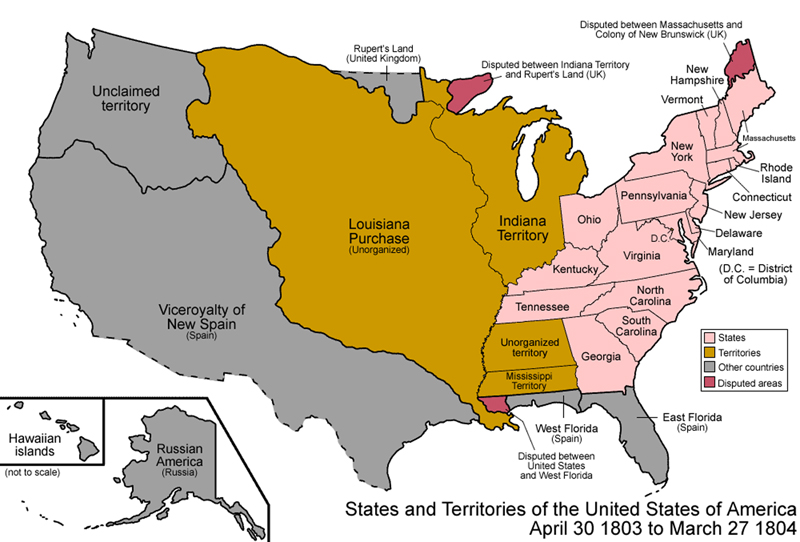
The Louisiana Purchase doubled the land size of the United States. But, there was some controversy in the mind of Thomas Jefferson. Jefferson was a believer in a strict interpretation of the Constitution. Yet, nowhere in the constitution did it say that the government could add land to the current United States. Jefferson wanted to make an amendment that specifically allowed the government to add land. Yet, there was not enough time to do so. Thomas Jefferson would then attempt to pass the treaty through Congress. It was a clear example of how loose interpretation of the constitution was used, even by someone who did not support that opinion. The Louisiana Purchase was considered one of the greatest accomplishments of the Thomas Jefferson presidency.
Lewis and Clark: There were a lot of new territories gained from the Louisiana Purchase. Yet, all of this territory was unexplored by American's. Thomas Jefferson would need to hire a team of men to map the land so that is would be safe for American settlers. He hired the now famous Meriwether Lewis and William Clark to lead this expedition. They would begin their journey near St. Louis, and it would end in Fort Clatsop which lied in what is now the state of Oregon. Embark with the famous explorers yourself by clicking here.
Banning Slave Trade: President Jefferson asks Congress to ban the trading of slaves in 1806, and Congress passes a law banning the importation of slaves starting January 1st, 1808.
Fun Fact: Aaron Burr and Alexander Hamilton have their famous duel during the Jefferson presidency.
Embargo Act: The continuation of British impressment of American sailors and goods angered President Jefferson. As a result, he issued the Embargo act which required all trade with the entire world to stop. This is super hard to enforce, as many American merchants gained profit from trade across the seas. However, President Jefferson wanted to be taken more seriously by other nations, as the British had been causing damage to the U.S. ego. There is also a second Embargo act the makes the law even more strict in attempts to keep the U.S. isolated. Keep these conflicts in mind, as the WebQuest moves into the James Madison presidency. The War of 1812 is the next major conflict America gets involved in with Britain.
James Madison 1809-1817: Trek 4

Battle of Tippecanoe: This was the battle that helped steer the United States into the war of 1812. Tecumseh, a Shawnee Indian, was attempting to create a union of Native American tribes. His hope was to push back the U.S. from further movement west. So, General William Henry Harrison went to end the formation of Tecumseh's union. The United States won a close victory and Tecumseh retreated to Canada under British safety.
War of 1812: The Federalist versus Democratic-Republican opinions comes back into play. The Democratic-Republicans wanted to go to war with Britain and expand westward to gain more land. This was because Democratic-Republicans were supporters of farm-based economies. The Federalists did not want to go to war because they supported trade to build their wealth. These conflicts with Britain meant that more laws would be put in place to restrict trade. Many people against the war would call it "Mr. Madison's war." Overall the war of 1812 was a weird war. It was the only war that brought violence to the nation's capital. The British in 1814 would start the White House on fire along with other federal government buildings. Also, due to war with France, Britain was unable to focus their attention on the United States until about 1814. After this time period, the American armies had a difficult time defending themselves under the might of the British. Although, national pride was built up when the sixteen ships in the U.S. Navy stood up against the massive British navy. One ship, known as the USS Constitution, was given the nickname "Old Ironsides" due to British cannonballs bouncing off of the ships hull.

Overall, the War of 1812 accomplished very little in terms of territorial gain. Between the British and the United States there truly was no winner. The Treaty of Ghent established no territorial change in either direction of the war. However, many Americans viewed the war as a victory. Heavy Native American casualties created less resistance to American migration westward and would pave the way for ideas of "Manifest Destiny" and the "Monroe Doctrine" to strengthen themselves. All-in-all, the War of 1812 had some huge benefits for American nationality and pride. More would establish themselves as a true Americans and felt it further established a truly independent nation. The war would end in early 1815.
Battle of New Orleans: This battle was an extraordinary defeat of British forces... after the treaty had been signed to end the war! Due to slow mail carrying time back in the day, news of the peace treaty had not made it to General Andrew Jackson. Because of this, the battle raged on two weeks after the end of the war. However, Andrew Jackson would become a national hero who was honored for this specific battle. Jackson only lost 71 soldiers, while over 2,000 British soldiers lost their lives. This battle was a big reason for a build-up in national pride even though it was never supposed to be fought. Click here to play a sword fighting game that asks you questions about the War of 1812.
Fun Fact: The Star Spangled Banner was created by Francis Scott Key during the conflict of the War of 1812.
James Monroe 1817-1825: Trek 5

Rush-Bagot Agreement: This was a treaty between the British and the United States after the Treaty of Ghent.
It involved monitoring ships on the Great Lakes. It had specific terms for both countries to follow.
● On Lake Ontario one ship not exceeding 100 tons and armed with one 18-pound cannon
● On the Upper Lakes two ships not exceeding 100 tons
● On Lake Champlain one ship not exceeding 100 tons
● All other armed ships on these Lakes were to be dismantled
● No other ships of War shall be armed or built there
The Rush-Bagot agreement helped to ease tensions between the two nations. It worked to demilitarize, or disarm, the Great Lakes region.
McCulloch v. Maryland: This was an important case viewed by the supreme court. The National Bank was in Maryland and the state attempted to impose a state tax on the bank. The Supreme Court, under John Marshall, said that states could not tax federal buildings created under the power of the Constitution. This was a massive hit to the idea of states' rights and power, further establishing the power of the central government.
Missouri Compromise: The government wanted to balance the power between slave states and free states. As the U.S. added more states, they needed a way to determine which states could have slaves and which could not. If the number of states did not match, one side would feel overpowered by the other. The Missouri compromise steps up to the plate and says that Missouri will be allowed into the Union as a slave state and that Maine would be admitted as a free state. It further established that any other territories added to the Union above the 36 degrees 30' latitude line (drawn on the map below) were to be free of slavery.

Doctrine: This can be defined as a belief or set of beliefs held and taught by a church, political party, or other group. In this example, James Monroe states his belief in the Monroe Doctrine.
Monroe Doctrine: This was a statement made by President Monroe saying that all future American lands would no longer be made into colonies by European powers. This was a bold statement, as pieces of North America were still under Spanish rule. On top of that, the United States was still a young nation. This fact would make it difficult for the government to back President Monroe's words. The Monroe Doctrine would still become a highlight of U.S. foreign policy. Secretary of State John Quincy Adams would be a heavy supporter of the Doctrine as well. Another history teacher has included important facts about the Monroe Doctrine under the melody of Adele's "Hello". Plug-in your headphones and enjoy.
The Monroe Doctrine would be another step by the central government to secure rights to the Western lands and support American nationalism. America was slowly but surely reaching toward the west-coast.
John Quincy Adams 1825-1829
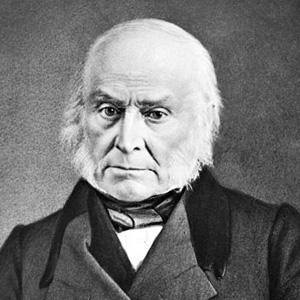
Election of 1824: The election of 1824 produces an outcome in which none of the four candidates achieve a majority of electoral votes. Andrew Jackson receives 99, John Quincy Adams 84, William Crawford 41, and Henry Clay 37. Because no one obtains the required constitutional majority, the election is sent to the House of Representatives to decide the presidency. People who supported Andrew Jackson were furious when John Quincy Adams was given the presidency.
Tariff of Abominations: This was a complete sabotage of the Adams presidency. People were still outraged by the fact that Andrew Jackson did not win the presidency. The tariff would place a high cost on raw materials, which protected merchants in the North. Yet, Vice President John Calhoun knew that this would anger many southern Democrats. This sealed Andrew Jackson's presidency in the Election of 1828.
End of Democratic-Republican Reign: All of the last four presidents have been members of the Democratic-Republican party. That is, 28 years of one party controlling the Executive branch. John Quincy Adams' defeat would seal the end of this party in office. The Federalist party also lost nearly all of its power in the James Monroe victory in 1820. Jackson's presidency would pave the way for a new shift in the political party system.
Andrew Jackson 1829-1837: Trek 6
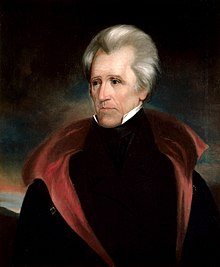
Who Was This Man?
Andrew Jackson gained heavy popularity as a war general. He led troops during the landslide victory in the battle of New Orleans. He was loved as the "common man" that people wanted to have control of the government. He highly valued states' rights and valued the preservation of the Union even more. He had a big personality and was viewed as a backwoodsman who was not afraid to duel with pistols, and party. He proved the desire to keep the Union when South Carolina, under John C. Calhoun, threatened to leave the Union because of the Tariff of Abominations. Andrew Jackson said he would send the military in to reject Calhoun's idea of nullification.
Political Shift: Andrew Jackson became the head of the Democrats, a party that separated itself from the Democratic-Republicans marking a change in political party power. Due to the rise of a two-party system in the United States, the development of the Whig party rose to oppose the Democrats. The Whigs believed that Congress should have more power over the President.
Indian Removal Act: This was first law by the United States government that actively sought to remove American Indians from their native lands. It was a dreadful piece of legislation that gave Native Americans unwanted lands to the west of their current location. The map below shows the unfamiliar lands that the Native Americans were moved to.

Many of these tribes would peacefully resettle in their new lands. Some argue that tribes were given fair treaties and money in exchange for their lands. This is only half true; They were given very little money for the land under the disguise of a treaty. An even bigger problem came from tribes in the south-east. The Chickasaw, Choctaw, Seminole, Cherokee, and Creek were known as the five civilized tribes. This is because these tribes had settled and the lands were home to them. Native Americans of these tribes refused to leave. That being the case, some 100,000 tribesmen were forced to march westward under U.S. military members in the 1830's. The short video below talks about feelings behind the Indian Removal Act.
There is a clear loser and winner when thinking about who was affected by the Indian Removal Act. Americans were now able to freely establish new farms and other lands where Native Americans once lived. This also aided in their desire to move farther west.
Trail of Tears: Anywhere from 10,000 to 14,000 Creek Indians were forced to march to lands in what is today, the state of Oklahoma. Around 4,000 of them would die on the way to their new lands. This practice also continued with the Cherokee Indians in 1838. Soldiers who "assisted" their removal would place some in stockades at bayonet point. Around 5,000 Cherokee died on the trip. The Trail of Tears is now a physical trail that is placed to remember those who died on the journey to government-given lands. Here is a link to the official map if you are interested in knowing where the Trail of Tears is in the present day United States.
President Jackson and the Power of the Veto: The picture below is used to represent what Congress felt about all of the Vetoes under President Jackson. This is funny as he is shown as a king, even though he was a candidate because of his belief in states' rights. Some believed that President Jackson was using the presidency to follow his own personal agenda.

Supporters of the national bank tended to be supporters of industry and business. They appreciated that the power of the government was behind their money and economy. The people who did not support the national bank were those who did not trust the central government. These people tended to be small farmers which were a lot of people back in the 1830’s. The Second National Bank had been designed to last from 1816 to 1836. Now, Congress had to see if they wanted to continue the use of a national bank. As a President, Jackson had the power to Veto, or reject laws passed by Congress. When Congress passed through the Bank Recharter Bill, Andrew Jackson rejected it by using his power of Presidential Veto. The Bank was one of the bigger Vetoes that Jackson used. However, Jackson used the power of Veto twelve times. That is more than any president before him.
Nullification: This can be defined as counteracting or overriding the effect or force of something. In this case, the state of South Carolina attempted to reject the "Tariff of Abominations."
Nullification Proclamation: Andrew Jackson was a strong states' rights supporter. But, this was not the case when he dealt with the actions by John Calhoun in South Carolina. The Nullification proclamation claimed that states were not allowed the power of nullifying federal government laws. He was willing to use military force to keep this proclamation followed. Congress wanted to work out a compromise so that civil war would not be started. A short video explains the proclamation down below
Force Bill: Congress passes the Force Bill, authorizing Jackson's use of the army to gain compliance with federal law in South Carolina.
Conclusion: Jackson's presidency would highlight the amount of power that the President had as an individual of the Executive Branch. His presidency will be remembered as a turbulent time in U.S history.
You've completed the Presidential Policy Adventure, Congratulations!!!

Evaluation
Conclusion
The policies and opinions of the first seven presidents impacted the development of our new nation in many different ways. Students should now be able to identify who the first seven presidents were and what their contributions were to the nation. They should be knowledgeable about the Proclamation of Neutrality, the Alien and Sedition Acts, the Louisiana Purchase, the War of 1812, the Monroe Doctrine, and the Indian Removal Act.
Credits
Websites used when compiling this WebQuest
https://millercenter.org/president
http://www.mountvernon.org/digital-encyclopedia/article/neutrality-proclamation/
http://encyclopedia.densho.org/Naturalization_Act_of_1790/
https://history.state.gov/milestones/1784-1800/jay-treaty
http://www.ushistory.org/us/19e.asp
http://www.ushistory.org/us/17d.asp
https://www.nationalgeographic.com/west/
https://www.loc.gov/resource/mgw2.024/?sp=229&st=text
https://www.britannica.com/event/Battle-of-Tippecanoe
https://www.greatsocialstudies.com/games/online-kids-games-war-1812
https://www.britannica.com/topic/Indian-Removal-Act
http://www.history.com/topics/native-american-history/trail-of-tears
https://www.nps.gov/trte/planyourvisit/maps.htm
https://sites.google.com/a/student.ccsd.edu/moving-westward-in-jacksons-era/the-reign-of-king-andrew
https://courses.lumenlearning.com/boundless-ushistory/chapter/realignment-of-the-party-system/
Teacher Page