
Introduction
Mayor's Orders, Philadelphia, 1793
|
ATTENTION DEAR CITIZENS OF PHILADELPHIA: |
1. ALL PERSONS SHOULD AVOID THOSE THAT ARE INFECTED.
2. THE HOMES OF THE SICK SHOULD BE MARKED.
3. SICK PEOPLE SHOULD BE PLACED IN THE CENTER OF LARGE AIRY ROOMS WITHOUT CURTAINS AND SHOULD BE KEPT CLEAN
4. WE MUST SUPPLY A HOSPITAL FOR THE POOR.
5. ALL BELL TOLLING SHOULD CEASE IMMEDIATELY.
6. THE DEAD SHOULD BE BURIED PRIVATELY.
7. THE STREETS AND WHARVES MUST BE KEPT CLEAN.
8. ALL PERSONS SHOULD AVOID FATIGUE OF THE BODY AND MIND.
9. ALL PERSONS SHOULD AVOID BEING IN THE SUN, DRAFTS, AND EVENING AIR.
10. ALL PERSONS SHOULD DRESS APPROPRIATELY FOR THE WEATHER.
11. ALL PERSONS SHOULD CONSUME ALCOHOL IN MODERATION.

THIS IS.... FEVER, 1793
 GO ON TO THE "FEVER, 1793" TAB
ON THE SIDEBAR FOR FURTHER INSTRUCTIONS.
Task
FEVER, 1793
|
Great numbers of the citizens have shut up their houses and fled into the country... |
The year is 1793. You live in Philadelphia, Pennsylvania.
Rumors are spreading about a deadly sickness that is
untraceable and contagious.
Your neighbors begin to flea.
No one goes to school anymore.
The slightest sign of sickness is tearing apart families and friends.
Your city is frantic.
Fear is spreading faster than the disease itself.
What is this disease?
Where did it come from?
How many have died?
How many will die?
How do we stop it?
Watch the following video for a brief historical summary of Yellow Fever, the disease that is destroying your city. Use the worksheet to take notes during this video.
CHOOSE: WHAT ROLE WILL YOU PLAY?
| A DOCTOR
|
AN ADVOCATE There is great distress in the city...Friendship is nearly banished from our city. -Dr. Benjamin Rush
Once you have picked the role that is right for you, please go to the appropriate tab on the sidebar for your next step. You will be responsible for creating a short Google Presentation with your findings to present to fellow classmates. |
A REPORTER The yellow fever will discourage the growth of great cities in our nation. -Thomas Jefferson
|

Process
Attn: Doctors
Doctors raving and disputing, death's pale army still recruitin'. -Philip Freneau
Pestilence: Written During the Prevalence of a Yellow Fever, 1793
You are a truly a brave soul and lover of science and public health.
As you explore the origins, spread of, and termination of the Philadelphia Yellow Fever Epidemic in 1793,
please fill in your medical notes.
When you are finished exploring deep into the medical world, you will then prepare a short presentation to share with your fellow citizens.
|
First, read the professional article of Yellow Fever and its affects on the human body.
|
Next, watch this short film about Dougie, a poor soul suffering and undergoing the symptoms, treatments, and further prevention of Yellow Fever.
Go the evaluation tab. |
Lastly, explore the doctoral debates over the treatment of Yellow Fever in Philadelphia in 1793.
|

Attn: Advocates
We set out to see where we could be useful - the black people were looked to. We then offered our services in the public papers, by advertising that we would remove the dead and procure nurses.
-Richard Allen and Absalom Jones
A Narrative of the Proceedings of the Black People During the Late Awful Calamity in Philadelphia in the Year 1793

You are a truly a humanitarian and an advocate for equality.
As you explore the aids and advocates of the Philadelphia Yellow Fever Epidemic in 1793, particularly the Free African Society, please fill in your notes.
When you are finished exploring deep into the Free African Society, you will then prepare a short presentation to share with your fellow citizens.
|
Richard Allen |
2. Go to the evaluation tab. |
3. |

Attn: Reporters
Wives were deserted by husbands, and children by parents. The chambers of diseases were destroyed, and the sick left to die of negligence. None could be found to remove the lifeless bodies. Their remains, suffered to decay by piecemeal, filled the air with deadly exhalations, and added tenfold to the devastation.
-Charles Brockden Brown
Memoirs of the Year 1793

Graveyard for Yellow Fever Victims Found
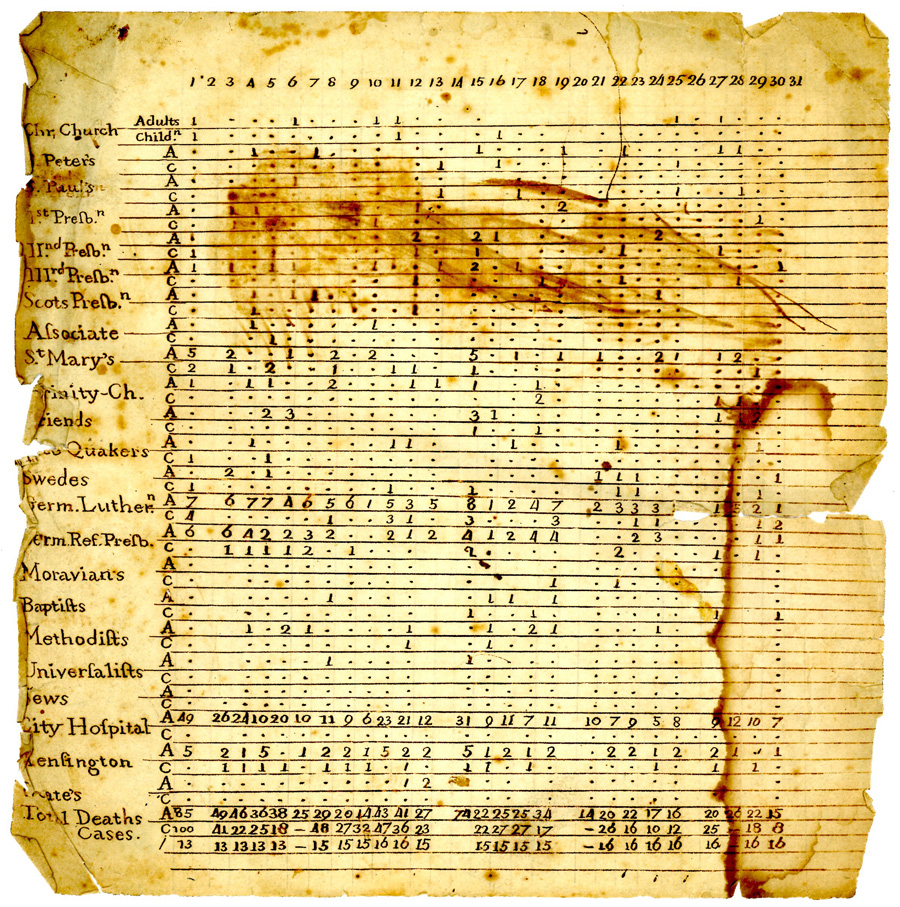
Death toll Record, 1793
You are truly a historian and a story teller.
As you explore the personal and historical accounts of the Philadelphia Yellow Fever Epidemic in 1793, please fill in your notes on the chart.
When you are finished exploring deep into these stories, you will then prepare a short presentation to share with your fellow citizens.
|
1. |
2. Next, take a look at how newspapers looked during the 1700 and 1800s. Examine how these newspapers have been archived.
Go to the evaluation tab. |
3. Lastly, research memorials of Yellow Fever Victims on the Internet. Is there one in Philadelphia? Are there memorials for Yellow Fever victims in other parts of the world? |

Evaluation
Attn. Doctors
Think deeply:
What did a doctor risk by aiding Yellow Fever victims? Why was there such medical controversy during this time? What kind of doctor would you be in 1793?
Then, for your final step, go to the Fever Feedback tab on the sidebar.
Attn. Advocates
Think deeply:
Why was it so revolutionary to have an African American aid group like the Free African Society step up and help during the Yellow Fever Epidemic?
What did they risk by helping?
Then, for your final step, go to the Fever Feedback tab on the sidebar.
Attn. Reporters
Think deeply:
Why is it important to preserve stories of historical tragedies and epidemics?
How important is a memorial?
Then, for your final step, go to the Fever Feedback tab on the sidebar.
Conclusion
FEVER FEEDBACK
|
Now that you have some background knowledge on the
Now, complete this Fever Feedback form to make some predictions about the novel: Look at the cover art for Fever, 1793. What inferences can you make about the choice of art? How does Laurie Halse Anderson organize the book? Are you excited and ready to read this book? Please share your thoughts/predictions/comments/concerns
|