Introduction

Storm Chasers Needed!
~
Are you ready for an adventure?
~
Do you seek excitement & thrill?
~
Have you ever wondered... How & Why?
~
Becoming a Storm Chaser will give you the opportunity to find those answers!
Before you can officially join our team of experts. We need to test your knowledge! Continue on to the TASK section to see what your first mission will be.
Good Luck!
Task
Welcome to our team, storm chasers!
We here at the U.S. Meteorological Society know that a big storm is brewing, but we need to know the warning signs so that we can get people to safety before it hits! Storm chasers like you play an important role in researching storms by observing their behavior and the effects that they have on people and their environment. That is why we need you to follow some big storms and report your findings. As soon as you are finished, give this research to your teacher so that they can send it to our top analysts ASAP. We are counting on you!

Before we get started, it’s important for you to know how to stay safe on
the job. There are FOUR rules that you should always follow.
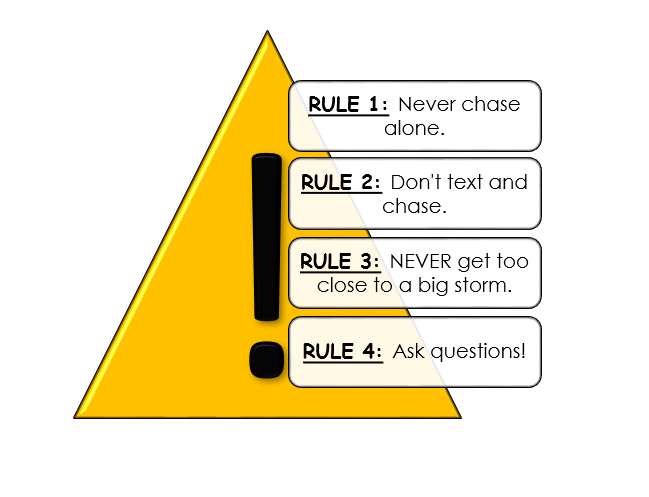
Now that you know the rules, it’s time to brief you on your first assignment. Here’s what we need you to do:
STEP 1: Make a timeline of the 3 worst storms in the U.S. Include at least ONE hurricane and ONE blizzard.
STEP 2: Find out what types of storms they were, and define each type.
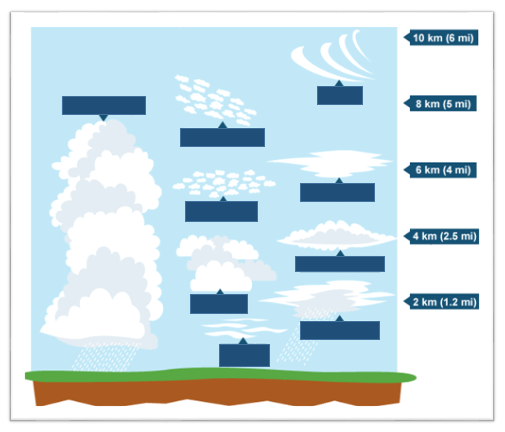
STEP 3: Identify and familiarize yourself with the types of clouds.
STEP 4: Plot your three storms on a MAP of the U.S. so that our analysts can get an idea of where these storms are happening.
STEP 5: List 3 interesting facts about each storm.
Process
Congratulations on receiving your first assignment!
This is the first step on your journey to becoming expert storm chasers. Since this is your first assignment, I am going to help you through each step. By the time we are finished, you and your team will be ready to tackle your next mission all on your own.
STEP 1: Make a timeline of the 3 worst storms in the U.S. Include at least ONE hurricane and ONE blizzard.

WHERE TO LOOK:
- http://ecology.about.com/od/Ecology/fl/The-11-Worst-Blizzards-in-US-His…
- http://ecology.about.com/od/Ecology/tp/8-of-The-Most-Devastating-Hurric…
- https://weather.com/storms/hurricane/news/10-worst-hurricanes-american-history-20140818#/1
STEP 2: Find out what types of storms they were, and define each type.

WHERE TO LOOK: EXPLORE these websites to find out about different types of storms. Remember, your storm may not be one of the four types we have shown above.
- http://youngmeteorologist.org/educator-resources/weather-science/
- http://www.weatherwizkids.com/
- http://skydiary.com/kids/
STEP 3: Identify the types of clouds in the image below.
WHERE TO LOOK:
STEP 4: Plot your three storms on a MAP of the U.S. so that our analysts can get an idea of where these storms are happening.
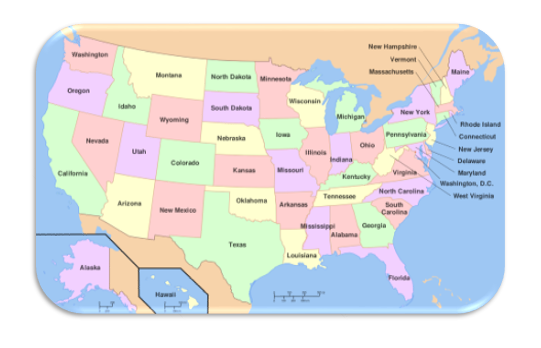
WHERE TO LOOK:
- https://coast.noaa.gov/hurricanes/ (you can search for them by name, year, and location)
- If you need help with this one, feel free to ask your teacher.
STEP 5: List 3 interesting facts about each storm.

WHERE TO LOOK: You may use any of the previous links for this step, we just want to know what sticks out to YOU about these storms.
Once you have completed your assignment, move on to the evaluation step, where you and your team will check your work.
Evaluation
Evaluation
Storm Chasers: Please check your work against these guidelines before turning your work into your teacher.
Teachers: Use this form to evaluate each team's work.
STEP 1:
3. Team has three storms graphed on timeline, including at least one hurricane and one blizzard. All three storms could be considered large/severe, and occurred in the United States.
2. Team has at least two storms graphed on timeline. All storms could be considered large/severe, and occurred in or near the United States.
1. Team has at least one storm graphed on timeline. Storm could be considered large/severe.
0. Team has graphed no storms on timeline.
STEP 2:
3. Team has identified the type of storm for each storm graphed on timeline. Team has also defined each storm type provided.
2. Team has identified the type of storm for each storm graphed on timeline.
1. Team has identified the type of storm for at least one of the storms graphed on timeline.
0. Team has not identified or defined any of the storm types on their timeline.
STEP 3:
3. Team has identified all cloud types in image provided.
2. Team has identified at least 6 cloud types in image provided.
1. Team has identified at least 3 cloud types in image provided.
0. Team has not identified at least 3 cloud types in image provided.
STEP 4:
3. Team has correctly plotted all storms on U.S. map.
2. Team has somewhat acurately plotted all storms on U.S. map.
1. Team has plotted at least 1 storm on U.S. map somewhat accurately.
0. Team has no storms plotted on U.S. map.
STEP 5:
3. Team has provided 3 facts about each storm.
2. Team has provided 2 facts about each storm.
1. Team has provided 1 fact about each storm.
0. Team has provided no interesting facts.
TOTAL POINTS:
A: 11-15 points B: 7-10 points C: 3-6 points D: 1-2 points
Conclusion
Excellent Work, Storm Chasers!
Con-GRAD-ulations Storm Chasers! You have completed the mission and therefore graduated from Storm Chaser Trainee, to being a valued member of our very own Storm Chasing team! You will receive a personalized Storm Chasing badge, along with your diploma! This means you can get out there and start identifying and chasing down storms all on your own! Remember the FOUR RULES to safe storm chasing, and you will always succeed! Wishing you the best on your future journeys into those BIG BAD storms!
Chase Storms at your own Risk!