
Introduction
This webquest will be used to help students gain a better understanding of football rules and its meaning

Football is a family of team sports that involve, to varying degrees, kicking a ball with the foot to score a goal. Unqualified, the wordfootball is understood to refer to whichever form of football is the most popular in the regional context in which the word appears. Sports commonly called 'football' in certain places include: association football (known as soccer in some countries); gridiron football(specifically American football or Canadian football); Australian rules football; rugby football (either rugby league or rugby union); and Gaelic football. These different variations of football are known as football codes.
International rules football (Irish: Peil na rialacha idirnáisiunta; also known as inter rules in Australia and compromise rules in Ireland) is a team sport consisting of a hybrid of football codes, which was developed to facilitate international representative matches between Australian rules football players and Gaelic football players.
Football Field
The football field is 120 yards long and 53 ½ yards wide. At each end of the field and 100 yards apart are the goal lines. The additional 10 yards at each end is the end zone. The field is divided up every 5 yards by a yard line. The middle yard line marker is called the 50 yard line. In parallel to the side lines are rows of hash marks. The football is always placed on or between the hash marks at the start of each play. This ensures that the teams have space to line up on both sides of the football. The position of the football that defines the sides of the ball is called the "line of scrimmage". There are also goal posts at the back of each football end zone. One way to score is to kick the football through the goal posts. The ball must go between the uprights and over the crossbar. If any part of a player with the football touches outside the side lines or the end zone it is considered Out of Bounds.
Game Format
Football is a timed sport. The team with the most points at the end of the time period, wins the game. The game is divided up into 4 periods or quarters with a long "half time" between the second and third quarter. Time is counted while plays are running and sometimes between plays (i.e. time continues after a running play where the player was tackled in bounds, but stops on an incomplete pass). To keep the game going at a good pace the offense has a limited time (called the play clock) between plays.
Football Players
The rules in football allow each team to have eleven players on the field at a time. Teams may substitute players between plays with no restrictions. Each team must start a play on their side of the ball. The defensive players may take any position they want and can move about their side of the football prior to the play without restriction. Although there are certain defensive positions that have become common over time, there are no specific rules defining defensive positions or roles. The offensive players, however, have several rules that define their position and what role they may take in the offense. Seven offensive players must be lined up on the line of scrimmage. The other four players must be lined up at least one yard behind the line of scrimmage. All of the offensive football players must be set, or still, prior to the play beginning with the exception of one of the four backs which may be moving parallel or away from the line of scrimmage. Further rules say that only the four backs and the players at each end of the line of scrimmage may catch a pass or run the football.
Read more at: http://www.ducksters.com/sports/footballrules.php
Read more at: http://www.ducksters.com/sports/footballrules.php
Task
1)Explain common rules among the sports
2)What international rules do you know?
3)Compare rules given in the text and define them
Cambridge rules
In 1848, at Cambridge University, Mr. H. de Winton and Mr. J.C. Thring, who were both formerly at Shrewsbury School, called a meeting at Trinity College, Cambridge with 12 other representatives from Eton, Harrow, Rugby, Winchester and Shrewsbury. An eight-hour meeting produced what amounted to the first set of modern rules, known as theCambridge rules. No copy of these rules now exists, but a revised version from circa 1856 is held in the library of Shrewsbury School.[80] The rules clearly favour the kicking game. Handling was only allowed when a player catches the ball directly from the foot entitling them to a free kick and there was a primitive offside rule, disallowing players from "loitering" around the opponents' goal. The Cambridge rules were not widely adopted outside English public schools and universities (but it was arguably the most significant influence on the Football Association committee members responsible for formulating the rules of Association football).
Sheffield rules
By the late 1850s, many football clubs had been formed throughout the English-speaking world, to play various codes of football. Sheffield Football Club, founded in 1857 in the English city of Sheffield by Nathaniel Creswick and William Prest, was later recognised as the world's oldest club playing association football. However, the club initially played its own code of football: the Sheffield rules. The code was largely independent of the public school rules, the most significant difference being the lack of an offside rule.
The code was responsible for many innovations that later spread to association football. These included free kicks, corner kicks, handball, throw-ins and the crossbar. By the 1870s they became the dominant code in the north and midlands of England. At this time a series of rule changes by both the London and Sheffield FAs gradually eroded the differences between the two games until the adoption of a common code in 1877.
Australian rules
There is archival evidence of "foot-ball" games being played in various parts of Australia throughout the first half of the 19th century. The origins of an organised game of football known today as Australian rules football can be traced back to 1858 in Melbourne, the capital city of Victoria.
In July 1858, Tom Wills, an Australian-born cricketer educated at Rugby School in England, wrote a letter to Bell's Life in Victoria & Sporting Chronicle, calling for a "foot-ball club" with a "code of laws" to keep cricketers fit during winter. This is considered by historians to be a defining moment in the creation of Australian rules football. Through publicity and personal contacts Wills was able to co-ordinate football matches in Melbourne that experimented with various rules, the first of which was played on July 31, 1858. One week later, Wills umpired a schoolboys match between Melbourne Grammar School and Scotch College. Following these matches, organised football in Melbourne rapidly increased in popularity.
Wills and others involved in these early matches formed the Melbourne Football Club (the oldest surviving Australian football club) on May 14, 1859. Club members Wills, William Hammersley, J. B. Thompson andThomas H. Smith met with the intention of forming a set of rules that would be widely adopted by other clubs. The committee debated rules used in English public school games; Wills pushed for various rugby football rules he learnt during his schooling. The first rules share similarities with these games, and were shaped to suit to Australian conditions. H. C. A. Harrison, a seminal figure in Australian football, recalled that his cousin Wills wanted "a game of our own". The code was distinctive in the prevalence of themark, free kick, tackling, lack of an offside rule and that players were specifically penalised for throwing the ball.
The Melbourne football rules were widely distributed and gradually adopted by the other Victorian clubs. The rules were updated several times during the 1860s to accommodate the rules of other influential Victorian football clubs. A significant redraft in 1866 by H. C. A. Harrison's committee accommodated the Geelong Football Club's rules, making the game then known as "Victorian Rules" increasingly distinct from other codes. It soon adopted cricket fields and an oval ball, used specialised goal and behind posts, and featured bouncing the ball while running and spectacular high marking. The game spread quickly to other Australian colonies. Outside of its heartland in southern Australia the code experienced a significant period of decline following World War I but has since grown throughout Australia and in other parts of the world, and the Australian Football League emerged as the dominant professional competition.
Process
2006 rule changes
A number of rule changes were introduced before the 2006 International Rules Series:
• per quarter was reduced from 20 minutes to 18 minutes
• A player who received a red card is to be sent off and no replacement is allowed; in addition to this a penalty is awarded regardless of where the incident takes place (Previously a replacement was allowed and a penalty was only awarded if the incident happened in the penalty area)
• A yellow card now means a 15-minute sin bin for the offending player, who will be sent off if he receives a second card
2008 rule changes
• Maximum of 10 interchanges per quarter
• Teams are allowed only four consecutive hand passes (ball must then be kicked)
• Match time reduced from 80 minutes to 72 minutes (18 minutes per quarter)
• Goalkeeper can no longer kick the ball to himself from the kick-out
• Suspensions may carry over to GAA and AFL matches if The Match Review Panel sees fit
• A dangerous "slinging" tackle will be an automatic red card
• A front-on bump (known as a shirtfront in Australian football) endangering the head will result in a red card
• Physical intimidation can result in a yellow card
• Keeper can not be tackled or touched when the keeper is charging
• An independent referee can cite players for reportable offences from the stands
• Yellow card sin bin reduced to 10 minutes
2014 rule changes
• Maximum number of interchanges per quarter increased from 10 to 16
• Unlimited number of interchanges allowed at quarter and half time breaks
• Number of consecutive hand-passes teams are allowed increased from 4 to 6
• Marks will not be paid for backwards kicks caught by a teammate
• Goalkeepers required to kick the ball out beyond the 45m line after all wides, behinds and overs
• Failure of a goalkeeper to kick over the 45m line will result in a free kick to the opposition (from the 45m line)
Evaluation
This is how your work will be evaluated.
| Beginning 1 |
Developing 2 |
Qualified 3 |
Exemplary 4 |
Score |
|
|---|---|---|---|---|---|
| Stated Objective or Performance | Description of identifiable performance characteristics reflecting a beginning level of performance. | Description of identifiable performance characteristics reflecting development and movement toward mastery of performance. | Description of identifiable performance characteristics reflecting mastery of performance. | Description of identifiable performance characteristics reflecting the highest level of performance. | |
| Stated Objective or Performance | Description of identifiable performance characteristics reflecting a beginning level of performance. | Description of identifiable performance characteristics reflecting development and movement toward mastery of performance. | Description of identifiable performance characteristics reflecting mastery of performance. | Description of identifiable performance characteristics reflecting the highest level of performance. | |
| Stated Objective or Performance | Description of identifiable performance characteristics reflecting a beginning level of performance. | Description of identifiable performance characteristics reflecting development and movement toward mastery of performance. | Description of identifiable performance characteristics reflecting mastery of performance. | Description of identifiable performance characteristics reflecting the highest level of performance. | |
| Stated Objective or Performance | Description of identifiable performance characteristics reflecting a beginning level of performance. | Description of identifiable performance characteristics reflecting development and movement toward mastery of performance. | Description of identifiable performance characteristics reflecting mastery of performance. | Description of identifiable performance characteristics reflecting the highest level of performance. | |
| Stated Objective or Performance | Description of identifiable performance characteristics reflecting a beginning level of performance. | Description of identifiable performance characteristics reflecting development and movement toward mastery of performance. | Description of identifiable performance characteristics reflecting mastery of performance. | Description of identifiable performance characteristics reflecting the highest level of performance. | |
| Stated Objective or Performance | Description of identifiable performance characteristics reflecting a beginning level of performance. | Description of identifiable performance characteristics reflecting development and movement toward mastery of performance. | Description of identifiable performance characteristics reflecting mastery of performance. | Description of identifiable performance characteristics reflecting the highest level of performance. | |
| Stated Objective or Performance | Description of identifiable performance characteristics reflecting a beginning level of performance. | Description of identifiable performance characteristics reflecting development and movement toward mastery of performance. | Description of identifiable performance characteristics reflecting mastery of performance. | Description of identifiable performance characteristics reflecting the highest level of performance. |
Conclusion
International rules of football
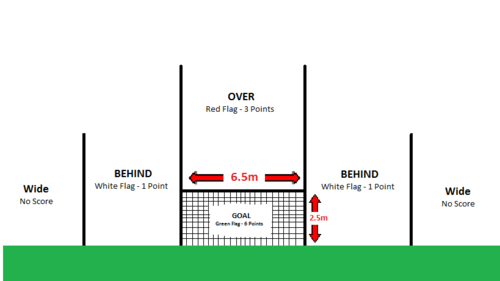
The game uses two large posts usually sets 6.5 metres apart, and connect 2.5 metres above the ground by a crossbar with goal net that could extend behind the goalposts and attached to the crossbar and lower goalposts, as in Gaelic football. A further 6.5 metres apart on either side of those and did not connected by a crossbar are 2 small post, known as behind post, as in Australian rules football.
Points are scored as follows:
Under the crossbar and into the goal net (a goal): 6 points, umpire waves green flag and raises both index fingers.
Over the crossbar and between the two large posts (an over): 3 points, umpire waves red flag and raises one arm above his head.
Between either of large posts and a small posts (a behind): 1 point, umpire waves white flag and raises one index finger.
Scores are written so as to clarify how many of each type of score were made as well as, like Australian football, giving the total points score for each team; for example, if a team scores one goal, four overs and 10 behinds, the score is written as 1-4-10 (28), meaning one goal (six points) plus 4 overs (4 × 3 = 12 points) plus 10 behinds (10 × 1 = 10 points), for a total score of 28 points.
An international rules match lasts for 72 minutes (divided into four quarters of 18 minutes each). Inter-county Gaelic football matches go on for 70 minutes, divided into two halves, and Australian rules matches consists of four 20 minutes quarters of game time, although with the addition of stoppage time, most quarters actually last between 25 and 30 minutes.
International rules is played in various locations throughout North America and the Caribbean, Europe, Asia, and Australia and New Zealand between fledgling Australian rules football and Gaelic football clubs.
In 2006, an exhibition match between South African youth teams and an Indigenous Australian touring side composed of players from the Clontarf Foundation, led by Sydney's Adam Goodes, was held at Potchefstroom.
The University of Birmingham, UK, holds an annual International Rules match between its Australian Rules football team and its Gaelic Football team, with the 2013 edition won by the Australian Rules team 56–55, before a crowd of over 400 students.[18]
In the International Rules Series, the most well-known International Rules event, Ireland currently leads Australia 10-9 in series wins, 21-17 in Tests won (with two draws) and 2,268 to 2,121 in total points scored. They also won the most recent event 56-52 in a one-off test at Croke Park in Dublin.
The rules of football are officially referred to as the "Laws of the Game". The Laws of the Game are described very precisely (approximately 150 pages) on the FIFA website here.
There are 17 laws in total, each one briefly summarised below.
Field of Play. The game can be played on either natural or artificial surfaces, the surface must be green and rectangular in shape. The two long sides of the rectangle are called touch lines and the two shorter sides are called goal lines. The field is divided in half by the halfway line.
Ball. Must be spherical, made of leather (or similar) 68-70 cm in circumference and of a certain pressure.
Number of Players. Two teams of no more than 11 players (one of which is the goalkeeper). A game cannot start if either team has less than 7 players.
Equipment. Players must wear a jersey, shorts, stockings, shinguards and footwear.
Referee. The referee ensures the Laws of the Game are respected and upheld.
Assistant Referees. There may be at most 2 assistant referees.
Duration of the Match. The game is played in 2 halves consisting of 45 minutes each. The half time interval must not exceed more than 15 minutes. At the discretion of the referee more time is allowed to compensate for any stoppage during play e.g. Due to substitutions or care and attention of injured players.
Start and Restart of Play. A kick-off starts play at the start of the match or after a goal. A kick-off involves one player kicking the ball, from stationary, forward from the centre spot. All players must be in their own half prior to kick-off. A coin is tossed pre-game, the team which loses the toss are awarded the kick-off to start the game whilst the team that win the toss are allowed to choose which direction they want to play. After half time the teams switch direction and the other team will kick-off. After a goal is scored, the team which conceded the goal will kick-off to restart play.
Ball in and Out of Play. The ball is out of play once a goal has been scored or when the referee has stopped the game. The ball is in play at all other times.
Method of Scoring. The ball crosses the goal line inside the goal mouth.
Offside. It is an offence for a player to be in contact with the ball when they are closer to the opponents' goal than both the ball and the second-last opponent. The offside rule exists to ensure there are always opponents (generally the goal keeper and a defender) between a player receiving the ball and the goal. Without the offside rule, play can become boring with repeated long balls being kicked to a player stood next to the goalkeeper for an easy goal.
Fouls/Misconduct. These are many and varied, broadly speaking it is an offence to use excessive force whilst playing the game either deliberately or undeliberately or to handle the ball (unless you are a goal keeper). The referee may show the yellow card to caution players for less serious offences and the red card for more serious offences resulting in the player being sent off. Two yellow cards are equivalent to one red card.
Free Kicks. Are given by the referee for fouls and misconduct. A free kick can either be direct or indirect. A goal can be scored directly from a direct free kick. A goal can only be scored from an indirect free kick if it touches at least one other player first. The free kick must be taken from a stationary position with that position varying depending on whether the free kick was given inside or outside the goal area and whether it's direct or indirect. The opposing team must be a minimum of 9.15 m from the ball when the free kick is taken.
Penalty Kicks. Are given against a team when they commit an offence which would normally be awarded a direct free kick inside their goal area. The ball is kicked from stationary from the penalty spot. The opposing team must be outside of the penalty area and at least 9.15 m from the ball.
Throw-in. Used to restart play after the whole of the ball has crossed the touch line.
Goal kick. Used to restart play after a goal has been scored.
Corner Kick. Is given when the whole of the ball crosses the goal line and was last touched by a member of the defending team (and no goal was scored). A corner kick is taken from inside the corner arc closest to the point where the ball crosses the goal line. The defending team must be at least 9.15 m from the ball when the corner kick is taken.
Credits
Author biography
I'm Saifullaeva Nazerke. I'm studying at the Eurazian National university after named L.N.Gumilyov. I am very fond of children and their education. I have the pleasure and enjoyment of working with children and adore my specialty.
Permissions
We all benefit by being generous with our work. Permission is granted for others to use and modify this WebQuest for educational, non-commercial purposes as long as the original authorship is credited. The modified WebQuest may be shared only under the same conditions. See the Creative Commons Attribution • Non-Commercial• Share-Alike license for details.
This WebQuest was created in https://www.createwebquest.com/
Teacher Page
This webquest will be used to help students gain a better understanding of football rules and its meaning