
Introduction
Therapeutic Hypothermia & Arctic Sun
By: Katherine Holloway, RN
Excelsior College
October 2016
Introduction
You can contact me via e-mail at ktnursing1986@yahoo.com or for additional help see the CONTACT section under Create a WebQuest. or simply click on the hyperlink below:
https://www.createwebquest.com/contact
Click on Introduction: Voki
This staff Development course is designed for educational purposes of the implementation of Therapeutic Hypothermia within the Intensive Care Unit. Learners include: Registered Nurses within the Intensive Care Unit, Hospitals and Intensivist, and ancillary departments that wish to attend. Throughout this course, we will define Therapeutic Hypothermia, understand concepts and identify what patients meet criteria for Therapeutic Hypothermia, benefits of Therapeutic Hypothermia, review videos, pictures, and will conclude with a multiple choice exam following the presentation and an indivudual based evaluation on the following criteria:
|
Evaluation Objectives |
Points Received |
|
1. Discuss the benefits of therapeutic hypothermia in post cardiac arrest patients (20 pts) |
|
|
2. Identify inclusion criteria and the 3 phases of hypothermia (20 pts) |
|
|
3. Describe potential adverse effects and risks associate with therapeutic hypothermia (20 pts) |
|
|
4. Demonstrate application of Arctic Sun equipment (machine function and proper pad placement) (20 pts) |
|
|
5. Successfully complete simulation experience (20pts) |
|
|
Total
|
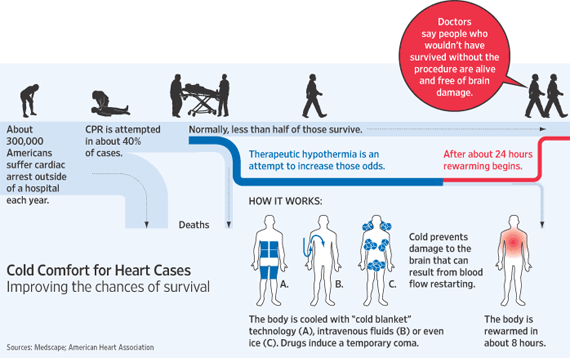
Therapeutic Hypothermia is defined as an induction of temperature control at 32-34 degrees Celsius. Approximately 300,000 people in the United States suffer from cardiac arrest outside of the hospital each year. Through the induction of therapeutic hypothermia in cardiac arrest patients has an impact on long-term neurologically intact survival and may prove to be one of the most important clinical advancements in the science of resuscitation. However, studies are being conducted to include patient criteria such as hemorrhagic stroke and patients with severe brain injury to determine if Therapeutic Hypothermia induction would be beneficial for these patients.
Task
Click on: Overview and Objectives Animoto
Objectives:
1. Discuss the 3 phases of therapeutic hypothermia.
2. Explain the pathophysiology associated with cardiac arrest that leads to cell death.
3. List and identify adverse and potential side effects of Therapeutic Hypothermia.
Benefits of Therapeutic Hypothermia for Cardiac Arrest Patients Click on: Video YouTube
If the link does not open click the link here. https://youtu.be/r77qNC1IHZg
Pathophysiology
Cardiac arrest at ROSC is a case of whole-body ischemia and subsequent reperfusion injury. This injury along with pre-arrest comorbidities cause enormous biochemical, structural, and functional insults which in a complex interrelated process leads to progressive cell destruction, multi-organ dysfunction, neuronal apoptosis, and death. Hypothermia has been shown to attenuate or ameliorate many deleterious temperature sensitive mechanisms, thereby contributing to protection of the brain and heart.
Process
How it Works
Click on: Adverse Effects Powtoons
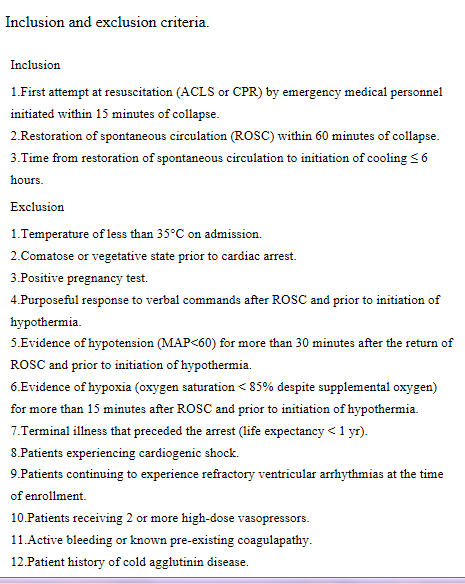
Inclusion criteria
Patients that have been shown to benefit from induced hypothermia: Intubated patients with treatment initiated within a 6-hour post cardiac arrest time window, those able to maintain a systolic blood pressure >90mm Hg with or without pressors, those in a coma at the time of cooling (brainstem reflexes and pathological/ posturing movements are permissible and patients with a GCS of 3 are eligible)

Evaluation
Click on: Treatment Protocols Glogster
Treatment goal: The patient is actively cooled by using an induced hypothermia protocol for 24 hours to a goal temperature of 32-34 degrees Celsius. The goal is to achieve the targeted temperature as quickly as possible. In most cases, this can be achieved within 3-4 hours of initiation especially with the medical device, Arctic Sun. Shivering may occur as this is the body’s attempt to maintain homeostasis.
Click on: Review and Key Points Jing
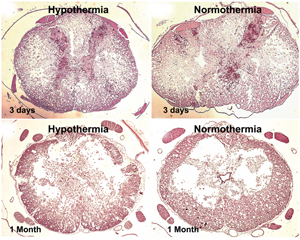
After studying 133 patients that experienced out of hospital cardiac arrest and were treated with therapeutic hypothermia, within one year post arrest over ¾ of these patients were able to return to work. Therapeutic hypothermia may also confer benefits to patients experiencing cardiac arrest in other clinical environments, patients with hemorrhagic shock and patients with other forms of severe brain injury. Currently, at least 19 clinical trials are underway and focus primarily on ROSC, traumatic brain injury, stroke, and neuroencephalopathy.
Evaluation
Please complete the following questions:
1. What is the ideal temperature for cooling with therapeutic hypothermia? _____________
2. What is the primary device used for cooling throughout this course? ______________
3. Can a patient utilize therapeutic hypothermia if their systolic blood pressure is <90? (y/n) _________
4. Can a patient utilize therapeutic hypothermia if they are in cardiogenic shock? (y/n) _________
5. What is the ideal time frame to cool a patient with therapeutic hypothermia? __________
6. What is one sign to watch for in patients that are being treated with therapeutic hypothermia? _________
7. Fill in the Blank: Therapeutic hypothermia with conventional cooling methods improves both survival and ________ outcomes for patients who experience cardiac arrest.
8. Approximately __________ people experience cardiac arrest each year in the United States?
9. Cardiac arrest and __________ is a case of whole body ischemia and subsequent reperfusion injury?
10. Therapeutic hypothermia contributes to the protection of the brain and ________?
Conclusion
Conclusion
In conclusion, we must remember that approximately 250,000 Americans suffer from out of hospital cardiac arrest each year. World wide, the average survival rate for out-of-hospital cardiac arrest is just 6%. Approximatley 20% of cardiac arrest survivors who remained comatose have awakened with a good neurological outcome. With the implementation of therapeutic hypothermia in post cardiac arrest patients, we as healthcare professionals can improve these statistics and change the lives of others.
Discussion: Have you ever been a team member in the induction of therapeutic hypothermia? In what ways will you monitor signs and symptoms of adverse side effects of hypothermia and how will you educate families about potential side effects taht the patient may experience while undergoing therapeutic hypothermia?
Credits
REFERENCES
Adler, J., Peter, K., Bessman, E., Setnik, G., & Talavera, F. (2014, April 30). Therapeutic
Hypothermia. Retrieved from http://www.emedicine.medscape.com/articles/812407-
Overview
Heard, K., Peberdy, M., Sayre, M., Sanders, A., Geocadin, R., Dixon, S., . . . O'Neil, B. (2010,
January). A Randomized Controlled Trial Comparing the Arctic Sun to Standard
Cooling for Induction of Hypothermia After Cardiac Arrest. Retrieved from
http://www.ncbi.nlm.nih.gov/pmc/articles/PMC2815241
NewYork Presbyterian hospital. (2007, August). Hypothermia/ Normothermia: Arctic Sun
Temperature Management System Protocol and Procedure [Department of Nursing,
Critical Care Manual].