
Introduction
What is Algebra?
Algebra is the branch of Mathematics that is designed to help you solve equations quicker and easier.
Why do we use Algebra?
Algebra is a useful tool that we could use in real life situations.
Where is algebra used in our every day lives?
One example of Algebra in our every day lives would be when we are shopping to figure out how many bags we may need for the amount of items we bought or even to determine how much those items may cost.
Watch the video below to learn more about Algebra!
[video:https://www.youtube.com/watch?v=5Q0FlxcEEIw]
Task

PICTURE THIS!
Imagine you are no longer a student in Algebra class. You are now an adult who has to go to work during the week. Your responsibility is to make sure you complete your job everyday. One of the responsibilities of having a job is also to complete your timesheet, which is a report of how many hours you worked each week. For your job, you can recieve bonuses for positive work ethic, and deductions can be made from your salary. Bonuses will include fully participating in class, cleaning your workspace when you leave the classroom, helping out a co-worker (your other classmates and teacher), and more! Possible deductions will include failure to complete your job for that day, failure to submit homework, failure to complete your timesheets and more. Every Friday, you will be responsible for calculating your pay for that week. This will include your daily salary, any bonuses that you have received and any prior deductions that you were given. But wait, here's the most important part... All calculations will be done by using ALGEBRA!
Jobs Options:
- Board Eraser- Erases the board for Mr. Shanley when it is needed
- Paper Passer- Passes out and collects papers when it is needed
- Light Monitor- Turns lights on and off when they are needed
- Technology Assistant- Assists Mr. Shanley in the use of the computer and/or the projector
- Classroom Organzier- Organizes classroom before and after class. Also picks up garbage from the floor after class
- Substitutes- Completes the job of the absent employees (students)
- Homework Collector - Collects homework when the class begins.
How to calculate salaries!
Process

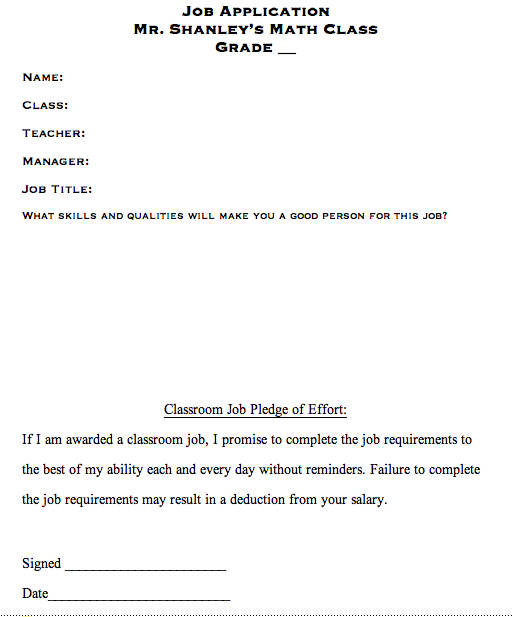
Step 1: Get a job application sheet and select the job(s) that you would like to apply for. List 3 jobs, in order of preference just in case someone else applies for the same job. (If you are absent, a substitute will do your job for the days that you are not there. Therefore, when applying for a job, make sure to assign someone as your substitute. Let that person know they are your substitute. It is your job to let them know what their duties are, in case you are not there to fulfill them. Excessive absences will result in deductions from your paycheck.)
Step 2: Wait until you have received notice saying what your job is that you have been assigned.
** Steps 3 and 4 are done simultaneously on the first day you begin work **
Step 3: Start working. Every minute that you are in the office counts, so make sure you are always doing your job.
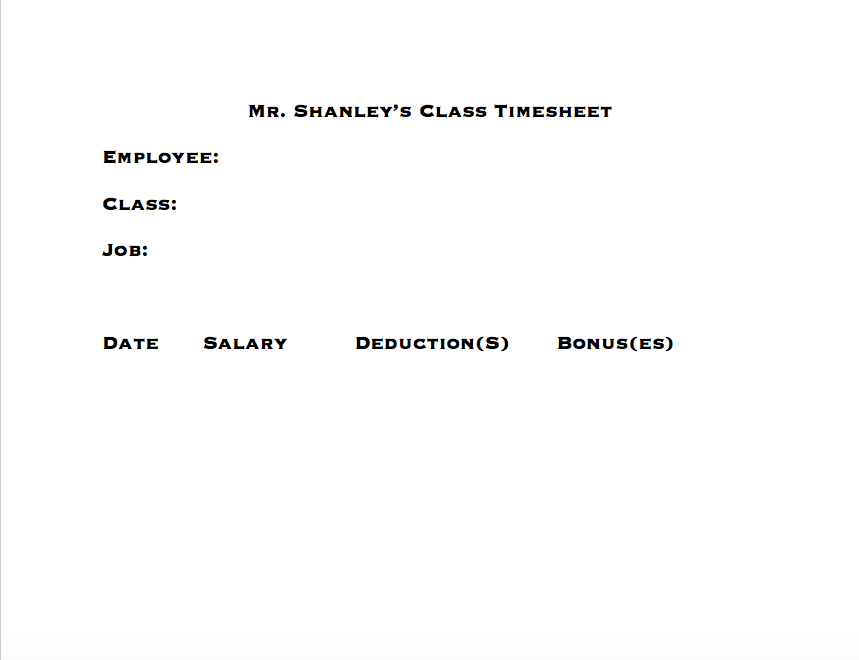
Step 4: Once the week begins, make sure to begin a timesheet, so your attendance can be tracked and you can get paid accordingly.
Step 5: Once the week is coming to an end, look over your hours, bonuses and deductions to calculate your paycheck.
Rules to follow for office jobs:
1. If your job is not completed, 50% is deducted from your paycheck.
2. If you do not bring a ruler to class, 15% is deducted from your paycheck.
3. If you are absent and your substitute does not complete the job, 10% is deducted from your paycheck. Reason being that it is your responsibility to make sure your substitute completes the work if you are not present.
4. If you fail to submit your homework, 25% is deducted from your paycheck.
5. If your timesheet is not completed by the last work day of the week 5% will be deducted from your paycheck.
6. When the week is over check to see if your attendance will affect your pay. 5% will be deducted from your paycheck for 2 absences and 10% will be deducted for 3 or 4 absences, and no pay will be awarded to anyone who is absent for a full 5 days. ** Remember ** you are ONLY payed for the days that you are in work and complete your job.
Not sure about timesheets? No problem! Here's a video to help you understand more about them!
[video:https://youtu.be/n1HwjPPIf_4 align:center]
Here's a video to help you learn all about polynomials!
[video:https://youtu.be/tUY9dUkfBmE]
Timesheet:
Job Application:
Evaluation
Here's how it works!
Salary: $5 per day (plus/minus any bonuses or deductions)
Bonuses:
- Good class participation
- Leaving your workspace (desk) clean when leaving the classroom
- Arriving to class on time
- Bringing proper materials to class
- Having textbook in class everyday
Deductions:
- Failure to complete timesheet (5% deduction)
- Failing to complete homework (10% deduction)
- Late to class, without an excuse (10% deduction)
- Excessive talking during a lesson (8% deduction)
- Failing to bring ruler to class (15% deduction)
Students will be evaluated on their weekly salary calculations.
Conclusion
In conclusion, students experienced real world situations affiliated with job performances, and money. After applying percentages of bonuses and deductions, students utilized their Algebraic math skills and learned how they apply to the real world. Math is a very common element used in every day life, specifically with money. After a student produced a hard work ethic, they received 5$ a day. If a student failed to execute their job, a percentage of their pay was deducted. Both payments and deducations heavily prepare the students for a real job; if you execute, you receive your earnings, if you do not complete your job, you will lose money.