
Introduction
The following presentation is an overview of major concepts covered in Ethics and Legal Issues presented at Northcentral University, to include copyright, fair use, intellectual property and property rights violations. This toolkit encompasses various resources to provide teachers with tangible information they need in understanding and complying with laws, rules, regulations and acts involving these major issues.
Task
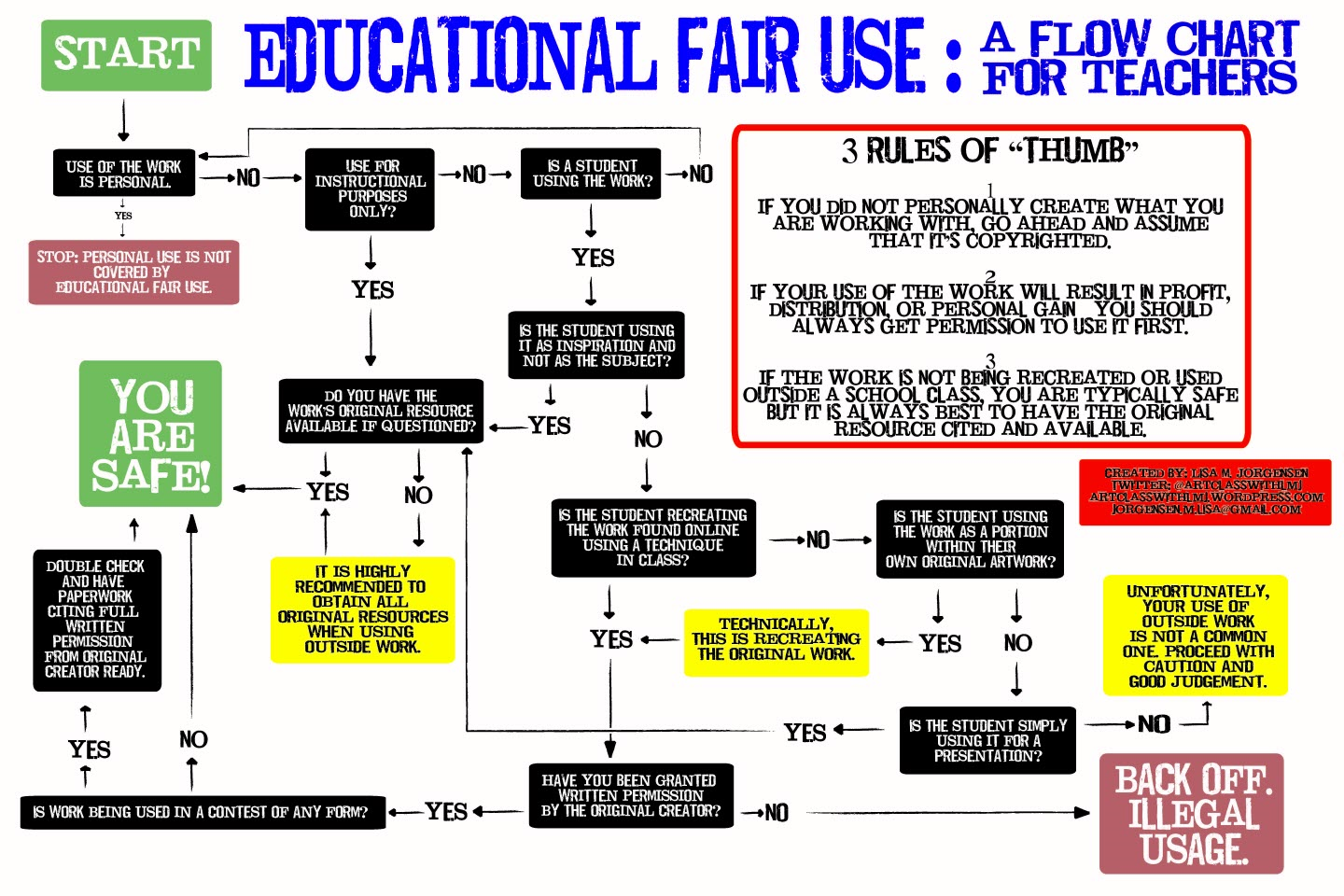
The following list of resources are valuable in that they provide detailed information on the history and current challenges we have to contend with on copyright law, fair use, intellectual property, and personal rights and property. They consists of short lectures and presentation from Youtube sites, to language on FERPA from the Department of Education, and links to other sites that students should use, that are free of charge, and free of copyright violation. The following are some basic definitions on the above.
Copyright is a legal protection afforded to the creators of original works of authorship such as literary works, drawings, art, music and dance.
Fair Use is any copying of copyrighted material done for a limited and “transformative” purpose, such as to comment upon, criticize, or parody a copyrighted work.
Intellectual Property is a work or invention that is the result of creativity, such as a manuscript or a design, to which one has rights and for which one may apply for a patent, copyright, trademark, etc.
Personal Rights and Privacy is not the result of the U.S. Constitution or the Bill of Rights, but it is addressed as a result over many landmark cases. Specifically, in the world of education, the rights of students are protected under The Family Educational Rights and Privacy Act (FERPA) (20 U.S.C. § 1232g; 34 CFR Part 99). This is a Federal law that protects the privacy of student education records. The law applies to all schools that receive funds under an applicable program of the U.S. Department of Education. FERPA gives parents certain rights with respect to their children's education records. These rights transfer to the student when he or she reaches the age of 18 or attends a school beyond the high school level.
https://www.youtube.com/watch?v=Uiq42O6rhW4 (Copyright and Fair Use Animation)
https://www.youtube.com/watch?v=QqGIewyq5Xs (Four Factors of Fair Use)
https://www.youtube.com/watch?v=_xpk28Rzmq4 (Everyday ways your personal privacy is under threat)
http://www2.ed.gov/policy/gen/guid/fpco/ferpa/index.html (FERPA policy)
http://www.copyright.gov/title17/92preface.html (Copyright Law)
http://www.ala.org/advocacy/copyright/teachact/distanceeducation (TEACH Act)
http://www.ifla.org/copyright-issues-for-libraries (Copyright Issues for Libaries)
https://www.unr.edu/Documents/research/RIO/Resources/FERPA%20Flowchart.pdf (FERPA Flowchart)
https://iapp.org/news/a/privacy-in-the-classroom-what-you-need-to-know-about-educational-software/ (IAPP Org Classroom Privacy)
https://www.ted.com/talks (TedTalks)
https://www.khanacademy.org/ (Khan Academy)
http://www2.ed.gov/free/index.html (Free Government Resources)
http://www.blogherald.com/2008/02/18/the-limitations-of-fair-use/ (Blog on Fair Use)
https://onlinelaw.wustl.edu/blog/case-study-am-records-inc-v-napster-inc/ (A&M Records v. Napster)
https://www.eff.org/issues/intellectual-property (Blog on Intellectual Property)
Process
The approach I took to put this toolkit together for Copyright, Fair Use and Personal Rights Privacy was done by assuming that my student audience had very little to no knowledge of these areas. The websites and links cover the basics, so I started out by providing their definitions. I then moved onto various links to websites.
The websites I provided included Youtube videos (both animated and included a lecture), Department of Education websites that are specific to the subject areas taught, blogs, a link to TedTalks and the Khan Academy as well. I wanted students to know that there are legal sites that exists that they can draw from for artworks, downloading images, and written works, without infringing on anyone else's work that exist in the public domain. I also provided a link to Creative Commons so that students know that there are places where teachers can go to in order to protect and share (if they choose to) their own creations.
I finally provided the following diagram that I hope will provide teachers with a "Important Points" on what Copyright, Fair Use and Personal Rights and Privacy entail.
| Copyright Law | Fair Use Act | Personal Rights and Privacy | |
| Law, Act, or Rule |
Copyright is a legal protection afforded to the creators of original works of authorship such as literary works, drawings, art, music and dance. According to the U.S. Copyright Office, a copyright gives the creator of a work the exclusive right to reproduce, sell and create derivative works from that creative work. The author of a new original work secures a copyright the moment he/she creates the work |
The doctrine that brief excerpts of copyright material may, under certain circumstances, be quoted verbatim for purposes such as criticism, news reporting, teaching, and research, without the need for permission from or payment to the copyright holder. |
Intellectual Property is a work or invention that is the result of creativity, such as a manuscript or a design, to which one has rights and for which one may apply for a patent, copyright, trademark, etc. FERPA is a Federal law that is administered by the Family Policy Compliance Office (Office) in the U.S. Department of Education (Department). 20 U.S.C. § 1232g; 34 CFR Part 99. FERPA applies to all educational agencies and institutions (e.g., schools) that receive funding under any program administered by the Department. |
| Limitations |
What does copyright mean?
|
|
Generally, schools must have written permission from the parent or eligible student in order to release any information from a student's education record. However, FERPA allows schools to disclose those records, without consent, to the following parties or under the following conditions:
|
| Additional Information |
Copyright begins when a work is created. It continues for your lifetime and for up to 70 years after your death. |
It;s smart to take only what you absolutely need, make sure that your use is for some kind of public good and that the use damages the copyright holder as little as possible. | FERPA rights transfer to the student when he or she reaches the age of 18 or attends a school beyond the high school level |
Evaluation
I believe the items I selected for my toolkit will help students understand copyright, Fair Use, Intellectual Property and Personal Rights because the links I provided are both informative and relative to today's digital environment. There are lawyers and educators that specialize in these areas of course, but for a novice, the information provided to students ranges from the rights on the copyright owners, to rights of educators through the TEACH Act, to the rights of the students privacy, their work and their records (FERPA). For this assignment, I utilized 15 different sites that hit on various topics related to the subject areas to also include a famous lawsuit between A&M Records and Napster over property rights. In short, every item listed in this toolkit is going to benefit the student, and the student will have a greater frame of reference in understanding how these laws and acts came about, and how they impact their learning now.
Conclusion
In conclusion, the Toolkit I prepared provides a list of resources on this Webquest that are valuable because they provide detailed information on the history and current challenges we have to contend with on copyright law, fair use, intellectual property, and personal rights in today's digital and letigious environment. As the use of technology increases, the likelihood of privacy infringement increases. This will continue to be a subject matter that is of great importance to our generation and future generations. This toolkit has information that provides definitions, historical perspectives, how the rules are applied today, and what happens when they are violated. Furthermore, they address what resources students have for obtaining images and other works that are part of the public domain and free of charge with no worry of infringing on others work. For the future, the protecting one's privacy rights will remain a challenge to be debated as some legislators and consumers believe that if you have nothing to hide, you don't need privacy, while others believe (as I do), that privacy is one of our most basic rights as human beings.
Having gone through the Ethics and Legal Issues course, the topics in this presentation are relevant to what was covered and the items I listed are the ones I found to be most useful. Furthermore, this is the first time in which I have used Webquest and found it to be extremely beneficial, and I certainly plan on using this in the near future with faculty where I work.
❌ Photo unavailable
Credits
References
Anonymous, Protecting the privacy of student education records. (1997). The Journal of School Health, 67(4), 139-140. Retrieved from http://search.proquest.com.proxy1.ncu.edu/docview/215677040?accountid=28180
Asllani, A. (2012). Privacy concerns in higher education. International Journal of Computer Science and Information Security, 10(2), 6-10. Retrieved from http://search.proquest.com.proxy1.ncu.edu/docview/1038456394?accountid=28180
Nelson, C. R., Barnett, G., Gorman, R. A., Reichman, H., Zurbriggen, E., et al. (2014). Defending the freedom to innovate: Faculty intellectual property rights after Stanford v. Roche. http://search.proquest.com.proxy1.ncu.edu/docview/1554587426?accountid=28180
Masson, S. R. (2012, March). Online HIghway Robbery: Is your intellectual PropertyUp for Grabs in the Online Classroom? Journal of Online Learning and Teaching,6(1), 1-9.
A&M Records vs. Napster https://onlinelaw.wustl.edu/blog/case-study-am-records-inc-v-napster-inc/
Copyright and Fair Use Animation https://www.youtube.com/watch?v=Uiq42O6rhW4
Copyright Issues for Libraries http://www.ifla.org/copyright-issues-for-libraries
Copyright Law http://www.copyright.gov/title17/92preface.html
Everyday as your personal privacy is under threat https://www.youtube.com/watch?v=_xpk28Rzmq4
Khan Academy https://www.khanacademy.org/
IAPP Org Classroom Privacy
https://iapp.org/news/a/privacy-in-the-classroom-what-you-need-to-know-about-educational-software/
Intellectual Property Blog https://www.eff.org/issues/intellectual-property
Limitations of Fair Use Blog http://www.blogherald.com/2008/02/18/the-limitations-of-fair-use/
FERPA Flowchart https://www.unr.edu/Documents/research/RIO/Resources/FERPA%20Flowchart.pdf
FERPA Policy http://www2.ed.gov/policy/gen/guid/fpco/ferpa/index.html
Four Factors of Fair Use https://www.youtube.com/watch?v=QqGIewyq5Xs
Free Government Resources http://www2.ed.gov/free/index.html
TEACH Act http://www.ala.org/advocacy/copyright/teachact/distanceeducation
TedTalks https://www.ted.com/talks