
Introduction
INTRODUCTION
People always perfom task by immitating what other peolple has already perfomed the issue behind is due to social learning.This work explain more about social learning theory.
Many theory explain why people behave as they do populized by personality doctrines depicted to be behaviors according to Bandura it was difficult to demonstrate that person psychodynamically oriented treatment benefited more than nontreated case(Bandura 1969a, begin1966).also resolved that behaviors highly affected by psychodynamic, man’s superior cognitive capacity, product of direct experience, environment determinants
¨Bandura’s Social Learning Theory posits that people learn from one another, via observation, imitation, and modeling. The theory has often been called a bridge between behaviorist and cognitive learning theories because it encompasses attention, memory, and motivation¨This work will much explain on this theory
Task
MEANING OF THE THEORY
Bandura’s Social Learning Theory posits that people learn from one another, via observation, imitation, and modeling. The theory has often been called a bridge between behaviorist and cognitive learning theories because it encompasses attention, memory, and motivation
People learn through observing others’ behavior, attitudes, and outcomes of those behaviors “Most human behavior is learned observationally through modeling: from observing others, one forms an idea of how new behaviors are performed, and on later occasions this coded information serves as a guide for action.” (Bandura). Social learning theory explains human behavior in terms of continuous reciprocal interaction between cognitive, behavioral, and environmental influences.
HISTORY OF THE THEORY
Behaviorism, with its emphasis on experimental methods, focuses on variables we can observe, measure, and manipulates, and avoids whatever is subjective, internal, and unavailable – i.e. mental. In the experimental method, the standard procedure is to manipulate one variable, and then measure its effects on another. All this boils down to a theory of personality that says that one’s environment causes one’s behavior. Bandura found this a bit too simplistic for the phenomena he was observing – aggression in adolescents – and so decided to add a little something to the formula: He suggested that environment causes behavior, true; but behavior causes environment as well. He labeled this concept reciprocal determinism:The world and a
person’s behavior cause each other. Later, he went a step further. He began to look at personality as an interaction among three "things:" the environment, behavior, and the person’s psychological processes. These psychological processes consist of our ability to entertain images in our minds, and language. At the point where he introduces imagery, in particular, he ceases to be a strict behaviorist, and begins to join the ranks of the cognitivists. In fact, he is
often considered a "father" of the cognitivist movement! Adding imagery and language to the mix allows Bandura to theorize much more effectively than someone like, say, B. F. Skinner, about two things that many people would consider the "strong suit" of the human species: observational learning (modeling) and self-regulation.
Normal
0
false
false
false
EN-US
X-NONE
X-NONE
/* Style Definitions */
table.MsoNormalTable
{mso-style-name:"Table Normal";
mso-tstyle-rowband-size:0;
mso-tstyle-colband-size:0;
mso-style-noshow:yes;
mso-style-priority:99;
mso-style-qformat:yes;
mso-style-parent:"";
mso-padding-alt:0in 5.4pt 0in 5.4pt;
mso-para-margin-top:0in;
mso-para-margin-right:0in;
mso-para-margin-bottom:8.0pt;
mso-para-margin-left:0in;
line-height:107%;
mso-pagination:widow-orphan;
font-size:11.0pt;
font-family:"Calibri","sans-serif";
mso-ascii-font-family:Calibri;
mso-ascii-theme-font:minor-latin;
mso-fareast-font-family:"Times New Roman";
mso-fareast-theme-font:minor-fareast;
mso-hansi-font-family:Calibri;
mso-hansi-theme-font:minor-latin;}
Process
BOBO DOLL EXPERIMENT
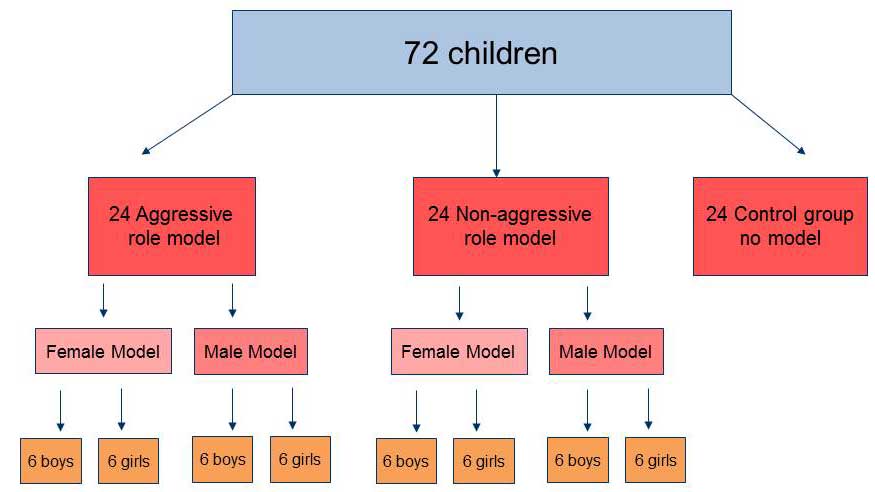
A lab experiment was used, in which the independent variable (type of model) was manipulated in three conditions:
- Aggressive model shown to 24 children
- Non-aggressive model shown to 24 children
- No model shown (control condition) - 24 children
Stage 1: Modeling
In the experimental conditions children were individually shown into a room containing toys and played with some potato prints and pictures in a corner for 10 minutes while either:
- 24 children (12 boys and 12 girls) watched a male or female model behaving aggressively towards a toy called a 'Bobo doll'. The adults attacked the Bobo doll in a distinctive manner - they used a hammer in some cases, and in others threw the doll in the air and shouted "Pow, Boom".
- Another 24 children (12 boys and 12 girls) were exposed to a non-aggressive model who played in a quiet and subdued manner for 10 minutes (playing with a tinker toy set and ignoring the bobo-doll).
- The final 24 children (12 boys and 12 girls) were used as a control group and not exposed to any model at all.
Stage 2: Aggression Arousal
All the children (including the control group) were subjected to 'mild aggression arousal'. Each child was (separately) taken to a room with relatively attractive toys.
As soon as the child started to play with the toys the experimenter told the child that these were the experimenter's very best toys and she had decided to reserve them for the other children.
Stage 3: Test for Delayed Imitation
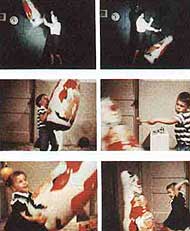
• The next room contained some aggressive toys and some non-aggressive toys. The non-aggressive toys included a tea set, crayons, three bears and plastic farm animals. The aggressive toys included a mallet and peg board, dart guns, and a 3 foot Bobo doll.
• The child was in the room for 20 minutes and their behavior was observed and rated though a one-way mirror. Observations were made at 5-second intervals therefore giving 240 response units for each child.
• Other behaviors that didn’t imitate that of the model were also recorded e.g. punching the Bobo doll on the nose
RESULT.
• Children who observed the aggressive model made far more imitative aggressive responses than those who were in the non-aggressive or control groups.
• There was more partial and non-imitative aggression among those children who has observed aggressive behavior, although the difference for non-imitative aggression was small.
• The girls in the aggressive model condition also showed more physical aggressive responses if the model was male, but more verbal aggressive responses if the model was female. However, the exception to this general pattern was the observation of how often they punched Bobo, and in this case the effects of gender were reversed.
• Boys were more likely to imitate same-sex models than girls. The evidence for girls imitating same-sex models is not strong.
• Boys imitated more physically aggressive acts than girls. There was little difference in the verbal aggression between boys and girls.
Evaluation
There are some advantages of the experiment
1. Experiments are the only means by which cause and effect can be established. Thus, it could be demonstrated that the model did have an effect on the child's subsequent behavior because all variables other than the independent variable are controlled.
2. It allows for precise control of variables. Many variable were controlled, such as the gender of the model, the time the children observed the model, the behavior of the model and so on.
3. Experiments can be replicated. Standardized procedures and instructions were used, allowing for replicability. In fact the study has been replicated with slight changes, such as using video and similar results were found
EDUCATION IMPLICATION OF THE THEORY
Social learning theory has numerous implications for classroom use.
Students often learn a great deal simply by observing other people. When the student observing some people’s action example when then they watch people who are aggressive even in the film the student learn much faster.
Describing the consequences of behavior is can effectively increase the appropriate behaviors and decrease inappropriate ones. Social respect can be much increase through social learning
This can involve discussing with learners about the reward and consequences of various behaviors.
Modeling provides an alternative to shaping for teaching new behaviors. Instead of using shaping, which is operant conditioning; modeling can provide a faster, more efficient means for teaching new behavior. To promote effective modeling a teacher must make
Sure that the four essential conditions exist; attention, retention, motor reproduction, and motivation.
Teachers and parents must model appropriate behaviors and take care that they do not model inappropriate behaviors.
Teachers should expose students to a variety of other models. This technique is especially important to break down traditional stereotypes.
Students must believe that they are capable of accomplishing school tasks. Thus it is very important to develop a sense of self efficacy for students. Teachers can promote such self-efficacy by having students receive confidence-building messages watch others be successful, and experience success on their own..
Teachers should help students set realistic expectations for their academic accomplishments. In general in a class that means making sure those expectations are not set too low. If they want to realistically challenge their students. However, sometimes the task is beyond a student's ability, example would be the cancer group.
Self-regulation techniques provide an effective method for improving student behavior
Conclusion
¨From the theory above we learned that People learn through observing others’ behavior, attitudes, and outcomes of those behaviors “Most human behavior is learned observationally through modeling: from observing others, one forms an idea of how new behaviors are performed, and on later occasions this coded information serves as a guide for action.” (Bandura). Social learning theory explains human behavior in terms of continuous reciprocal interaction between cognitive, behavioral, and environmental influences. This summarize that what we perform or we do it we always immitating from other people That is, children learn social behavior such as aggression through the process of observation learning - through watching the behavior of another person