
Introduction

Congratulations!!
You are a proud new parent of a brand new baby! Apart from all the excitement and dirty diapers you are now responsible for guiding this person through their critical developmental years. This is not an easy task! Your job is to research and apply what Child Developmental theorists you believe to be the most influential to how we see child development today in terms of social and cognitive development. Then you must embark on the difficult task of applying this new found research to your parenting decisions. Good luck!!
Task

You will name your baby then research and make an informed and insightful decision on how best to raise your baby to become a constructive member of society. Individually, as new mommies and daddies, you will be assigned a theorists who has contributed to the understanding of how children develop to research. You will not be alone, as you will be placed in an expert group to help guide your information to get a better understanding of your theorist and their theories. Then, you will get back together with your parental group and share with them the information you have uncovered. With your parental group you will then create a powerpoint presentation displaying your decisions on how you are going to raise your child to meet their developmental needs in terms of toys, games, rearing and discipline. You will need to justify and defend why you made the decisions you did and connect them to the theories you have learned about. You will then present your powerpoint to the class. Have fun!
Process

Step One: The first task of your parental group, of four, is to decide on the sex of your baby and your baby's name!! Get creative with the baby's last name by choosing a few letters from everyone's last name in the group. Then click the website below to choose a name for your baby!
http://www.babycenter.com/celebrity-baby-name-generator
Step Two: Decide which group member will research which theorist and then individually look at the websites assigned to your theorist.
Piaget:
http://muskingum.edu/~psych/psycweb/history/piaget.htm
http://www.webmd.com/children/piaget-stages-of-development#1
http://webspace.ship.edu/cgboer/piaget.html
Vygotsky:
http://www.simplypsychology.org/vygotsky.html
http://www.muskingum.edu/~psych/psycweb/history/vygotsky.htm
Erickson:
http://muskingum.edu/~psych/psycweb/history/erikson.htm
http://www.learning-theories.com/eriksons-stages-of-development.html
Bowlby:
http://www.simplypsychology.org/attachment.html
http://www.slideshare.net/preethibalan9/bowlbys-theory-of-attachment
Presentation graphic organizer
Step Three: Individually complete a graphic organizer outlining your theorists theory and important information including critisisms.
Step Four: Create a handout with your expert group and make a copy for each of your fellow parents.
Step Five: Back in your parental group, educate your fellow parents on what you have learned pertaining to your theorist.
Step Six: Together, construct how you are going to raise your child and what kind of environment you will raise him/her in on the basises of games/toys and guidance/discipline for the first 5 years of their life.
Step Seven: Justify why you made the decisions you did.
Step Eight: Connect your decisions to one of the theories studied.
Step Nine: Create a media presentation to show the class your finished product outlining information from steps 6, 7 and 8.
Step Ten: Present to class.
Step Eleven: Evaluate your group member's participation.
Evaluation
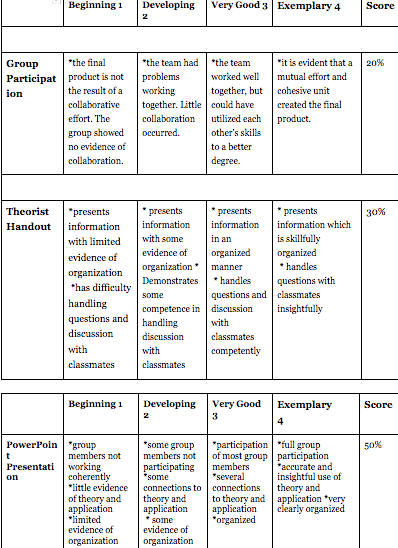
Evaluation Rubric
Conclusion

Yay! Great job! You have raised a happy, healthy and well adjusted child thanks to all your research skills. You now have a better understanding of the developmental theories of Piaget, Erikson, Bowlby and Vygotsky. Hopefully, you will now take the knowledge you have gained and put it to use with children you come in contact with both now and in the future.
Teacher Page
Focus: This WebQuest is designed to be used in a high school Child Development class. This WebQuest focuses on cooperative learning strategies, with a modified jigsaw strategy of using expert groups being used. Students teaching students is a great way to hold students accountable for their own and other's learning.
Objectives/Goals: The goal of this WebQuest is for students to be introduced to the theory's of Piaget, Vygotsky, Bowlby and Erikson.
Students will:
1) Describe Piaget's theory of cognitive development.
2) Identify Erikson's psychosocial of development theory.
3) Explain Bowlby's theory of attachment.
4) Describe Vygotsky's sociocultural theory.
Prerequisite Skills: Students need to be familiar with basic web browsing skills, basic word processing skills and knowledge of presentation programs.
Time Required: This WebQuest designed for 5, 48 minute classes and 2, 48 minutes classes for presentations.
Technology Required: One computer per student, as well as access to a printer.
Credits: Shannon Bingham, whose WebQuest was the basis for this one.