
Introduction
The activities found in this WebQuest have been designed to aid Kindergarten students in understanding number quantities. These activities have been designed to introduce Kindergarten students to the idea that numbers are represented by a certain set. These skills directly align with the West Virginia Content Standards and are a critical part in a Kindergarten students overall mathematical foundation.
|
Understanding(s): Students will understand that verbal numbers also represent actual sets of objects. Students will also understand that each number representation does not change (four always means four objects).
|
Essential Question(s): How can I show a number that I say? How can I show how many when I see a written number?
|
|
Students will know... Students will know that number words and written numerals can be represented through visuals sets.
|
Students will be able to... Match written numerals with visual sets. Verbally count and physically represent how many.
|
Task
Today you are going to learn how to show how much when you hear or see a certain numeral. When you ask for three stickers or five crayons you get a certian set every time. During this lesson you will be making different sets of numbers through a whole class activity. Then you will be paired up to play a memory matching game where you will match a written number with a set of stickers. Finally, you will be asked to look at a number and show that many using connection blocks. Don't worry there will be plenty of practice and fun along the way!

Process
Let's learn to show how many!
First, let's start with a song!
- Click on the video below to begin
[video:https://www.youtube.com/watch?v=d7klXv1KoBM&list=PLFcoQG775LexxLG8R8cXE… align:center]
Next, let's play a class game!
In order to get our brains thinking about numbers and physically recognizing how many we will use our whole bodies to count.
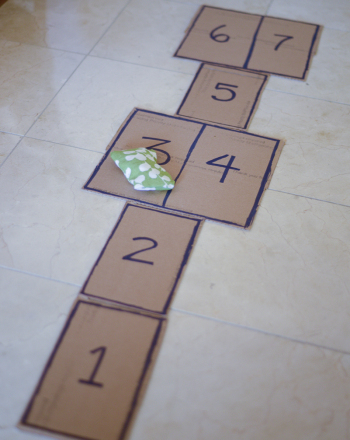
Number Hopscotch
- The class will be divided up into groups of 4 or 5 students.
- Each group will be given a large cardboard hopscotch board and a single bean bag.
- Groups will toss the bean bag onto the board and then hopscotch to the bag, pick it up and return to the starting point.
- While hoping students will count their hops outloud both to and from the bean bag that they tossed.
Now let's really get into it!
- The class will be assembled for a whole group lesson.
- Using large number cards 1-9 display numbers randomly.
- You will be randomly chosen to represent a displayed number anyway you choose, various methods could include: fingers, peers, blocks, drawings or claps/taps.
- When a number is displayed several students will be chosen to represent the same number but the method can not be repeated. This will help us recognize that the number hasn't changed even though we showed how many differently.
Show what you know!
Finally, you will be paired up to play Number Memory. Each set of cards has a single written number and a matching card that shows how many with stickers. Feel free to count the stickers to make sure they match!

Evaluation
The Kindergarten students will be evaluated throughout the WebQuest to ensure mastery in number quantity recognition. At the end of this particular activity students will be given an individual assessment that requires them to look at a sentence strip with randomly written numbers 1-10 written on it. Using the connection blocks they will have to represent how many for each number written and then they will be asked to order the sets either from biggest to smallest or vise versa and to explain why they ordered them that way.

Conclusion
We did it!
We learned all about showing "how many" in multiple ways.
Keep up the great work!

Credits
Thank you CreateWebQuest.com for making this presentation possible.
Images were reteived from:
http://www.education.com/activity/article/Number_Memory_kindergarten/
http://www.education.com/activity/article/indoor-hopscotch/
Content Standards retrieved from:
http://apps.sos.wv.gov/adlaw/csr/readfile.aspx?DocId=27353&Format=PDF
Video retrieved from:
https://www.youtube.com/watch?v=d7klXv1KoBM&list=PLFcoQG775LexxLG8R8cXEwGOJAbDFGx5u&index=9
Teacher Page
This WebQuest has been designed to introduce Kindergarten students to number quantities. The activities have been aligned to the West Virginia Content Standards listed below.
M.K.4 – Understand the relationship between numbers and quantities; connect counting to cardinality.
a. When counting objects, say the number names in the standard order, pairing each object with one and only one number name and each number name with one and only one object.
b. Understand that the last number name said tells the number of objects counted and the number of objects is the same regardless of their arrangement or the order in which they were counted.
c. Understand that each successive number name refers to a quantity that is one larger.
M.K.5 – Count to answer questions (e.g., “How Many?”) about as many as 20 things arranged in a line, a rectangular array, a circle, or as any as 10 things in a scattered configuration; given a number from 1-20, count out that many objects.
M.K.6 – Identify whether the number of objects in one group is greater than less than, or equal to the number of objects in another group (e.g., by using matching and counting strategies).
Assessment Rubric:
At Standard | Developing | Emergent |
|
|
|
Higher Order Thinking is addressed in two areas in this WebQuest. First, during the whole class activity students will utilize higher order thinking skills when they are asked to examine the number being shown and then formulate a unique visual representation. Second, during the assessment students are asked to demonstrate understanding of number quantities and then compare and reorgnaize their quantity sets.
Also, during both of these activities students will be prompted with deeper level thinking questions such as:
What would happen if you added/took away...?
How could you make that into ...?
How is ... similar to ...?
What would you suggest if I wanted to make ... from ...?
How could you rank these sets from biggest to smallest/smallest to biggest?