
Introduction

What will your future home look like from inside?
How many rooms will it have?
Today will be the day to create that amazing home! Take a minute or two to watch this video clip of an Architect at work.
[video:https://www.youtube.com/watch?v=DOV3bYfQ8ys align:center]
My future architect let us continue on this journey!(Click on Task below to move on)
Task
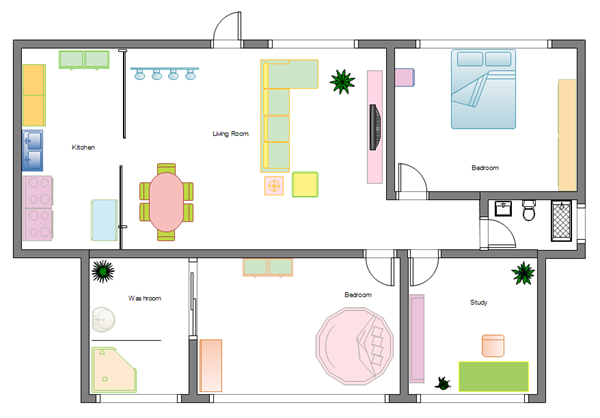
Your task will be to create the floor plan to your future house with the use of 2-Dimensional shapes. You will need to have an understanding of the 2-dimesnional shapes taught in class by name and their properties. Once this understanding has been shown through the use of practice in class and homework, you and your partner will need to think about how many rooms you will have and how these shapes will be used. This will be presented to your classmates through the use of PowerPoint. It will be fun to see what your home looks like and how it differs from your peers.
Example of a floor plan:
(Click on Process below to move on)
Process
Hey guys these are you instructions, please be sure to read everything before clicking on the links!
1) Practice with 2-dimensional Jeopardy Game
2) Watch this with your partner: Powerpoint Review
3) Review Teacher Powerpoint and be sure to complete Quick Assessment at the end of the PowerPoint: Two-Dimensional Figures
Once your done, get with your partner and start on your Powerpoint Presentation:
•You first need to think of your future home, how do you want it to look? How many rooms do you want to have? What would you have inside of your rooms?•Time to design, you will need to create a PowerPoint with a slide for one or more rooms of your home.•You will need to create your room using the 2-dimensional shapes that you have learned about.•You need to describe what shape you have used by their names and their properties.•You will be asked to record yourself describing the names and their properties.•This project will be displayed for your classmates to view.**You will need to use the Evaluation Rubric to see how this Multimedia Project will be graded. Use it as a guide, to ensure that you have everything required in your PowerPoint!**(Click on Evaluation below to move on)
Evaluation
|
|
CATEGORY |
13-10 |
9-6 |
5-3 |
2-0 |
|
Originality |
Product shows a large amount of original thought. Ideas are creative and inventive. |
Product shows some original thought. Work shows new ideas and insights. |
Uses other people\'s ideas (giving them credit), but there is little evidence of original thinking. |
Uses other people\'s ideas, but does not give them credit. |
|
Attractiveness |
Makes excellent use of font, color, graphics, effects, etc. to enhance the presentation. |
Makes good use of font, color, graphics, effects, etc. to enhance to presentation. |
Makes use of font, color, graphics, effects, etc. but occasionally these detract from the presentation content. |
Use of font, color, graphics, effects etc. but these often distract from the presentaion content. |
|
Content |
Covers topic in-depth with details and examples. Subject knowledge is excellent. |
Includes essential knowledge about the topic. Subject knowledge appears to be good. |
Includes essential information about the topic but there are 1-2 factual errors. |
Content is minimal OR there are several factual errors. |
|
Organization |
Content is well organized using headings or bulleted lists to group related material. |
Uses headings or bulleted lists to organize, but the overall organization of topics appears flawed. |
Content is logically organized for the most part. |
There was no clear or logical organizational structure, just lots of facts. |
|
Use of Manipulatives |
Student always listens and follows directions and only uses manipulatives as instructed. |
Student typically listens and follows directions and uses manipulatives as instructed most of the time. |
Student sometimes listens and follows directions and uses manipulatives appropriately when reminded. |
Student rarely listens and often \"plays\" with the manipulatives instead of using them as instructed. |
|
Explanation |
Explanation is detailed and clear. |
Explanation is clear. |
Explanation is a little difficult to understand, but includes critical components. |
Explanation is difficult to understand and is missing several components OR was not included. |
|
Completion |
All problems are completed. |
All but one of the problems are completed. |
All but two of the problems are completed. |
Several of the problems are not completed. |
|
Mathematical Terminology and Notation |
Correct terminology and notation are always used, making it easy to understand what was done. |
Correct terminology and notation are usually used, making it fairly easy to understand what was done. |
Correct terminology and notation are used, but it is sometimes not easy to understand what was done. |
There is little use, or a lot of inappropriate use, of terminology and notation. |
RubiStar
Rubric Made Using:
RubiStar ( http://rubistar.4teachers.org )
(Click on conclusion below to move on)
Conclusion
My fellow learners, by the end of this activity you should be able to recognize 2-dimensional shapes and their properties. You will also be full of exciting knowlege when it comes to the use of Power Point. Both of these pieces of information will be used when you move on in your journey of education and life!
 (Click on Credits below to move on)
Credits

The Websites utilized in this Webquest are as follows:
https://www.youtube.com/watch?v=DOV3bYfQ8ys
http://rubistar.4teachers.org
http://www.esc20.net/users/0104/STAAR%20Grade%205%20MathREVISED.pdf
Teacher Page
Standards that are reached for this activity:
SUBJECT: 5th Grade Math
State Standard Reporting Category 3: 5.5A Classify two-dimensional figures in a hierarchy of sets and subsets using graphic organizers based on their attributes and properties.
2016 ISTE Standards for Students
Empowered Learner
1c. Students use technology to seek feedback that informs and improves their practices and to demonstrate their learning in a variety of ways.
1d. Students understand the fundamental concepts of technology operations, demonstrate the ability to choose, use and troubleshoot current technologies and are able to transfer their knowledge to explore emerging technologies.
Knowledge Constructor
3a. Students plan and employ effective research strategies to locate information and other resources for their intellectual or creative pursuits.
3b. Students elevate the accuracy, perspective, credibility and relevance of information, media, data, or other resource.
3c. Students curate information from digital resources using a variety of tools and methods to create collections of artifacts that demonstrate meaningful connections or conclusions.
Innovative Designer
4a. Students know and use a deliberate design process for generating ideas, test theories, creating innovative artifacts or solving authentic problems.
4d. Student exhibits a tolerance for ambiguity, perseverance and the capacity to work with open-ended problems.
Creative Communicator
6c. Students communicate complex ideas clearly and effectively by creating or using a variety of digital objects such as visualizations, models, or simulations.
Global Collaborator
7b. Students use collaborative technologies to work with others, including peers, experts or community members to examine issues and problems from multiple viewpoints.
7c. Students contribute constructively to project teams, assuming various roles and responsibilities to work effectively toward common goals.