
Introduction
 Has anyone in your life, teachers, parents, friends, ever asked you this big question:
"What do you want to be when you grow up?"
Some of you may already know the answer to this question, and some of you may still be trying to make your minds. That's okay if you haven't dediced yet, you still have time to make up your minds, but it's never too early to start thinking about what you want to become. It's important to discover what kinds of careers are out there, even if you're not sure it would be something you like or feel interested in.
You can be more than one kind of artist at a time, but for this WebQuest, we are going to chose one for our focus.
Here's a list of art careers to help you out with your research. If you find one that's not on this list, ask your teacher.
|
List of Art Careers
|
31. Jewelry Maker/Designer |
Task
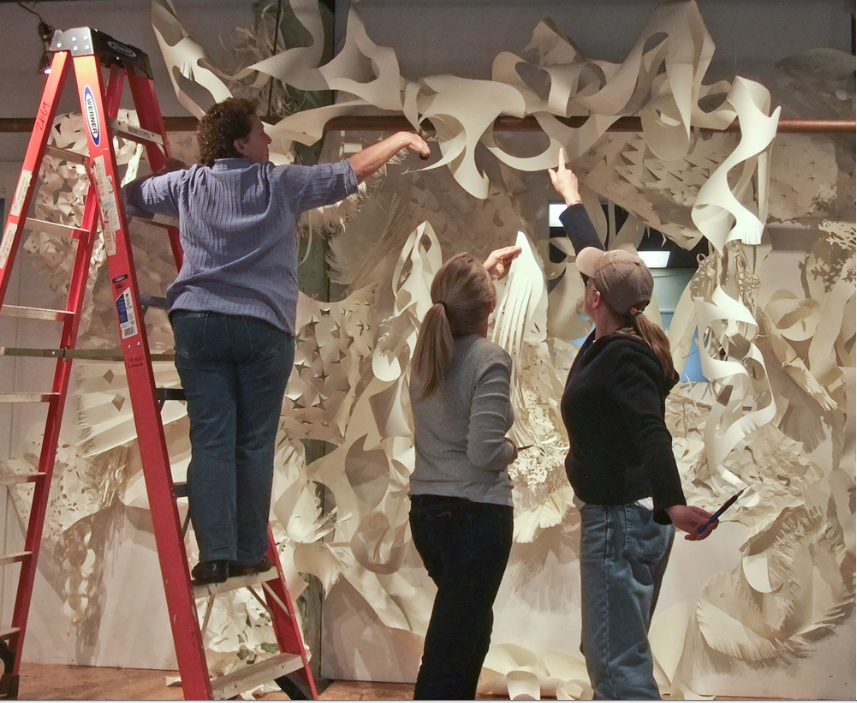 If you ever decide you want to go to college, it helps to be prepared, or have an idea of what direction you should go. Even if you know what you want to do when it comes time to go to college, you might still change your mind!
There are a lot of careers out there, but for this art class, we are going to focus on visual art careers, and we are going to do a WebQuest to find answers to this question.
So imagine you're already a junior or a senior in high school. Art is your t
Your mission, is to choose what kind of artist you want to be, do research on the art career you chose, create a career map, and an artwork related to your art career. Finally, you will write a hing, and you want to pursue some kind of career in art. Ask yourself these questions: What kind of art can you do? What are your talents? What kind of artist are you going to be?
Then you will write a blog post to reflect on your chosesn art career path and inform your classmates about what you've learned.
Process
To accomplish your mission, you will complete 6 steps:
- Choose an art career.
- Complete questions on the worksheet finding the information on the Internet.
- Create a career map using bubbl.us.
- Brainstorm/sketch for an artwork related to your art career.
- Create an artwork related to your art career.
- Write a reflection in a blog post on Art Career WebQuest Blog and include your career map and a picture of your completed artwork.
1. Choose an art career.
Review the list on the intro page of art careers. If you can't decide, write down a few careers that look interesting. Take a few minutes to google each of the careers you wrote down to get more information about them so you can narrow down your choices. Then, choose one art career to focus on.
2. Complete questions on the worksheet finding the information on the Internet.
Here is the worksheet. It is a Microsoft Word document. Click on the file, open it and print a copy for yourself to work on.
Follow the instructions on the worksheet and complete the first five questions using the links on this page as a guide. If you are unable to find information using the following links, use the search engine, Google, Internet Explorer to look up more information on the career.
3. Create a career map using bubbl.us.
Using the information you have gathered answering the five questions on the worksheet, sketch a basic concept map on your art career. Set it up, and plan how you will make you career map in bubbl.us. It's better to start out with a sketch first, then create the map in bubbl.us.
- When your concept map sketch is completed, go to bubbl.us and create a username.
- Write it on the worksheet and on your concept map sketch so you remember it.
- Begin creating your career map. Make sure that you make it with the career of choice in the center bubble with the information stemming from the central idea, and then branching off into other bubbles with related concepts, like a tree.
- Color code the concept map so it is clear to understand and follow. It should not be every color of the rainbow. The colors should be used to help orgnaize the information you found.
- Websites you used to find the information should be included within the bubbles. This allows viewers to easily access where you got the information from if they decide they want to look at that site. It also is a way to cite where you got the information from.
When you’re finished with the concept map, save it as a jpg (image file) and place it in your student folder. You will insert this image into your blog post in step 6.
It is your responsibility to keep track of your username and password.
4. Brainstorm/sketch for an artwork related to your art career.
Complete the last section of the worksheet. Think about what media might lend itself best to an artwork related to your career.
- What type of artwork would make the most sense to create in relation to my art career?
- Should my artwork be 2D or 3D?
- What should the artwork look like? (Consider the elements of art.)
- What is my artwork trying to show/express?
Supplies Available for Use:
Pencils, colored pencils, crayons, markers, rulers, scissors, pastels, charcoal, cardboard, tempera paint, watercolors, popsicle sticks, poster board, construction paper, drawing paper, tissue paper, decorative paper (shiny), masking tape, yarn, plastic needles, elemers and tacky glue, gluesticks, buttons.
5. Create an artwork related to your art career.
Use all of the information you gathered in step 4 to create your artwork. The artwork should relate to your art career. The artwork should be completed within 3 class periods. Your grade will reflect time spent on task, patience and effort applied to the artwork and whether or not the idea for the artwork shows originality and creativity. Use your time wisely.
When you are finished with your artwork, your teacher will take a digital picture of it. Place this picture in your student folder and put it in your blog post.
6. Write a reflection in a blog post and include your career map and a picture of your completed artwork.
When the previous five steps of the project are completed write a reflection about the project in paragraph form responding to the following items:
- What did you learn about your art career that you didn’t know before?
- Do you think you might pursue this art career in your future, why or why not?
- Describe your artwork and how it relates to the art career you chose.
- Why did you choose the medium you did for your artwork?
- If you could redo any part of this project, what would it be any why?
- How do you feel this WebQuest was beneficial?
The reflection should be free of grammatical and spelling errors and should clearly answer all of the above questions. Go to the Art Career WebQuest Blog and post your reflection. Attach your career map and an image of your artwork.
Evaluation
| 100 points |
Excellent |
Passing |
Insufficient |
|---|---|---|---|
|
Career Map 40 points |
Career map includes information from all 5 questions and includes all information entered on worksheet All bubbles on career map include websites links Career map is color coded, and organized. |
Career map includes information from 4 questions and is missing some information from the worksheet. Not all bubbles on career map include links. Career map is color coded, but not enough colors, or the same colors were used for coding different concepts. |
Career map includes information from all 3 or less pertinent questions and includes no extra valuable information from worksheet. No on career map include websites where information was found. Career map is not color coded or organized. |
|
Artwork 40 points |
Artwork is related to the art career. Artwork is unique and displays originality. The artwork was completed on time and with concern for craftsmanship, and attention to detail. |
Artwork is somewhat related to the art career. Artwork demonstrates originality. The artwork was completed with average craftsmanship, and attention to detail. The artwork was late, but complete. |
Artwork is not related to the art career. Artwork shows little evidence of original thought. The artwork lacks finishing or concern for craftsmanship or detail. Student did not complete the assignmentl. The artwork shows not use of time for completion. |
|
Blog Post/Reflection 20 points |
Blog post includes a well-written reflection in paragraph form that includes answers to all reflection questions with no grammatical or spelling errors. Blog post includes image of career map and artwork. |
Blog post includes a well-written reflection in paragraph form that includes answers to some reflection questions with few grammatical or spelling errors. Blog post includes only image of career map or artwork. |
Blog post includes a well-written reflection in paragraph form that includes answers to the reflection questions with no grammatical or spelling errors, but does not include an image of career map or artwork. Or blog post includes an image of career map and artwork, but contains many gramatical and spelling errors, or is not well written. |
Conclusion
 Congratulations, you have successfully completed your WebQuest, and now you more than you did before about art, and it's many winding paths. You did a lot of work to get here, and you should pat yourself on the back for completing this WebQuest.
Hopefully, you learned something you didn't know before about visual arts. Maybe art isn't your thing, and you want to learn about something else you could be and do when you grow up. If you decided you do not like visual arts, at least you have learned how to research careers, make choices, organize your findings,think about what you have learned, and share it with others. You have learned how to use the internet as a way to find information you need. You can create a mindmap for whatever career you choose to explore.
(Teacher's Note) Some aspects of this lesson may be subject to change. Not all students may be able to complete the steps or have prior skills. I would change the website resources for areas such as bubbl.us, if necessary, or make accomodations for special needs students. Some parts of the lesson could be omitted or simplified to make it more accessible. Additional teaching on how to use the website bubbl.us may be required, or a separate lesson prior to this one may be needed so students can better complete the WebQuests assignment.
Credits
Art Career Webquest, Brown, M.(2013).Boise State University, Department of Educational Technology, Retrieved on June 23, 2016 from http://edtech2.boisestate.edu/mollibrown/502/webquest/intro.html
Artist at Work Retrived on June 23, 2016 from https://www.dreamstime.com/photos-images/cartoon-artist-palette-brush.html#details23406730 ID 23406730 © Alexandra Petruk | Dreamstime.com
Image retrieved on June 23, 2016 from http://www.fsfaboston.com/growingagallery/
Image on June 23, 2016 retrieved from http://www.papercitymag.com/arts/drawing-attention-two-texas-artists-work-wonders-graphite-command-notice/
Image on June 23, 2016 https://gooseberry.blender.org/artists-at-work-and-making-the-video/
Teacher Page
Which Visual Arts Career Should I Choose?
Brenan Searain
Fifth-Sixth Grade
Visual Arts
Content Area: Visual Arts | ||
Standard: 4. Relate and Connect to Transfer | ||
Prepared Graduates:
| ||
| ||
Grade Level Expectation: Sixth Grade |
| |
Concepts and skills students master: |
| |
1. Critical thinking in the arts transfers to multiple lifelong endeavors |
| |
Evidence Outcomes | 21st Century Skills and Readiness Competencies |
|
Students can:
| Inquiry Questions:
|
|
Relevance and Application:
|
| |
Nature of Visual Arts:
|
|
ISTE-Nets Student Standards
3. Research and information fluency
Students apply digital tools to gather, evaluate,
and use information.
a. Plan strategies to guide inquiry
b. Locate, organize, analyze, evaluate, synthesize,
and ethically use information from a variety of
sources and media
c. Evaluate and select information sources and
digital tools based on the appropriateness to
specific tasks
d. Process data and report results
4. Critical thinking, problem solving,
and decision making
Students use critical thinking skills to plan
and conduct research, manage projects, solve
problems, and make informed decisions using
appropriate digital tools and resources.
a. Identify and define authentic problems and
significant questions for investigation
b. Plan and manage activities to develop a solution
or complete a project
c. Collect and analyze data to identify solutions
and/or make informed decisions
d. Use multiple processes and diverse
perspectives to explore alternative solutions
6. Technology operations and concepts
Students demonstrate a sound understanding
of technology concepts, systems, and operations.
a. Understand and use technology systems
b. Select and use applications effectively
and productively
c. Troubleshoot systems and applications
d. Transfer current knowledge to learning
of new technologies
Objective:
Students will use the internet to find and research an art career that interests them, compile pertinent information about it, create a career concept map using bubbl.us, create an artwork that demonstrates their art career of choice, and reflect on their career in a blog post.