
Introduction
“Harlem"
What happens to a dream deferred?
Does it dry up
like a raisin in the sun?
Or fester like a sore--
And then run?
Does it stink like rotten meat?
Or crust and sugar over--
like a syrupy sweet?
Maybe it just sags
like a heavy load.
Or does it explode?”
― Langston Hughes
 Langston Hughes was one of the most famous poets of Harlem, he wrote during the 1920s and 1930s, when there was an explosion of African American writers and poets, writing and publishing during the Harlem Renaissance. Hughes was concerned with portraying the lives of the members of the African American community. He wanted to highlight their concerns and the challenges they faced in America at that time, including racism.
Jazz music was popular during the Harlem Renaissance and was loved by many in the African American community. Hughes loved jazz music and used some of its' elements to incoporate within his poetry.

As you begin your study of Langston Hughes and his impact on the Harlem Renaissance, I want you to reflect on his poetry and make a personal connection to your life? What are your dreams, your fears, your challenges, and your hope for the future? What positive changes can you make within the world?
Task
"An artist must be free to choose what he does, certainly, but he must also never be afraid to do what he might choose." -Langston Hughes
You will assume the role of an 1920-30's Harlem Renaissance artist (Poet, writer, artist or exhibitionist) and imagine you are going to showcase your creative piece to an audience. Be sure to research this artist in order to assimilate his/her style, form, and objective. You will discuss why you chose this individual and how you will make your own impact on the world.

Process
"I have discovered in life that there are ways of getting almost anywhere you want to go, if you really want to go".- Langston Hughes
Step 1: Research Harlem Renaissance artist
-What is his/her craft?
-What impact did he/she have on the Harlem Renaissance?
-What were the defining points in his/her life?
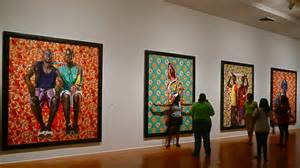
Step 2:Visit local Art museum and identify the Harlem Renaissance artists
- Study presented artwork/drawings
-Document findings
-Write down Questions and research about particular painting of interest
-Link to social reform(1920-1930)
OR
Visit Library and Locate Audio media section for Harlem Renaissance Music
-Identify the style/form
-Research song and identify the musician's objective/intent
-Link to social reform(1920-1930)
-Take time to set up an appointment with a museum curator and interview them. Create a list of questions before you go to the museum. Discuss their decision-making process.
Step 3: Ask yourself questions..
-Who is your artist?
-What did he/she stand up for during the Harlem Renaissance?
-How were they similar to Langston Hughes?
-How did he/she make a difference in the world?
Step 4: Create a creative representation of your artist by using Prezi/powerpoint, Drawings, musical demonstrations, visual media (short clips) and etc.
Step 5: Follow Evaluation rubric
Helpful Resources:
http://www.poetryoutloud.org/poet/langston-hughes
http://historyoftheharlemrenaissance.weebly.com/artists.html
http://www.americanart.si.edu/exhibitions/online/aaa/
http://www.artcyclopedia.com/history/harlem-renaissance.html
Evaluation
Please Follow the Link Below to see Rubric:
http://ms-ingalls-wiki-la.wikispaces.com/file/view/Bio+PowerPoint+Rubri…
Conclusion
*Stay Motivated!!
*Enjoy the pathway to learning
*Be the change you want to see in the world!!
Credits
Teacher Page
ISTE Standards
1. Creativity and innovation
Students demonstrate creative thinking, construct knowledge, and develop innovative products and processes using technology.
Apply existing knowledge to generate new ideas, products, or processes
Create original works as a means of personal or group expression
Use models and simulations to explore complex systems and issues
Identify trends and forecast possibilities
2. Communication and collaboration
Students use digital media and environments to communicate and work collaboratively, including at a distance, to support individual learning and contribute to the learning of others.
Interact, collaborate, and publish with peers, experts, or others employing a variety of digital environments and media
Communicate information and ideas effectively to multiple audiences using a variety of media and formats
Develop cultural understanding and global awareness by engaging with learners of other cultures
Contribute to project teams to produce original works or solve problems
3. Research and information uency
Students apply digital tools to gather, evaluate, and use information.
a. Plan strategies to guide inquiry
b. Locate, organize, analyze, evaluate, synthesize, and ethically use information from a variety of sources and media
c. Evaluate and select information sources and digital tools based on the appropriateness to speci c tasks
d. Process data and report results
ELA CCLS
Analyze in detail how a key individual, event, or idea is introduced, illustrated, and elaborated in a text (e.g., through examples or anecdotes).
Integrate information presented in different media or formats (e.g., visually, quantitatively) as well as in words to develop a coherent understanding of a topic or issue.
Compare and contrast one author's presentation of events with that of another (e.g., a memoir written by and a biography on the same person).