
Introduction
Task
Process
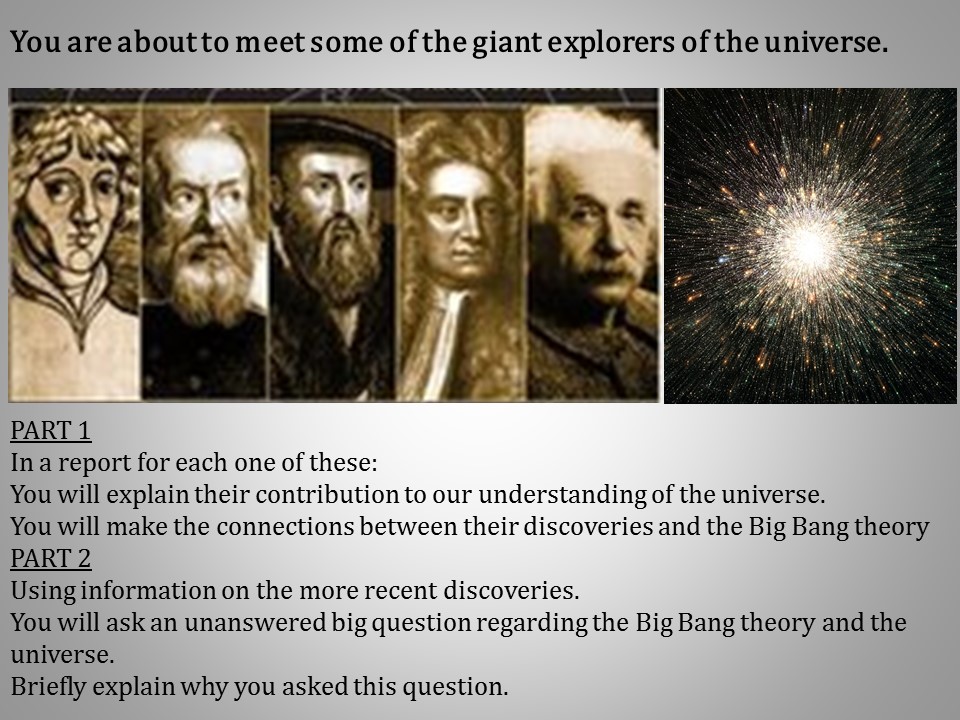
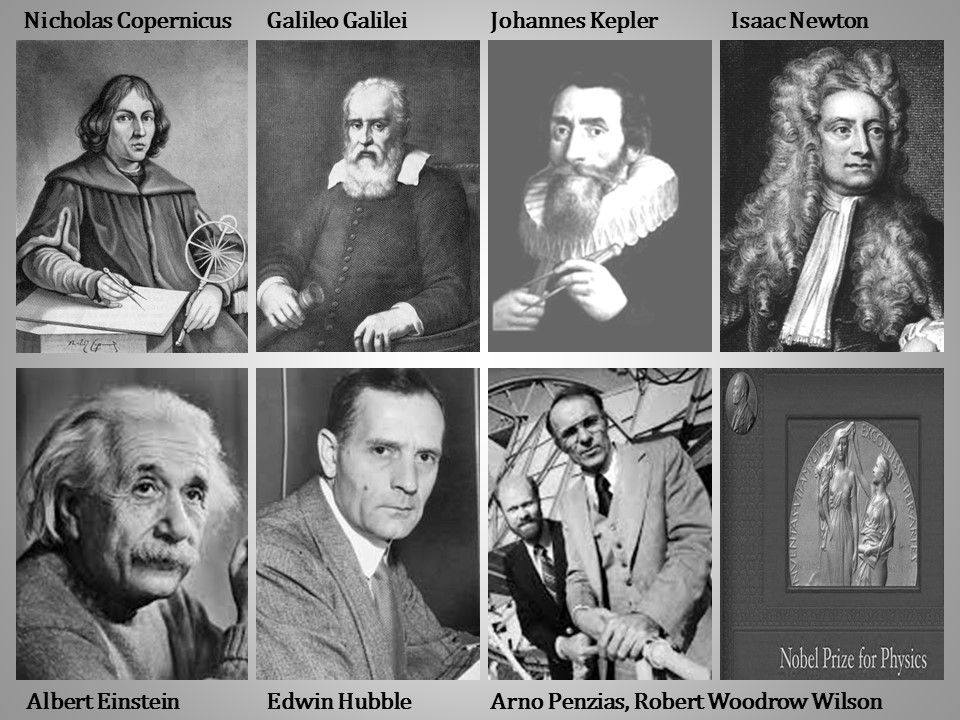
Each of these giants of science shown below have made massive contributions to the advancement of humanity's understanding of the universe.
Since 1901 some others built on that knowledge and have received the Nobel Prize for Physics
.
.
.
.
.
.
.
.
.
.
.
What contibution did their predecessors make to the achievement?
What new questions arose from their area of cosmological exploration?
Nicholas Copernicus
https://www.youtube.com/watch?v=8fbCIQK977Y
Galileo Galilei
https://www.youtube.com/watch?v=Maqhxq_LEMQ
https://www.youtube.com/watch?v=2J0-ZbbrD6U
Johannes Kepler
https://www.youtube.com/watch?v=x3ALuycrCwI#t=773.7254916 7:40 to 12:40
https://www.youtube.com/watch?v=s77LJO6USEY
http://www-istp.gsfc.nasa.gov/stargaze/Skeplaws.htm
Isaac Newton
https://www.youtube.com/watch?v=Jk5E-CrE1zg
https://phet.colorado.edu/en/simulation/gravity-and-orbits
Albert Einstein
https://www.youtube.com/watch?v=6MJ0lTEhoL8
http://map.gsfc.nasa.gov/universe/bb_theory.html
Edwin Hubble
https://www.youtube.com/watch?v=Fx71iaAtKSQ
http://map.gsfc.nasa.gov/universe/bb_tests_exp.html
https://www.youtube.com/watch?v=1sFQCf95CDg
Reflecting on the history and using the sights below and their links as inspiration,
ask a question and explain why you think is a unresolved mystery of the universe and the big bang.
Arno Penzias, Robert Woodrow Wilson and other Nobel Laureates
https://www.youtube.com/watch?v=2bnL_ztPo6s
https://www.nobelprize.org/nobel_prizes/physics/laureates/1978/
http://www.nobelprize.org/nobel_prizes/physics/laureates/2006/
https://www.nobelprize.org/nobel_prizes/physics/laureates/2011/
Evaluation
| Descriptor (Wieght) | A | B | C | D | E |
|
Explanation of the main scientific contribution of the scientist (30%) |
Explanation of all scientific contributions are always detailed and clear |
Explanation of all scientific contributions are mostly detailed and clear |
Explanation of scientific contributions are usually detailed and clear |
Explanation of scientific contributions are sometimes detailed and clear |
Explanation of scientific contributions lack details and are unclear or missing |
|
Description of link to previous scientist and relevance to Big Bang Theory (30%) |
Highly insightful detailed and distinctly relevant description |
Insightful detailed and relevant description |
Good insightful fairly detailed and usually relevant description |
Somewnat insightful lacking detail and occassionally relevant description |
Little insight poorly detailed and mostly irrelevant description or missing |
| Question asked and justified (25%) |
Intelligent question is thouroughly justified |
Thoughtful question is justified | Considered question is reasonalbly justified | Obvious question is somewhat justified | Question lacks indication of thought and poorly justified or missing |
| Writing (15%) |
Excellent quality writing skills clearly demonstrated throughout. No or minimal errors |
High quality writing skills mostly demonstrated. Some minor errors. | Good quality writing skills usually demonstrated. Some errors. |
Satisfactory quality writing skills demonstrated. Multiple errors. |
Unsatisfactory writing with errors thoughout. |
Conclusion
The question you have asked is one of many our ancient massive and mysterious universe poses.
But with determination and scientific knowledge and skill passed down through millenia anyone of us may make the next big breakthough.
Like the recent breakthough where the gravitational waves you have seen proposed by Einstein have been show to exist.
http://www.space.com/31922-gravitational-waves-detection-what-it-means.html
Never cease to wonder and you too can see farther on the shoulders of giants.
Credits
Createwebquest.com https://www.createwebquest.com/
Webquest.org http://webquest.org/
ACARA. (2015) Information and Communication Technology Capability learning continuum http://www.acara.edu.au/verve/_resources/General_capabilities_-_ICT_-_learning_continuum.pdf
Hawking, S. (2004) The Illustrated - On the Shoulders of Giants. Philadelphia, PA. Running Press Book Publishers.
Killen, R. (2013). Effective Teaching Strategies – Lessons from Research and Practice. 6th Ed. South Melbourne, Vic. Cengage Learning.
Krause, K-L. Bochner, S. Duchesne, S. (2003) Educational Psychology for Learning and Teaching. 2nd Ed. South Melbourne, Vic. Cengage Learning.
Queensland (Education) (2002) A guide to ...Productive Pedagogies - Classroom reflection manual. Brisbane, Qld. Curriculum Implementation Unit.
QSA. Queensland Studies Authority. (2015) Year 10 Science: Australian Curriculum in Queensland https://www.qcaa.qld.edu.au/downloads/p_10/ac_science_yr10.pdf