
Introduction

Task
WELCOME!!
You have just finished your HSC and you landed yourself a job as a Legal Assistant for one of the most top law firms in the city! You have been told that as your first task, you need to create a booklet which compares crime in Australia, United States and India. You have come to the right place as this WebQuest will guide you through the content you need in order to produce your booklet.
After you finish the booklet you are required to create and present a PowerPoint presentation to your colleagues about your findings.
Goodluck in your first task as a legal assistant!
Hope you succeed with flying colours!
Process
Question 1:
a) What are the types of common crimes committed in each country?
b) Why do you think the crimes committed in each country differ from one another in
terms of its commonness?
Question 2:
The table below shows data on recorded crime as published by the ABS for the period 1996 to 2012. Interpret the table below and answer the following questions.
http://www.aic.gov.au/publications/current%20series/facts/1-20/2013/1_recorded.html
|
Table 1 Victims of selected violent crimes, 1996–2012 (n) |
|||||
|
Homicidea |
Assaultb |
Sexual assault |
Robberyc |
Kidnapping/abduction |
|
|
1996 |
354 |
114,156 |
14,542 |
16,372 |
478 |
|
1997 |
364 |
124,500 |
14,353 |
21,305 |
564 |
|
1998 |
334 |
130,903 |
14,689 |
23,801 |
707 |
|
1999 |
385 |
134,271 |
14,699 |
22,606 |
766 |
|
2000 |
362 |
138,708 |
16,406 |
23,336 |
695 |
|
2001 |
347 |
152,283 |
17,577 |
26,591 |
767 |
|
2002 |
366 |
160,118 |
18,718 |
20,989 |
706 |
|
2003 |
341 |
157,280 |
18,025 |
19,709 |
696 |
|
2004 |
302 |
156,849 |
19,171 |
16,513 |
768 |
|
2005 |
301 |
166,507 |
18,695 |
17,176 |
729 |
|
2006 |
321 |
172,441 |
19,555 |
17,375 |
726 |
|
2007 |
283 |
176,077 |
19,954 |
17,996 |
733 |
|
2008 |
293 |
170,720 |
19,992 |
16,513 |
788 |
|
2009 |
293 |
175,277 |
18,807 |
15,238 |
564 |
|
2010 |
261 |
171,083 |
18,027 |
14,631 |
608 |
|
2011 |
276 |
117,992 |
17,592 |
13,653 |
675 |
|
2012 |
297 |
116,105 |
18,153 |
13,155 |
636 |
a) Which major category of offence is committed the most?
b) Which year had the most crimes committed?
c) Calculate the percentage of homicide offence committed.
d) Calculate the percentage of assault committed.
e) Create a line graph to represent the trend in the above table.
f) Referring to your line graph, explain the trend of homicide offence.
Question 3:
The number of victims of selected violent offences that occurred within each type of location is presented in the below table. Interpret the table and answer the following questions.
http://www.aic.gov.au/publications/current%20series/facts/1-20/2013/1_recorded.html
|
Table 3 Location type of violent crimes, 2012 |
||||
|
Murder |
Sexual assault |
Robbery |
Kidnapping/abduction |
|
|
Residential |
||||
|
Residential dwelling |
134 |
11,215 |
1,064 |
237 |
|
Outbuilding/residential land |
11 |
234 |
171 |
8 |
|
Other residential |
12 |
248 |
27 |
0 |
|
Total residential |
157 |
11,697 |
1,262 |
245 |
|
Community |
||||
|
Transport |
5 |
607 |
1,121 |
15 |
|
Street/footpath |
38 |
1,197 |
5,128 |
250 |
|
Other community location |
20 |
1,527 |
383 |
48 |
|
Total community |
63 |
3,331 |
6,632 |
313 |
|
Other location |
||||
|
Retail |
10 |
767 |
3,809 |
33 |
|
Recreational |
8 |
839 |
988 |
30 |
|
Other |
6 |
253 |
262 |
8 |
|
Total other |
24 |
1,859 |
5,059 |
71 |
|
Unspecified |
10 |
1,193 |
138 |
7 |
|
Total |
254 |
18,080 |
13,091 |
636 |
a) In which location have the crimes occurred the most?
b) In which location did murder occur the most? Calculate the percentage.
c) In which location did sexual assault occur the most? Calculate the percentage.
d) In which location did kidnapping occur the most? Calculate the percentage.
e) Which crime was most committed in retail? Why do you think this is the case.
f) Create an area graph for the above data to demonstrate its trend.
Question 4:
- http://www.legalserviceindia.com/Criminallaws/criminal_law.htm
- http://www.nationmaster.com/country-info/profiles/India/Crime
a) Explain how the criminal law is governed in India?
b) How is the guilt or innocence decided by the court?
c) Compare India’s crime rate with Australia and United States.
d) What is the highest amount of crime in India?
e) What is the lowest amount of crime in India?
f) Compare India’s murder rate with the rest of world.
Question 5:
a) As of 2014, how many crimes were reported in the United States?
b) What were the highest numbers of arrests for?
c) From the given statistics on the above website, create a table to summarise the information provided.
Question 6:
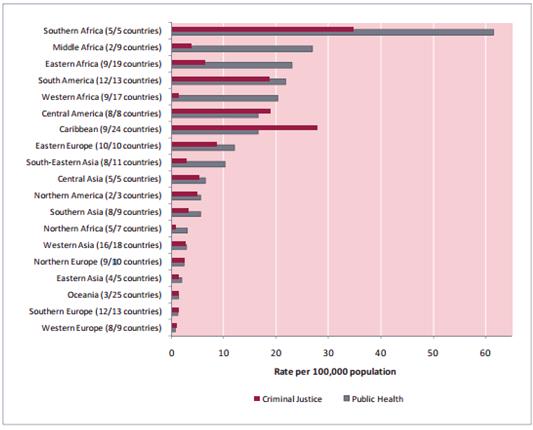
a) Where are low levels of homicide?
b) Where are high levels of homicide?
c) Create a table that summarises the above data.
Question 7:
- http://www.afp.gov.au/contact/crime-stoppers
- http://www.afp.gov.au/contact/report-a-crime
- https://www.fbi.gov/about-us/cjis/ucr/ucr
- https://www.usa.gov/report-crime
- http://www.legalserviceindia.com/Criminallaws/criminal_law.htm
a) Go to the above websites and investigate the procedure of how to report crime in Australia, United States and India. Explain the procedure of each country by writing a 500 word report.
Question 8:
Watch the below video and answer the following questions.
https://www.youtube.com/watch?v=MCCmxEYIVkw
a) Can you remain anonymous while calling crime stoppers?
b) Do the crime stoppers record their calls?
c) What do the crime stoppers do with the information collected over the phone?
d) Does the person calling then have to present themselves at court to make a statement?
e) How does the employee communicate to the person speaking over the phone? Explain the tone of language used.
f) How does the employee record the information being said over the phone?
Question 9:
Answer the questions by visiting the website below and with reference to the below hierarchy.
http://www.hierarchystructure.com/indian-police-service-hierarchy/
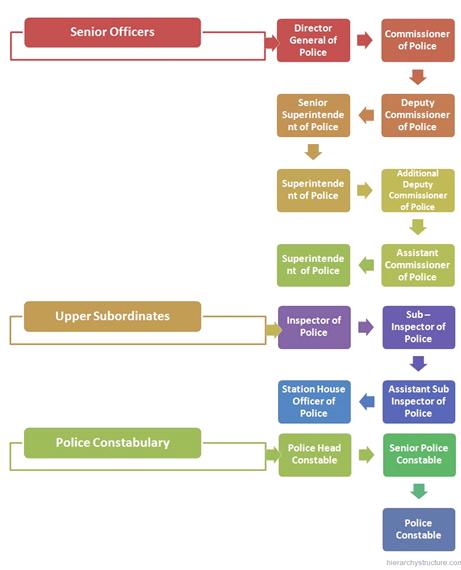
a) How are the senior officers selected and explain their role.
b) Examine the role of upper subordinates.
c) What are police constabulary responsible for? How much of the police force do they represent?
Question 10: Below is the information of prisoners in Australia.
http://www.abs.gov.au/AUSSTATS/abs@.nsf/0/8D5807D8074A7A5BCA256A6800811054?Opendocument
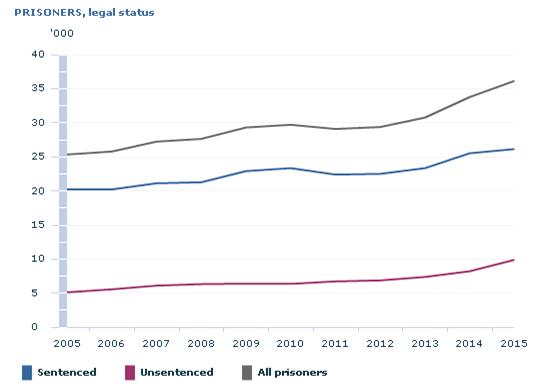
Interpret the graph and explain the trend.
.
.
.
.
.
.
.
.
.
.
Question 11: below is the data of prisoners in United States.

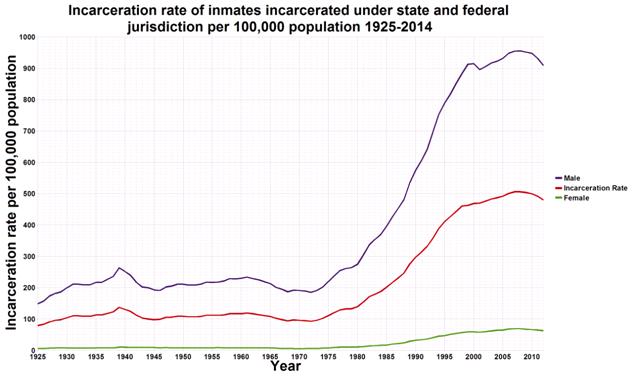
Interpret the graph and explain the trend.
.
.
.
.
.
.
.
.
Question 12:
http://news.bbc.co.uk/2/shared/spl/hi/uk/06/prisons/html/nn2page1.stm
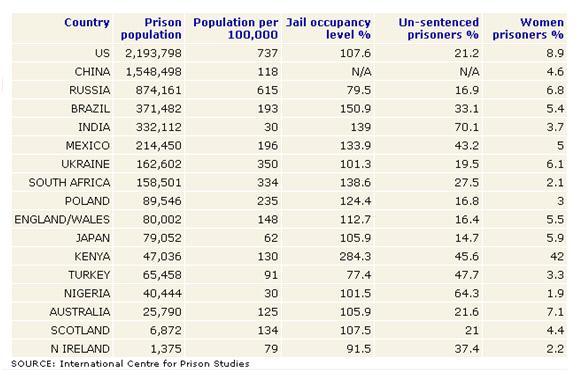
a) Compare and explain the results of Australia, United States and India.
b) Create a bar graph to represent the above data.
.
.
.
.
.
.
.
Question 13: visit the below websites for access to Australia’s United States and India’s crimes legislation and answer the following questions.
- http://www.austlii.edu.au/au/legis/nsw/consol_act/ca190082/
- http://indiacode.nic.in/acts-in-pdf/132013.pdf
- https://www.law.cornell.edu/uscode/text/18/part-I
a) Create tables for each of the below and report on the following for each country:
- Punishment for murder
- Child murder
- Manslaughter
- Attempt to murder
- Suicide and attempt to suicide
- Threatening
- Possession of weapon
- Poisoning
- Assault
- Sexual assault
- Child prostitution
- Kidnapping
- Robbery
Question 14:
You Be The Judge- You are the judge and have to decide on the sentencing for an offender.
Matt Burg is a 22 year old man and was 20 at the time of the offence. He is described as placid and easygoing. Over 3-4 years Matt became obsessed about death and committing murder. He has a verbal IQ of 71 and failed at school. Since leaving school he has been a successful cabinet maker. He has been found guilty of one count of murder. Matt Burg and his friend Tony were drinking beer at a mutual friend’s house. Matt produced a knife he had earlier stolen and told his friends that he needed it for protection. Soon after Matt and Tony returned to their flat. In an unprovoked attack, Matt stabbed Tony a number of times. Tony broke free and ran out onto the road where passengers of cars stopped and called for ambulance. Meanwhile Matt slashed his wrist and stabbed himself in the chest. He then called 000 saying that he needs serious help and that he had tried to killed a friend with a knife. Matt showed no concern of the fate of his friend but concentrated on his own wound. Meanwhile police and ambulance arrived in response to the passengers of cars who had called for ambulance. Tony died in hospital an hour later. Matt was treated for his wounds in hospital and underwent psychiatric examinations.
Factors for consideration- Matt pleaded guilty as soon as it was discovered that he isn’t mentally impaired. From the age of 15 Matt downloaded grotesque and depraved images and materials of the internet. At all times Matt frankly admitted responsibility for his actions and never blamed alcohol or drugs for his actions. Despite his difficulties at school, Matt’s teachers found him polite and easy to deal with. Matt is single and has a full-time job. He has no previous convictions.
What sentence would you give Matt?
- If imprisonment, what would be the head sentence and non-parole period?
- If a partially suspended sentence, what would be the length of sentence and operational period?
- If a totally suspended sentence, what would be the length of sentence and operational period?
Question 15: What do you favour? Rate the below from 1 to 13 (1 being the most you favour and 13 being the less you favour).
|
Since 1973, 138 people on Death Row have been found innocent |
139 countries have stopped using the death penalty |
It costs around 38% more for a country to execute someone than to keep them in prison for life |
|
Killing someone is murder, whatever for your reasons |
Only 5% of people on Death Row can afford a lawyer to help fight their case |
It is a Human Right that no one should suffer from a cruel punishment such as the death penalty |
|
You can never be 100% certain that someone has committed a crime |
Everybody deserves a second chance |
A better punishment is to make them think about what they have done for the rest of their lives |
|
The death penalty is seen by some as the only acceptable form of punishment for murderers |
If you murder someone then you have given up your Human Rights, including the Right to Life |
No one has proven that the death penalty stops other people committing the same crime |
|
Only the death penalty will stop killers |
|
|
Evaluation
|
Criteria |
Mark |
|
Fail 0 - 14 |
|
Pass 15 - 19.4 |
|
Credit 19.5 – 22.4 |
|
Distinction 22.5 – 25.4 |
|
High Distinction 25.5 - 30 |
Conclusion
Well done! You employer is very proud of you!
Now you gotta nail one more task do your presentation!
Goodluck, Im sure you'll do fine in your presentation!
All the very best!