
Introduction
Introduction
This web quest is designed for educators within the Early Childhood sector to be able to search for communicable or infectious diseases that may be present within the Northern Tasmanian region.
Communicable or Infectious diseases are those that are spread from one person to another in an environment such as a childcare service, family day care, after school care or vacation care program. Infectious diseases take many forms including:
Bacteria: Organisms that are present in the environment. There are 'good' bacteria and 'bad' bacteria.
Viruses: Viruses are germs that require a host cell to reproduce and survive.
Fungi: Organisms that require certain environmental factors to survive. They prefer places that are moist and warm.
Protozoa: Microscopic living cells that are found mostly in water.
Parasites: Insects or other living creatures such as worms that survive by feeding on the host.
(Staying Healthy in Childcare, 2012)
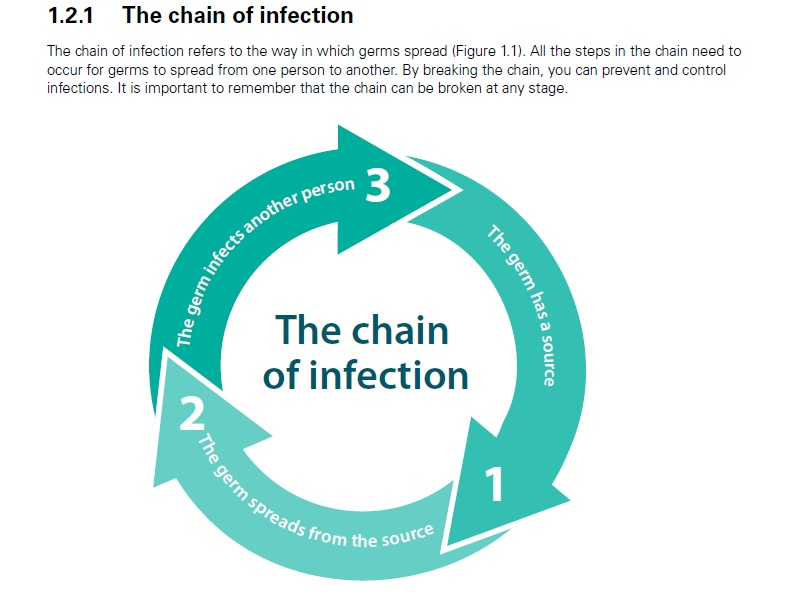
The Chain of Infection (Staying Healthy in Childcare, 2012)
Infectious diseases can be passed from one child to another (or from child to adult; adult to child; or adult to adult) through a variety of methods, these are:
Coughing or sneezing: By exposure to mucous or saliva that spreads via droplets of fluid when these actions occur.
Breathing in contaminated air: Breathing in air that contains droplets or small particles of germs. This can be direct from an individual or via a secondary source (like an air conditioner).
Direct contact: From touching another person or contact with bodily fluids (blood, saliva, urine, faecal matter, vomit). Direct contact can also occur when germs are left on surfaces such as benches or toys.
Animals: Animals can have infectious diseases on their body or through contact with their bodily fluids.
Food: Germs can survive on food that is not prepared hygienically (the person preparing), has been stored incorrectly or has not been washed (dirt, faecal matter, weed products etc.).
(Staying Healthy in Childcare, 2012)
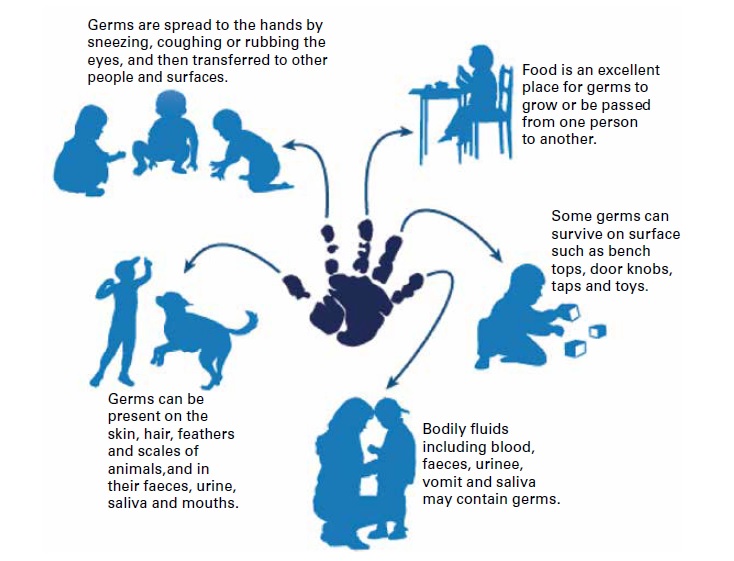
The Spread of Disease (Staying Healthy in Childcare, 2012)
Your role is to find information on some of the different diseases that are commonly found in the childcare setting with children from birth to 12 years.
Task
Task
Your task is to search the linked websites for information regarding the kinds of communicable or infectious diseases that are commonly found in early childhood settings. For this task you will need to identify the:
- Name or the disease.
- The symptoms that will be present.
- The period where the disease is communicable (where it is able to be transmitted to another person).
- The recommended exclusion period from the service required.
- Any precautions that can be taken to minimise the spread of the disease.
Process
Process
- You are to work in groups consisting of your team/room members. If you work on your own you are allowed to join another group for this task.
- From your research you are to construct a table of your findings that can be used as a quick reference to your room/team members.
- Suggest ways in which we can promote a healthy environment for the children we work with. Are there any changes you can think of that will reduce the spread of infection in our service?
- Report your findings back to the educational leader or service director.
Resources
Some of the below websites may assist you in completing this task
The Department of Health
http://www.health.gov.au/casedefinitions#c
Queensland Health
http://disease-control.health.qld.gov.au/#g
World Health Organisation
http://www.who.int/mediacentre/factsheets/en/
Time out poster: Queensland Department of Health
https://www.health.qld.gov.au/ph/documents/cdb/timeout_poster.pdf
Staying Healthy in Childcare PDF (2012)
http://www.imagineeducation.com.au/files/GapTraining/Staying_Healthy_5th_Edition.pdf
Some diseases to consider
Although there are many communicable diseases that can be transferred to children in the childcare setting, there are some that may be more common than others.
Some diseases may be preventable by proper immunisation schedules but they may still present in the early childcare community as children may not be covered by a full immunisation status; parents or family may have the disease; they may have been immunised but may present with a mild form of the disease following immunisation.
Diseases to consider are:
- Chicken Pox (varicella)
- Cold sores (herpes simplex)
- Conjunctivitis
- Gastroenteritis (vomiting and/or diarrhoea)
- Hand, foot and mouth
- Head lice
- Influenza
- Measles
- Meningitis (bacterial and viral)
- Parvovirus (slap check)
- Pertussis (whooping cough)
- Ringworm
- Rubella (German measles)
- School sores (impetigo)
- Thrush
- Worms
There may be other diseases you may wish to add to this list... feel free to add them.
Evaluation
Evaluation
This project will be expected to be completed by the next scheduled staff meeting.
You are to schedule time to complete this project within your team meeting for this month. If staff schedules allow, the team leader will be given an additional hour of planning within the last week of the month to write up the final completion of your findings. This information will be presented in the next staff meeting as a part of our professional development.
Conclusion
Conclusion
At the completion of this task you will become more familiar with the diseases that are prevalent within the early childhood sector and how to best prevent these diseases from being spread.
This task relates to:
- The National Quality Standard 2.1 (Each child’s health is promoted)
- The National Quality Standard 3.1.2 (Premises and furniture and equipment are safe, clean and well maintained)
- Early Years Learning Framework Principle 5. (Ongoing learning and reflective practice).
- Early Years Learning Framework Outcome 3. (Children have a strong sense of wellbeing).
Credits
References
Commonwealth of Australia (2012). Staying healthy in childcare (5th ed.). Commonwealth of Australia.