
Introduction
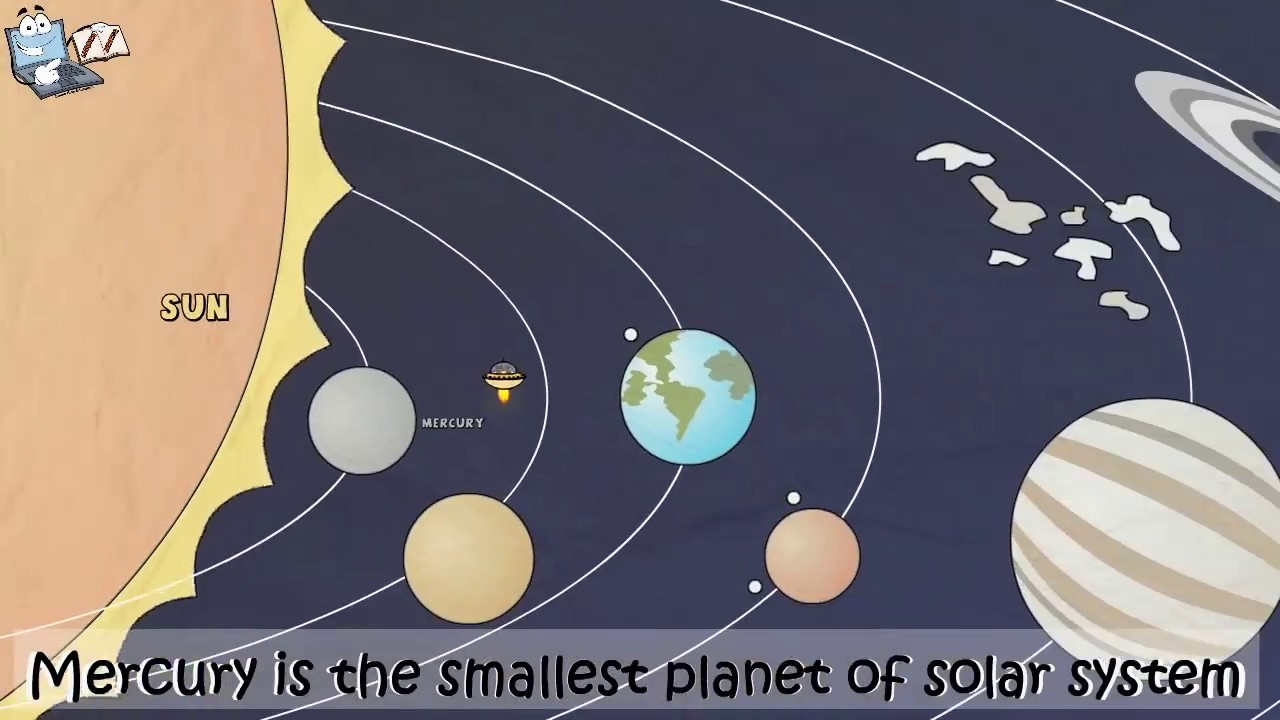
Our solar system has 8 planets that orbit a big star called the Sun. (An orbit is the path that a planet moves through.) All the planets orbit the Sun in elliptical paths. (An ellipse is just a stretched out circle.)

All the planets take different amounts of time to get all the way around the Sun. Our Earth takes a year to make one complete orbit. In fact, that's how we decided how long a year should be - it's the length of time it takes us to get all the way around the Sun!
Also, all the planets spin while they move around the Sun... Just like tops!
There is another mess of stuff that orbits the Sun... We call it the Asteroid Belt and it is just a bunch of really big rocks.
Here's a picture of all the orbits:

If you need to remember the order of the planets, here's a trick: Just look at the first letters of each planet in order, starting with Mercury and working your way out... M, V, E, M, J, S, U, N and make up a funny sentence that uses these letters. Here's one:
Mooing very eagerly, Mary jogged slow unfortunately numb.
How do all their sizes compare? The big yellow circle is the Sun's size and all the others are arranged from smallest to largest. (Man, look how little the Earth is compared to the Sun!)

The inner planets, Mercury, Venus, Earth and Mars are called terrestrial planets. This means that they have a hard surface (rock) to stand on.
Jupiter, Saturn, Uranus and Neptune are called the Jovian planets, since they are all a lot like Jupiter. (Jove was another name for the Roman god, Jupiter). They are also called gas giants. This is because they are made of gas and liquid (but not water). There's no hard surface to stand on!
Task
TASK:
You are a space cadet and the entire world is counting on you to save all the planets from destruction. While in outer space study each planet thoroughly to rescue each planet from destruction. There will be question concering each planet's fuctions. Each fun fact is a booster pack for your futuristic space ship to save the planets as quickly as possible.
Process
SOLAR SYSTEM!

MERCURY

1. Mercury was the roman version of Greek God Hermes.
2. Mercury's core make-up 75% of the planet.
FUN FACT: Did you know if you weigh 70 pounds on Earth that you will weigh 27 on Mercury.
VENUS
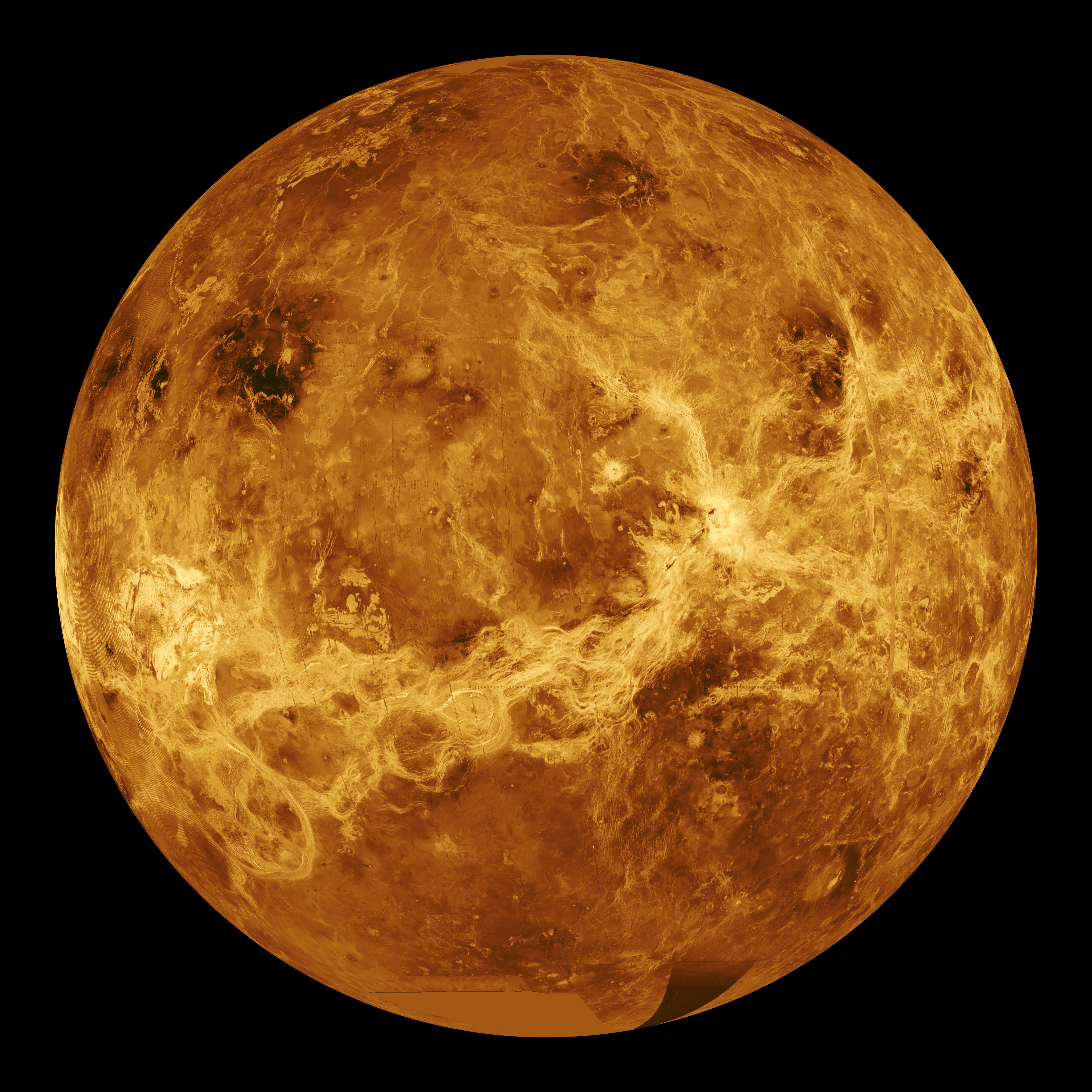
1. Venus is a deadly world where the surface temperature is not enough t cook a meal in minutes.
2. The atmosphere effectively traps the suns energy causing surface to burn much hotter than it would.
FUN FACT: Venus and Earth are almost the exact same size! If you weigh 70 pounds on Earth then on Venus you would weigh 63 pounds.
EARTH

1. Earth is the biggest of all terrestrial planets.
2. Our planet is an oasis of life in an otherwise desolate universe Earths temperature keep it just right to keep us alive.
FUN FACT: Earth has one moon it's name is Luna.
MARS

1. Mars was the Roman God of War and Agriculture.
2. Mars once had rivers, streams, lake and even oceans.
FUN FACT: Mars has two moons their names are Deimos and Phobos.
JUPITER

1. By far the largest planet on our solar system.
2. "Eye of Jupiter" Jupiters red spot, visible in the picture above to the right, which is where a giant storm has been raging for at least 300 years.
FUN FACT: Jupiter is so big that Earth could fit inside Jupiter more than 1000 times.
SATURN

1. Saturn is the son of Uranus and the father of JUpiter.
2. Saurn is known for its rings, however it is not the only planet with rings.
FUN FACT: Saturn has 53 offical moons and a 9 provisional (unoffical) moons
URANUS

1. Uranus was the lord of the skies and husband of Earth.
2. Uranus is a gas giant unlike all other planets uranus spins on its side.
FUN FACT: Uranus has 27 moons!!
Neptune

1. For many centures people did not know this planet existed. It was finally discovered in 1846 by Johann Galle and Heinrich D'Arrest.
2. Neptune is a very windy place thewinds have reached nearly 1200 miles per hour. no other planet has stronger winds as neptunes.
FUN FACT: Neptune is smallest of four gas giants in our solar system.
PLUTO

1. Pluto is smaller than 7 of the moons in solar syate, because of how small pluto is; they do not consider pluto a planet.
FUN FACT: if you weigh 70 pounds on Earth, you would weigh 4 pounds on pluto!!

Evaluation
| CATEGORY | EXCELLENT (25pts) | GOOD (20pts) | FAIR (10pts) | POOR (5pts) |
| Coordination | All members of the group contributed to the webquest process. Work time was used effectively. | Three or more group members contributed to the webquest process. | One or two members of the group did NOT contributed in the webquest process. | Only one person of the group clearly led the way to finish the webquest. |
| Critical Thinking | Rich in content; the webquest was completed and very well oriented. | Three or more sections were done but some sections don't have enough information. | Only one or two sections were done and are poor in information. | Webquest shows no logic,very ambiguous. |
| Spelling and Proofreading | No misspellings or grammatical errors. | Three or fewer misspellings and/or grammatical errors. | Four misspellings and/or grammatical errors. | More than four errors in spelling and/or grammar. |
| Creativity | Used multiple colors and pictures. | Used at least three different colors and multiple pictures. | Used at least one different color and one picture. | Used black ink only and no pictures. |
Conclusion
Know that you have learned many ideas about space and what it would be like to live in a space station, how much you weigh on another planet and how to compute scientific notation! You have also learned how gravity affects our solar system and also about one of the great wonders of space, a Black Hole! The sun also has an affect on earth and the sun patterns page helped you to learn about how it gives us a lot of sun at certain times throughout the day and no sunlight at all at other points of the day. We hope that you have had fun learning about the planets in our solar system!
