
Introduction
Space is such a mysterious, vast subject but every day we begin to learn more about the solar system. The Solar System is a gravitationally bound system comprised of the sun and everything that orbits around it, including planets, moons, asteroids, comets and meteoroids.Technology helps scientists and us keep up and grow our knowledge of space. There is still so much we don't know and are trying to find out.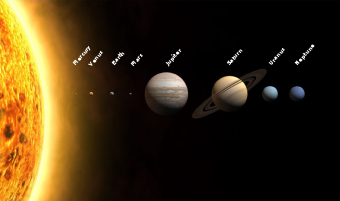
Task

Your task is to research information about our solar system. You can use the websites provided or find some of your own to learn more about space. Goal is to answer questions given to learn about our solar system and the technology we use to explore space and then pick one planet to report on. When you have decided which planet you want to report on you will take notes and develop some sort of creative presentation to teach others what you have learned.The presentation needs to be informative, accurate, and readable while also being creative.
Process
In order to the best work you can, complete the following steps...
1. Read through all directions to fully understand what is being asked of you to do.
2. Go to website Welcome to the Planets at http://pds.jpl.nasa.gov/planets/ from there explore and answer the following questions in a write up...
- How many planets are in our solar system?
- Which planets are rocky?
- Which planets are gaseous?
- On which planet might life exist? Why would it be possible there?
- Select three pictures that interest you. Write down three different words that describe each one.
- Choose one picture. Tell why you find it interesting and why you think your classmates will, too.
- Look up four types of technology that have been used to explore space. Name the tool, what it explored, and when it was used. Place your information in a chart.
3. Decide on the planet you want to present and look up resources of your own or use websites under resource page and take notes on important things you think you should know.
4. Develop a presentation including accurate information about your planet, pictures, and include your creativity.
5. Present to the class on the designated day and explain to the class all about your planet.
Evaluation
| CATEGORY | 5 points | 4 points | 3 points | 2 points |
| Write Up Completion | All question are completely answered and accurate with high level of thought and insight about topic. | All questions are completely answered with some degree of high level of thinking and with some accuracy. | Some questions are completed with little thinking and misunderstood and disorganized. | Only a couple of the questions are answered incompletely with little to no thought and inaccurate information. |
| Quality of Information | Information clearly relates to the planet chosen. It includes several supporting details and/or examples. | Information clearly relates to the planet you choose. It provides 1-2 supporting details and/or examples. | Information clearly relates to the planet you choose. No details and/or examples are given. | Information has little or nothing to do with the planet you choose. |
| Research | All resource sites are accurately and appropriately explored and cited correctly. | Most of the resource sites are accurately and appropriately explored and cited correctly. | Some of the resource sites are appropriately explored and cited correctly. | Did not appropriately explored the resource sites and are not cited correctly. |
| Presentation | Layout, illustrations and creativity are neat, accurate and add to the reader's understanding of the topic. | Layout and creativity are neat accurate and add to the reader's understanding of the topic. | Layout is neat and accurate and sometimes add to the reader's understanding of the topic. | Layout, illustration and creativity is not neat or accurate and it does not add to the reader's understanding of the topic. |
Conclusion
By the end of this project you should be able to be an expert on the solar system and your planet you chose and will be able to share information with others. When the project is done you will have gathered information from websites and increased your ability to research and report what you have found. In order to share your new found information with others you will complete a short 3-5 minutes presentation to the class explaining your presentation and the information you have found about the planet you choose. This project will help you to begin your researching skills and learn some new websites that may help you again in another project. 
Credits
Resource's Page
http://www.space.com/56-our-solar-system-facts-formation-and-discovery.html
https://pds.jpl.nasa.gov/planets/welcome.htm
http://solarsystem.nasa.gov/planets/
http://www.kidsastronomy.com/solar_system.htm
http://solarviews.com/eng/solarsys.htm
http://science.nationalgeographic.com/science/space/solar-system/
http://www.solarsystemscope.com/
http://www.universetoday.com/15451/the-solar-system/
Teacher Page
Teacher's Notes for Project
Title: The Planets and Our Solar System
Subject: Science (Astronomy)
Grade Levels: 3–6
Time Required: 2 weeks
Draft of Ideas:
Intro: In the webquest students will study the solar system and the planets. They will learn about space and find information on the planet they choose and report on it.
Task: Students will use the webquest to research the planets and our solar system. Finding websites and researching will help them to learn about the planets, the environment on that planet, the moons around that planet, etc. After they have researched the planets, they will choose a favorite to research more and then report back on. Report will be a creative presentation about their olanet and includes pictues of their planet.
Process: Students will go through websites and find out information on different planets. After they have learned about the different planets they will choose which planet they liked best and wanted to know more about. Next, they will research more on this planet and take some notes about what the planet looks like, the environment of the planet, facts about it, the moons of that planet, etc. Then they will create a presentation and will include a drawing or picture of this planet to go along with their report. Each student present their presentation to the class so every student will learn about each other’s planets.
We will talk about our solar system and all the information around that previously in the unit. Students will need to have a previous knowledge of what space is and what is in space and the different between our planet and others. They will also need to know that there is different solar systems but will just need to report on the planets within ours on their report.
Standards addressed:
Colorado k-12 academic standards:
Earth Science in 4th Grade: Understand Earth is part of the solar system, which includes the Sun, Moon, and other bodies that orbit the Sun in predictable patterns that lead to observable paths of objects in the sky as seen from Earth.
National Educational Technology Standards for Students:
3. Research and Information Fluency: students apply digital tools to gather, evaluate, and use information. B. locate, organize, analyze, evaluate, synthesize, and ethically use information from a variety of sources and media. C. evaluate and select information sources and digital tools based on the appropriateness of specific tasks. D. process data and report results.
WQ’s thinking skills: This webquest requires the skills of classifying, constructing support, creating report/presentation.
Adapting WQ: This activity can be adapted for a higher grade by including more research, information or a higher order thinking report. The students would be able to research more about the different planets with more detail and about the orbits. Also there can be a harder report that could include a more detailed written report.
Acknowledgements: I would like to thank the website https://pds.jpl.nasa.gov/planets/welcome.htm for helping research and being able to help answer the questions and google for pictures and more research.