
Introduction
Verbs have two voices: active voice and passive voice. "Voice" should not be confused with tense. Tense has to do with the time of the action; voice pertains to the way a verb functions relative to the subject of the sentence.
With active voice, the action of the verb is linear and straightforward. The movement of the sentence is subject –> verb –> rest of idea. "The report [subject] summarizes [verb] our findings [object and rest of idea]" is such a sentence.
With passive voice, the verb acts upon the subject. What would be the subject in a sentence using an active verb becomes the object. "Our findings are summarized by the report" is such a sentence.
Task
When the verb is active, the subject performs the action; when the verb is passive, the subject is the recipient of the action.
In the examples given above, both verbs are present tense; the difference between them is voice. This has a subtle effect upon the impact of the sentence. The active voice ("The reportsummarizes our findings") is more direct and forceful. The passive voice ("Our findings are summarized by the report") is less direct and requires more words. One reason for this, of course, is that the passive voice uses a helping verb: are summarized.
An elementary rule of style is: Prefer the active voice. That is, use the active voice unless you have strong reason to use the passive voice. (Notes regarding when the passive voice may be used appear after the active/passive examples below.)
Process
ACTIVE / PASSIVE VOICE
Active voice
In most English sentences with an action verb, the subject performs the action denoted by the verb.
These examples show that the subject is doing the verb's action.
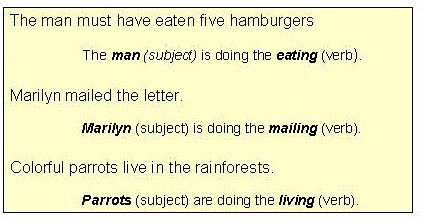
Because the subject does or "acts upon" the verb in such sentences, the sentences are said to be in the active voice.
Passive voice
One can change the normal word order of many active sentences (those with a direct object) so that the subject is no longer active, but is, instead, being acted upon by the verb - orpassive.
Note in these examples how the subject-verb relationship has changed.
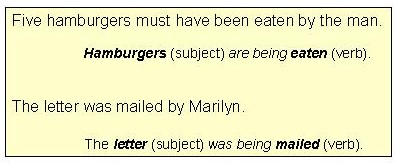
Because the subject is being "acted upon" (or is passive), such sentences are said to be in the passive voice.
NOTE: Colorful parrots live in the rainforests cannot be changed to passive voice because the sentence does not have a direct object.
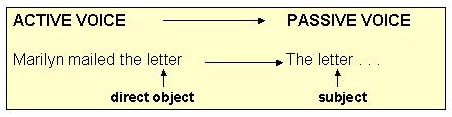
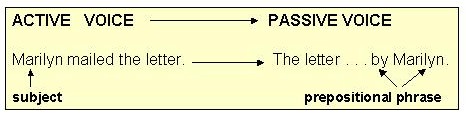
To change a sentence from active to passive voice, do the following:
1. Move the active sentence's direct object into the sentence's subject slot
2. Place the active sentence's subject into a phrase beginning with the preposition by
3. Add a form of the auxiliary verb be to the main verb and change the main verb's form
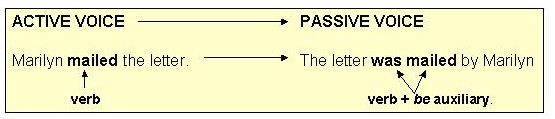
Because passive voice sentences necessarily add words and change the normal doer-action-receiver of action direction, they may make the reader work harder to understand the intended meaning.
As the examples below illustrate, a sentence in active voice flows more smoothly and is easier to understand than the same sentence in passive voice.
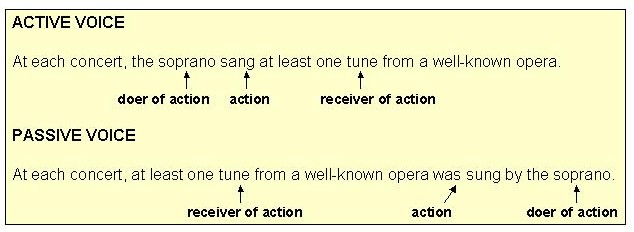
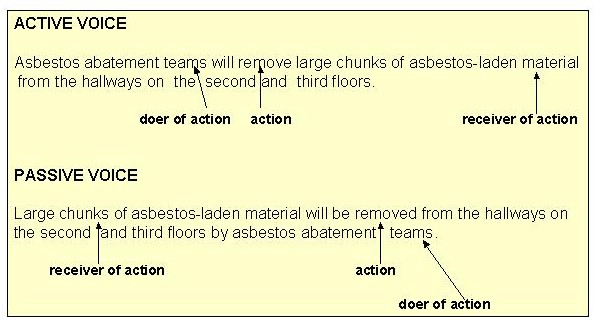
It is generally preferable to use the ACTIVE voice.
To change a passive voice sentence into an active voice sentence, simply reverse the steps shown above.
1. Move the passive sentence's subject into the active sentence's direct object slot
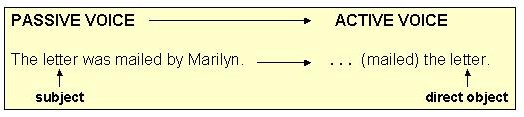
2. Remove the auxiliary verb be from the main verb and change main verb's form if needed
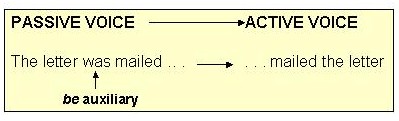
3. Place the passive sentence's object of the preposition by into the subject slot.
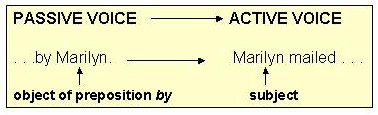
Because it is more direct, most writers prefer to use the active voice whenever possible.
The passive voice may be a better choice, however, when
- the doer of the action is unknown, unwanted, or unneeded in the sentence
Examples
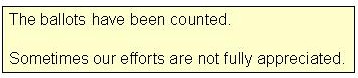
- the writer wishes to emphasize the action of the sentence rather than the doer of the action
Examples

- the writer wishes to use passive voice for sentence variety.
Evaluation
Active or Passive Quiz
| 1. I ate a piece of chocolate cake. --a) activeb) passive | Ans.a |
| 2. The librarian read the book to the students. --a) activeb) passive | Ans.a |
| 3. The money was stolen. --a) activeb) passive | Ans.b |
| 4. They are paid on Fridays. --a) activeb) passive | Ans.b |
| 5. The movie is being made in Hollywood. --a) activeb) passive | Ans.b |
| 6. I washed my car three weeks ago. --a) activeb) passive | Ans.a |
| 7. His hair was cut by a professional. --a) activeb) passive | Ans.b |
| 8. I will introduce you to my boss this week. --a) activeb) passive | Ans.a |
| 9. It would have been fixed at the weekend. --a) activeb) passive | Ans.b |
| 10. The national anthem is being sung by Jason this time. --a) activeb) passive | Ans.b |
Conclusion
Active Voice
When the subject is the doer of the action (verb), the voice of verb is active.
To make an active voice:
Subject + main verb
example: He passed the test.
In this sentence, the subject He did the action which was passing the test.
Passive Voice
The verb is in passive voice when the subject receives the action.
To make a passive voice:
Subject + auxiliary verb (to be) + main verb (past participle*)
example: The test was passed by him.
In this sentence, the subject test did not do the action. It was “him” who did. The subject “test” receives the action done by him.
Uses of passive voice
Credits
http://www.englishpage.com/verbpage/activepassive.html
http://www.ielts-useful-tips.com/voice-of-verb.html
English for you and me, Calma Ebodelle L.