
Introduction
Competence: Identifies and applies the writing process steps when practicing various tasks by publishing them.
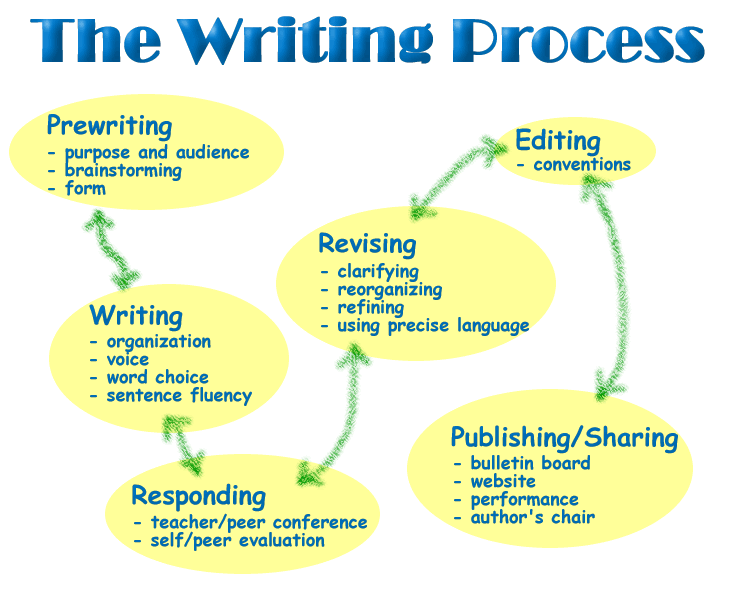
Every writer follows his or her own writing process. Often the process is a routine that comes naturally and is not a step-by-step guide to which writers refer. Being conscious of your own writing process is especially helpful when you find yourself struggling with a particularly tricky piece. Here are five steps towards creating or identifying your personal writing process.
Task
The final product is an online magazine about your own writing process.
Process

Make groups of 3:
1. Create an account at https://issuu.com/
2. Open a Power Point document, use one slide per each step for the writing process.
3. Remember to include images, examples and graphic organizers.
Stages of the Writing Process
Writing can’t be done without going through certain stages. All writers go through their own unique writing processes before they make their final drafts. Usually, writers start with choosing topics and brainstorming, and then they may outline their papers, and compose sentences and paragraphs to make a rough draft. After they make a rough draft, writers may begin revisingtheir work by adding more sentences, or removing sentences. Writers may then edit their rough draft by changing words and sentences that are grammatically incorrect or inappropriate for a topic.
Brainstorming
Before you start writing, you will think about what to write, or how to write. This is called,brainstorming. When you brainstorm for ideas, you will try to come up with as many ideas as you can. Don't worry about whether or not they are good or bad ideas. You can brainstorm by creating a list of ideas that you came up with, or drawing a map and diagram, or just writing down whatever you can think of without thinking about grammar. Think of this like the erratic thunder and lightning that comes from a thunderstorm.
Outlining
Next, you may want to outline your paper based off of the ideas you came up with while you were brainstorming. This means that you will think about the structure of your paper so that you can best deliver your ideas, and meet the requirements of writing assignments. You will usually outline your paper by beginning with its three major parts: introduction, body, and conclusion. The specific structure of each essay may vary from assignment to assignment. Many writers call this a skeleton unto which you develop or “flesh out” the paper. Once you have the skeleton in place, you can start thinking about how to add additional detail to it.
Rough Draft
Your professors or instructors will often require you to submit a rough draft of your paper. This usually means that your work is still in progress. In the rough draft, readers want to see if you have a clear direction in your paper. When you are required to submit a rough draft, it doesn't need to be perfect, but it does need to be complete. That means, you shouldn't be missing any of the major parts of the paper.
Revise and Edit your writing
What is the difference between revise and edit?
Revision lets you look at your paper in terms of your topic, your ideas, and your audience. You may add more paragraphs or remove paragraphs to better fit into a given genre or topic. In a word, revising means that you organize your writing better in a way that your audience can understand your writing better. You may want to read our resource on basic rhetorical elementsto help guide your revision.
Editing typically means that you go over your writing to make sure that you do not have any grammatical errors or strange phrases that make it difficult for your readers to understand what you are trying to say. In other words, editing means that you take care of minor errors in your writing. This is a lot like polishing your writing.
Polish your writing
We often hear professors or instructors say that you need to “polish your writing.” What do you mean by polish?
The word polish originally meant to make something smooth and shiny, as in “she polished her leather shoes.” In writing, polish can mean to improve or perfect, or refine a piece of writing by getting rid of minor errors. In other words, when your professors or instructors say, “polish your writing,” it means that you should go over your writing and make sure you do not have any errors in grammar, spelling, punctuation, and to make sure that you do not have any sentences that do not make sense.
5. Then you have to save the presentation and upload it at issuu.com
6. Finally send your magazine to my mail: missleythe@gmail.com
7. Be prepare to present your team work.
Evaluation

Click to each link
Magazine project rubric
http://www.rcampus.com/rubricshowc.cfm?code=S97B99&sp=yes
Writing process rubric:
http://www.rcampus.com/rubricshowc.cfm?sp=yes&code=W357B7
You can check the rubrics to ensure that your magazine is complete and correct.
Conclusion

From this webquest, we can make out that the writing process—prewriting, drafting, revising and editing, rewriting, publishing—mirrors the way proficient writers write, you are able to break writing into manageable chunks and focus on producing quality material. The final stage, publishing, ensures that students have an audience. Students can even coach each other during various stages of the process for further emphasis on audience and greater collaboration during editing.
Also success in writing greatly depends on a student’s attitude, motivation, and engagement. The writing process takes these elements into account by allowing students to plan their writing and create a publishable, final draft of their work of which they can be proud. It addresses students’ need for a real audience and to take the time to draft and redraft their work. You can help your students think carefully about each stage of their writing by guiding them through the writing process repeatedly throughout the year and across various content areas.
Credits

Teacher Page
[img_assist|nid=36930|title=Teacher|desc=|link=none|align=center|width=363|height=394]By: Miss Leythe Tenes
I hope you enjoyed and learned during the development of this task.