
Introduction
SUSTAINABILITY
What is this website? A WEBQUEST!
Welcome to our sustainability webquest! Our names are Buttercup and Dandelion. We are going to be your adventure guides! During this adventure you are going on, you will learn all about what sustainability is, how sustainability affects you, the history of recycling, how different materials are recycled, and the pros and cons of recycling these materials. You are going to follow the tabs up the top to the different parts of our webquest! Happy questing!
What is Sustainability?
Sustainability is based on a simple principle: Everything that we need for our survival and well-being depends, either directly or indirectly, on our natural environment. To pursue sustainability is to create and maintain the conditions under which humans and nature can exist in productive harmony to support present and future generations!!!
There are several steps in order for you to create your sustainability journey. You can find all of these steps on the page labled task!
Good luck and happy webquesting!
citation: Learn About Sustainability. (2016, February 26). Retrieved March 29, 2016, from https://www.epa.gov/sustainability/learn-about-sustainability#what
Task
- Day 1 tasks: Check or cross off as you complete!
- 1. Start section 1 of the scavenger hunt
- 2.Watch all of the videos on sustainability.
- 3. Complete the questions that follow the sustainability video!
- 4. Start on section one of the webquest about recycling, section 2. Follow the link attached to each part of the scavenger hunt.
- 5.Fill in the correct answers for the blanks on the webquest guide! Take your time and explore!
- 6. Move through the other sections of the webquest until you finish section 2.
- 7. Once you finish you may
- Read more about the sustainability or recycling topics
- http://squid.tepapa.govt.nz/the-deep/interactive > play this sustainability game
- Move to the choice board and select and activity
- Day 2 activity: Make sure to check off as you complete!
- Get into your assigned groups
- Chose what type of presentation you would like to give to the class
- Formulate ideas about what information you would like to include in the presentation! Make sure you think about what is required! Check the evaluation page!
- Gather information to present to the class as stated on the evaluation page!
- Start creating your script, poster, or presentation.
- Complete as much as possbile in class today and finish early tomorrow before presentations!
Process
PART I: What is sustainability?
Watch the following videos and answer the questions:
- https://www.youtube.com/watch?v=5ACfPVA-EE8
- https://www.youtube.com/watch?v=gTamnlXbgqc
- https://www.youtube.com/watch?v=bn8R_XqjjI0&list=PLQtNKAyd5CX01caZuktDP…
Questions:
- What does sustainability mean to you? Write your own definition!
- What are some ways you can be more sustainable?
- What does sustainability look like in our world, at home, in our community?
PART II: Scavenger Hunt
Recycling History Scavenger Hunt
Complete this scavenger hunt using the provided websites for paper, plastic, and glass.
Paper
http://www.fcgov.com/recycling/pdf/history-papermaking.pdf
The paper that we use today was first made in __________.
The first paper mill was built in __________.
The first American paper mill was built in __________.
American paper mills switched from using _________ to using __________ as the demand for paper grew.
Before paper, people communicated through __________.
During the 8th century, __________ learned paper making and brought the secret with them to Europe.
Paper mills use recycled paper, as well as __________ to make new paper.
When you recycle your used paper, paper mills will use it to make new __________.
Plastic
http://www.historyofplastic.com/plastic-history/history-of-plastic-recycling/
The first plastic waste-recycling mill in the world was created in __________ in 1972
__________ plastic, which were designed with recycling in mind, are recyclable plastic products that were introduced by Plastic Bottle Institute of the Society of the Plastics Industry and clearly marked on their containers by logo of triangle made of arrows.
Because of the complicated recycling process and unwillingness of people to properly dispose of their unwanted plastic, __________ of plastic lag far behind of other items such as paper, glass and metal.
During the recycling process, plastic is chopped into small pieces, cleaned to remove debris and small residue, melted down and compressed into pellets named __________.
Glass
http://www.slideshare.net/Ranchtwnrecycle/a-brief-history-of-recycling-glass
Recycling glass not only helps reduce the volume of waste in our landfills, it also saves the resources used to create more glass, such as __________.
Reusing glass also prevents more __________from being pumped into the air during the glass creation process.
There is some evidence that shows ancient civilizations were recycling glass as early as __________.
During __________, recycling and reusing glass became a necessity, as resources were limited and most people could not afford to buy new items.
Some states in the US began offering __________, where consumers are reimbursed when containers are brought to a recycling center.
PART III: Presentation

During the recycling scavenger hunt and the sustainability video, you learned a whole bunch of new information! You will all be divided up into 4 groups. Each group will present on their topic of sustainability, paper recycling, plastic recycling, or glass recycling. You will have to present all of the information you found out to the class. You can do this in several ways.
The options for your presentation are:
- Prezi
- Slide Show
- Skit
- Video Infomercial
- Poster
Your group can pick which presentation form they would like to do! Each presenation should include the information from the scavenger hunt, 2 facts from the resources, and what your group thinks about it! Please plan ahead and write a script, especially if you are preforming a skit or making an infomercial! It is your turn to teach the class!
Evaluation
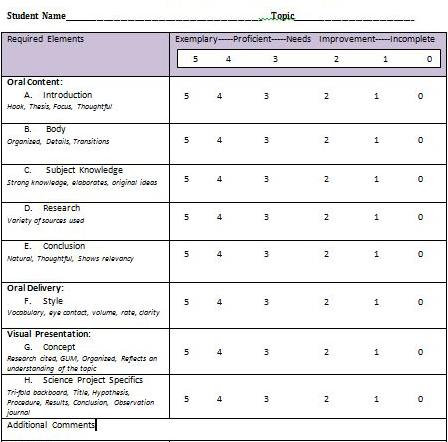
This is the rubrics to show you how you will be evaluated fpr your final presentation project! Do your best everyoneone! I know you will do a great job if you all work together!
|
Benchmark |
Milestones |
Milestones |
Capstone |
Score/Level |
|
|
Contributes to Team Meetings |
Shares ideas but does not advance the work of the group. |
Offers new suggestions to advance the work of the group. |
Offers alternative solutions or courses of action that build on the ideas of others. |
Helps the team move forward by articulating the merits of alternative ideas or proposals. |
|
|
Facilitates the Contributions of Team Members |
Engages team members by taking turns and listening to others without interrupting. |
Engages team members in ways that facilitate their contributions to meetings by restating the views of other team members and/or asking questions for clarification. |
Engages team members in ways that facilitate their contributions to meetings by constructively building upon or synthesizing the contributions of others. |
Engages team members in ways that facilitate their contributions to meetings by both constructively building upon or synthesizing the contributions of others as well as noticing when someone is not participating and inviting them to engage. |
|
|
Individual Contributions Outside of Team Meetings |
Completes all assigned tasks by deadline. |
Completes all assigned tasks by deadline; work accomplished advances the project. |
Completes all assigned tasks by deadline; work accomplished is thorough, comprehensive, and advances the project. |
Completes all assigned tasks by deadline; work accomplished is thorough, comprehensive, and advances the project. Proactively helps other team members complete their assigned tasks to a similar level of excellence. |
|
|
Fosters Constructive Team Climate |
Supports a constructive team climate by doing any one of the following: |
Supports a constructive team climate by doing any two of the following: |
Supports a constructive team climate by doing any three of the following: |
Supports a constructive team climate by doing all of the following: |
|
|
Responds to Conflict |
Passively accepts alternate viewpoints/ideas/opinions. |
Redirecting focus toward common ground, toward task at hand (away from conflict). |
Identifies and acknowledges conflict and stays engaged with it. |
Addresses destructive conflict directly and constructively, helping to manage/resolve it in a way that strengthens overall team cohesiveness and future effectiveness. |
|
sustainability rubric (teamwork)sustainability rubric (teamwork)
|
1 |
2 |
3 |
4 |
Score/Level |
|
|
Mechanics |
Text contains many spelling/grammar errors. Sentences seem disconnected, and there is carelessness throughout. |
Text contains some spelling/grammar errors. Little logical structure or flow to sentences. Evidence of carelessness in writing. |
Grammar and spelling are nearly flawless. Logical sequence apparent. Some wording is careless. Inconsistency in style. |
Grammar and spelling are flawless and the flow provides a logical pathway of ideas. Consistent and engaging style throughout. |
|
|
Graphics |
Images do not connect to text and/or are not relevant. |
Images are not always relevant. Text citations are not always present and do not connect to images. |
Images are mostly relevant. Text citations are usually present and identify the images. |
Images are relevant, and complement the text. Each image is cited in the text and identified. The number of images is appropriate. |
|
|
Planning |
Storyboard is incomplete. Little or no details about graphics, content, formatting, or effects are provided. |
Storyboard lacks some important details about graphics, content, formatting, and effects. |
Storyboard is mostly complete. Includes many important details about graphics, content, formatting, and effects. |
Storyboard is complete. All necessary information about graphics, content, formatting, and effects is included. |
|
|
Content |
Information is cursory or incorrect. Little understanding of content is evident from presentation. |
Some solid information presented; however, some information is incorrect or cursory. |
Information is clear and correct throughout most of presentation. |
Information is well presented, clear, and correct throughout. |
|
Conclusion

You did it! You completed the webquest! Now you have knowledge in the history of recycling. Go and use your knowledge to help others learn about the history of recycling, recycling, and why it is important to sustainability!!!!!!!!!!!!!!!!
#Yourock
#knowledge
#stayinschool
Teacher Page
Grade level: 5th grade
Subjects this webquest includes: Science, History, ELA
Completion time: 2 days
PA State Standards:
Standard - CC.1.4.5.C
Develop the topic with facts, definitions, concrete details, quotations, or other information and examples related to the topic; include illustrations and multimedia when useful to aiding comprehension.
- Anchor Descriptor - E05.C.1.2 Write informative/explanatory texts to examine a topic and convey ideas and information clearly.
- Eligible Content - E05.C.1.2.2 Develop the topic with facts, definitions, concrete details, quotations, or other information and examples related to the topic.
Standard - CC.1.4.5.E
Write with an awareness of style. • Use precise language and domain-specific vocabulary to inform about or explain the topic. • Use sentences of varying length.
Standard - CC.1.4.5.V
Conduct short research projects that use several sources to build knowledge through investigation of different aspects of a topic.
Standard - CC.1.5.5.B
Summarize the main points written text read aloud or information presented in diverse media and formats, including visually, quantitatively, and orally.
Standard - CC.1.5.5.D
Report on a topic or present an opinion, sequencing ideas logically and using appropriate facts and relevant, descriptive details to support main ideas or themes; speaking clearly with adequate volume, appropriate pacing, and clear pronunciation
Standard - CC.1.5.5.F
Include multimedia components and visual displays in presentations when appropriate to enhance the development of main ideas or themes.
Standard - CC.1.5.5.G
Demonstrate command of the conventions of standard English when speaking based on grade 5 level and content.
Standard - CC.1.2.5.G
Draw on information from multiple print or digital sources, demonstrating the ability to locate an answer to a question quickly or to solve a problem efficiently.
Anchor Descriptor - E05.B-C.3.1 Demonstrate understanding of connections within, between, and/or among informational texts.
- Eligible Content - E05.B-C.3.1.3 Interpret text features (e.g., headings, graphics, charts) and/or make connections between text and the content of text features.
Standard - 3.3.5.A2
Describe the usefulness of Earth’s physical resources as raw materials for the human made world.
- Anchor Descriptor - S5.B.3.2 Explain how renewable and nonrenewable resources provide for human needs.
- Eligible Content - S5.B.3.2.2 Describe the usefulness of Earth’s physical resources as raw materials for the human‐made world.
- Eligible Content - S5.B.3.2.3 Explain how different items are recycled and reused.
Concept: The students will engage in this webquest to discover and learn about recycling and sustainability in our world. The students will use this information about the different types of recycling to present in groups.
Objective: The students will investigate the topic of sustainability and different types of material recycling. The students will use this information to teach the class about one recycling topic using a method from the approved presentation list.
Materials:
Wequest papers to be filled out
Pencils
Poster materials
Computers
Internet
***This lesson plan webquest has been designed with UDL Principles taken into consideration and students with disabilities taken into consideration.
Accommodations:
For students who have Downs Syndrome:
- Downs Syndrome is defined as a genetic disorder caused when abnormal cell division results in extra genetic material from chromosome 21. This genetic disorder, which varies in severity, causes lifelong intellectual disability and developmental delays, and in some people it causes health problems.Down syndrome is the most common genetic chromosomal disorder and cause of learning disabilities in children (Down syndrome 2016).
Our student with Downs Syndrome is named Francis. He has a mild form of downs syndrome. He has problems with gripping the pencils and other fine motor skills. He is not a very strong reader, but understands information when it is spoken to him or he sees it visually.
- Down syndrome. (2016). Retrieved March 31, 2016, from http://www.mayoclinic.org/diseases-conditions/down-syndrome/basics/defi…
-For this assignment:
- For this assignment we are planning for a student who has mild downs syndrome. This student has a slight delay in fine motor, so writing can be hard for him.
- Accommodations:
- Pencil grips to help with low muscle tone
- Video webquest -- different level videos and reading with different questions
- Provide a check list for him or her to fill out as they go through the webquest process.
- Provide thick pencils to help with the fine motor skills
- Pair with a Para
- Lower Level Webquest:
History of Recycling
http://www.sciencekids.co.nz/sciencefacts/recycling.html - Go here to answer the questions below!
Recycling is the process of turning used waste and materials into new __________. This prevents potentially useful materials from being wasted as well as reducing energy use and pollution.
A wide variety of different materials can be recycled, including __________, __________, __________, metal, textiles and electronic equipment.
__________ recycling is often separated into colors because glass keeps its color after recycling.
For every ton of recycled glass turned into new products, __________ kilograms of extra carbon dioxide that would have been released during the creation of new glass are saved.
History of Recycling
http://www.sciencekids.co.nz/sciencefacts/recycling.html - Go here to answer the questions below!
Recycling is the process of turning used waste and materials into new __________. This prevents potentially useful materials from being wasted as well as reducing energy use and pollution.
A wide variety of different materials can be recycled, including __________, __________, __________, metal, textiles and electronic equipment.
__________ recycling is often separated into colors because glass keeps its color after recycling.
For every ton of recycled glass turned into new products, __________ kilograms of extra carbon dioxide that would have been released during the creation of new glass are saved.
For students with Low Vision-
What is Low Vision?
- Low vision is the term used to refer to a visual impairment that is not correctable through surgery, pharmaceuticals, glasses or contact lenses. It is often characterized by partial sight, such as blurred vision, blind spots or tunnel vision. Low vision can impact people of all ages, but is primarily associated with older adults (T. 2016)
- Our student with low vision is named Brandy. She can see very large and bold print, but her peripheral vision is impaired. She also benefits from having text to speech software.
-T. (2016). What is Low Vision? Retrieved March 31, 2016, from http://whatislowvision.org/what-is-low-vision/
For this assignment:
- We planned for a student who had low vision. This student with low vision has peripheral blind spots and suffers from slightly blurry vision. He is not blind and is not limited to braille.
Accommodations:
- Provide with the same webquest as his typically developing peers
- Partner with a classroom peer
- Have webquest printed in extremely bold and large print
- Increase the size of the websites, i.e. zoom in, so the student can read the same material
- Large Print Webquest:
PART I: What is sustainability?
Watch the following videos and answer the questions:
- https://www.youtube.com/watch?v=5ACfPVA-EE8
- https://www.youtube.com/watch?v=gTamnlXbgqc
- https://www.youtube.com/watch?v=bn8R_XqjjI0&list=PLQtNKAyd5CX01caZuktDP…
Questions:
- What does sustainability mean to you? Write your own definition!
- What are some ways you can be more sustainable?
- What does sustainability look like in our world, at home, in our community?
PART II: Scavenger Hunt
Recycling History Scavenger Hunt
Complete this scavenger hunt using the provided websites for paper, plastic, and glass.
Paper
http://www.fcgov.com/recycling/pdf/history-papermaking.pdf
The paper that we use today was first made in __________.
The first paper mill was built in __________.
The first American paper mill was built in __________.
American paper mills switched from using _________ to using __________ as the demand for paper grew.
Before paper, people communicated through __________.
During the 8th century, __________ learned paper making and brought the secret with them to Europe.
Paper mills use recycled paper, as well as __________ to make new paper.
When you recycle your used paper, paper mills will use it to make new __________.
Plastic
http://www.historyofplastic.com/plastic-history/history-of-plastic-recycling/
The first plastic waste-recycling mill in the world was created in __________ in 1972
__________ plastic, which were designed with recycling in mind, are recyclable plastic products that were introduced by Plastic Bottle Institute of the Society of the Plastics Industry and clearly marked on their containers by logo of triangle made of arrows.
Because of the complicated recycling process and unwillingness of people to properly dispose of their unwanted plastic, __________ of plastic lag far behind of other items such as paper, glass and metal.
During the recycling process, plastic is chopped into small pieces, cleaned to remove debris and small residue, melted down and compressed into pellets named __________.
Glass
http://www.slideshare.net/Ranchtwnrecycle/a-brief-history-of-recycling-glass
Recycling glass not only helps reduce the volume of waste in our landfills, it also saves the resources used to create more glass, such as __________.
Reusing glass also prevents more __________from being pumped into the air during the glass creation process.
There is some evidence that shows ancient civilizations were recycling glass as early as __________.
During __________, recycling and reusing glass became a necessity, as resources were limited and most people could not afford to buy new items.
Some states in the US began offering __________, where consumers are reimbursed when containers are brought to a recycling center.
PART III: Presentation
During the recycling scavenger hunt and the sustainability video, you learned a whole bunch of new information! You will all be divided up into 4 groups. Each group will present on their topic of sustainability, paper recycling, plastic recycling, or glass recycling. You will have to present all of the information you found out to the class. You can do this in several ways.
The options for your presentation are:
- Prezi
- Slide Show
- Skit
- Video Infomercial
- Poster
Your group can pick which presentation form they would like to do! Each presenation should include the information from the scavenger hunt, 2 facts from the resources, and what your group thinks about it! Please plan ahead and write a script, especially if you are preforming a skit or making an infomercial! It is your turn to teach the class!