
Introduction
Attention all middle school students, you are about to enter a natural disaster zone!
This webquest is designed to educate our students on tsunamis that happen on other parts of our world.
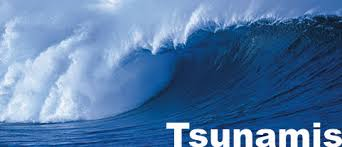
A tsunami, also known as a seismic sea wave, is a series of waves in a water body caused by the displacement of a large volume of water, generally in an ocean or a large lake.
Casual Factors of Tsunamis
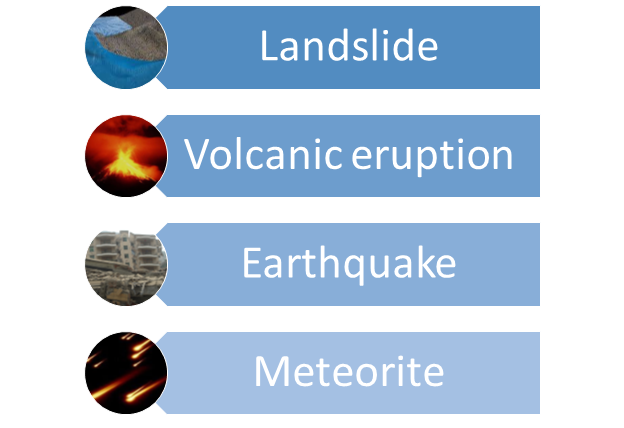
Can you guess which one is the number one cause of a Tsunami?
|
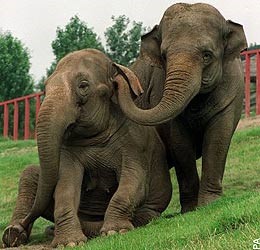
Did you know elephants moved to higher ground before the Asian tsunami on Boxing Day, 2004.
|
Task
This webquest is going to focus on getting students involved in our oceans. To learn how they are not just beautiful but can be dangerous.
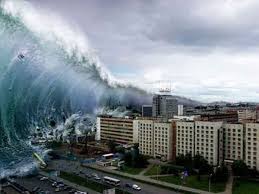
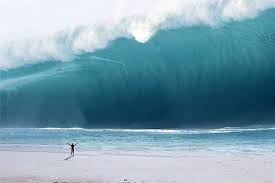
Upon completing this webquest you will be more knowledgeable about tsunamis. You will learn why they happen and the aftermath. You will see a few pictures to give you an idea of what a tsunami looks like and the distruction it leaves behind.
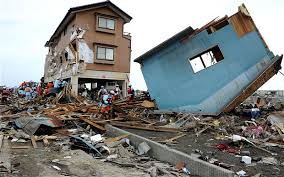
At the end of the webquest you will need to write 5 things you learned about tsunamis.
Process
You will need to learn more about Seismic Sea Waves through a couple of basic questions:
1) What causes tsunami? Click here to the answer
2) What are the characteristics of a tsunami? Click here to the answer
3) How fast does a tsunami travel? Click here to the answer
4) What does a tsunami look like when it reaches shore?

Evaluation
|
CATERGORY |
EXCELLENT (4 POINTS) |
GOOD (3 POINTS) |
FAIR (2 POINTS) |
POOR (1 POINT)
|
|
QUALIITY OF INFORMATION |
Information clearly relates to the main topic. It includes several supporting details and/or examples. |
Information relates to main topic but lacking supporting details in areas. |
Information somewhat relates to the main topic but not clear and concise. |
Information has nothing to do with the main topic. |
|
ORGANIZATION |
Excellent organization of ideas. Excellent us of paragraphs and sentence markers. |
Good organization of ideas Good use of paragraphs and sentence markers. |
Little organization of ideas. Paragraphs and sentence markers were used, but with some errors. |
Poor organization of ideas. No paragraph and sentence marker errors. |
|
DESIGN, PICTURES & GRAPHICS |
Excellent use of design, pictures and graphics. Clearly relates to main topic. |
Good use of design, pictures and graphics. Clearly relates to main topic. |
Adequate (fair) use of design, pictures and graphics. Somewhat relates to main topic. |
Poor use of design, pictures and graphics. No relation to main topic. |
|
VOCABULARY & SPELLING |
Excellent use of vocabulary and spelling with no errors. |
Good use of vocabulary and spelling with minimal errors. |
Adequate (fair) us of vocabulary and spelling. Some misuse of words and spelling errors. |
Poor use of vocabulary and spelling. To many errors. |
|
GRAMMER & PUNCTUATION |
Excellent use of grammar and punctuation. No errors are present. |
Good use of grammar and punctuation. A few errors are present. |
Adequate (fair) use of grammar and punctuation. Some errors are present. |
Poor use of grammar and punctuation. Many errors can be found. |
Scoring Table:
|
Excellent |
20-16 |
|
Good |
15-12 |
|
Fair |
11-7 |
|
Poor |
6 or less |
Conclusion
Congratulations all middle school students who have gone through the tsunami quest.
You are now one step closer to knowing how the ocean works.
Hope this quest you just went through has made a better understanding of how and why tsunamis happen.
Credits
Thanks, to the Foxtrot group participation. We sucessfully completed a webquest!
Introduction: Ana Garcia
Task: Victoria Arnold
Process: Manon Geoffroy
Evaluation: Edward Morales
Conclustion: Victoria Arnold