
Introduction
There are big differences between handicaps and disabilities. It's a common misconception to use them interchangeably.
When we use the word disability, we are talking about “those limitations that a person can overcome or compensate for by some means” (Samovar, Porter, McDaniel, & Roy, 2015, p. 163). But handicaps, something entirely different, occur as soon as “the physical or social environment interacts with it to impede a person in some aspect of his or her life” (Samovar et al, 2015, p. 164). We, as a society, create handicaps all the time by not making businesses and public places accessible to those with mobility impairments.
We create social handicaps, as well.
Another type of marginalization occurs when Temporarily Able Bodied people (TABs) do not grant accessibility for people with disabilities into relationship or friend groups. There are many reasons for this. Sometimes it's because TABs feel uncomfortable and don't know what to do. For fear of saying or doing the wrong thing, they say and do nothing, often avoiding contact with people with disablities. Regardless of the motives, it's ostracizing. Dealing with this "loss of status and power" in relationships and throughout society, people with disabilities are moving towards redefinition: creating "new ways of perceiving themselves and their disability" and developing new "ways of communicating as a result" (Samovar et al, 2015, p. 167).
Throughout the webquest, you will have a chance to:
1.) learn about the issue of accessibilty for people with mobility impairments
2.) change the way you evaluate people with disabilities
Throughout this webquest, you will find questions to think about and discuss highlighted in blue.
Let's get started.
Task
NOT EVERY DAY IS A TRIP TO THE MALL
Susan Skoney explains how individuals with disabilities are “a segment of the population that are being underserved”. “They can’t worship, they can’t shop, they can’t get medical attention… I think a lot of people will just give up.” She also plays on the word invalid, explaining how lack of accessibility and the loosely written text of the ADA makes her feel invalidated as a person.
Read through the news article and/or listen to the story with the link near the top of the page. (4:39)
http://news.wbfo.org/post/raising-accessibility-awareness-wheelchair-users#stream/0
After listening to this, you might have a better idea of how difficult it is to navigate the world with a mobility impairment. There are many factors that Temporarily Able Bodied folks (TABs) don’t think about. The mall’s general manager noted that there was an automatic door at one other location in this mall. Just go to that door, right?
In order to gain access to that door, you must find a closer parking spot. There are tons of spots for people with disablities. Oh. Wait. Someone blocked this one.
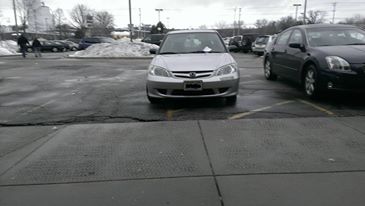
Since you use a wheelchair, you need that entire space between parking spots to open your door and transfer from your car into your wheelchair. It looks like this
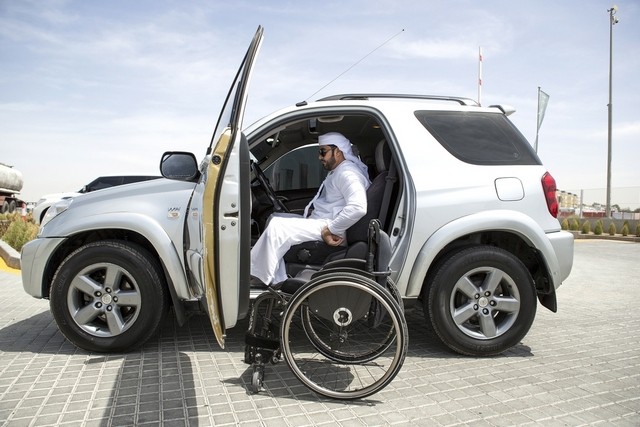
There are many people who abuse parking spaces. Check out this subreddit (note: some of the responses contain strong language).
https://www.reddit.com/r/badparking/search?q=disabled&restrict_sr=on&so…
How often do you see this in your daily life? What do you think we can do to impact this issue?
Listen to this news story:
https://www.youtube.com/watch?v=WZAwDAdyvpU
So we've pretty much nailed down that we should leave disabled parking spaces for those with disabilities. Let's get back to our trip to the mall...
- Imagine the last mall you went to.
- Now imagine having to navigate half of the circumference of the OUTSIDE of that mall before you can find an entrance.
- Also imagine we are in Wisconsin and it’s snowing.
- How far away from each other were your two favorite stores?
- Would you like to go to a third store? Are you sure?
- Then save enough energy to wheel yourself through the mall, attempt to pay for your purchases at counters that are taller than you, wheel yourself back to that one lonely door, go halfway around the outside of the mall again, and then transfer yourself and your wheelchair back into your car. It's still snowing, by the way.
- I hope you don’t have to use the bathroom. Perhaps there is a bathroom large enough to fit you and your wheelchair but there's not enough room to transfer onto a toilet seat.
Today's adventure was as easy or as difficult as you decided to make it in your head. You had the control. The same is not the case for those with disabilities. Accessibility is an adventure that some people can not choose whether or not they go on.
Process
ACCESSIBILITY
Jason DaSilva is a filmmaker, accessibility advocate, and a man with MS. He created a film entitled When I Walk (it’s available on Netflix! learn more about it here: http://www.pbs.org/pov/wheniwalk/) that chronicles his journey through the first few years of his struggle with MS, beginning with the diagnosis and then his increased mobility issues as the disease progressed. One of the striking differences that he noticed from being a TAB to having a mobility impairment that required use of an electric scooter was his inability to frequent businesses. He couldn’t find places to get groceries, go out to dine, or just enjoy live music in bars. Most days were spent looking for places to go and he wasted large amounts of time not finding anyplace accessible. This is how he birthed the idea of AXS map.
If there was a way he could find out ahead of time whether or not he’d be able to frequent an establishment, it would save time and money. So he set out to make that happen. His AXS map website was born. AXS map allows you to look up area businesses to find out if they’re accessible. It’s an interactive website where people can also rate businesses they’ve been to. Users can rate if it’s wheelchair accessible, how many steps there are in the entrance, the accessibility of the bathrooms, but it also addresses other accessibility concerns. Users can add other ratings, like if it’s spacious, quiet, well-lit, is a good place for service animals, or has nearby accessible parking.
http://www.axsmap.com/?gclid=CNSt54SexssCFZE0aQodBpoB4A
- If you look up "Chinese food" in Whitewater, for example, many businesses are listed but none are rated.
- If you search “food” in Madison, WI, you will find that a few places have ratings.
- Take a peek at Starbucks. I’m meeting a friend with a spinal cord injury. Would this be a good place to have coffee?
- Check out food in San Diego, CA and read the review for The Melting Pot.
- Look up “everything” in New York and find out if you can take your friend in a wheelchair to Patriot Tours, Inc.
Until ALL businesses are accessible, we have to rely on sites like AXS. But what if your potential lunch spot isn’t reviewed? We simply have to a.) go there and find out there’s no way to receive service or b.) search for clues on the business’s website. Find out if you can meet your friend with a mobility impairment to The Sunroom Café on State Street in Madison.
http://www.sunroomcafe.com/Pages/default.aspx
A friend of mine, Sarah, received a spinal cord injury a few years ago and is now a wheelchair user. She recognizes both the negatives and the positives of businesses who work toward accessibility. But sometimes it’s still a difficult road to travel. Here is her review of Red Sushi, a restaurant in Madison:
So, there are stairs to the main entrance. However, around back (along the side street) they do have accessible rampy-type thing. However, it's in the back of the restaurant. Now, if you cycle the pics half way down the home page (http://www.redsushi.net), you can see two different rows of seating. They are parallel rows. One row of tables, and then seats at the sushi bar. If NO ONE is seated anywhere in this rows, then I can go from back to front of the place, easy. This, however, is rarely the case. People at tables, people at the bar, I cannot get through without someone scooting their chair far in, or getting out of their seat entirely. It sucks.
Next time you go to your favorite restaurant, gas station, movie theatre, or store, take a look at your surroundings and evaluate them from an accessibility perspective.
Evaluation
CHANGING THE CONVERSATION
This discussion of accessibility is not intended to make you feel uncomfortable or make you feel sorry for those with disabilities. In fact, those reactions hinder communication with people with disablities. The next time you see someone in a wheelchair or with some other form of physical disability and you want to engage in a conversation, you might not know what to say because of lingering guilt. In your head, you could be thinking
It's easy for me to get in and out of places. They have it so much harder. Should I reach out to them and tell them about this webquest? Tell them about the things I'm learning about in my communications class? No. That'd be weird. I don't want to bring up the fact that I noticed that they're in a wheelchair. I should notice that they're a person first. That's the right thing to do, right? But then what should I say to them? Forget it. I'm not going to say anything. I'll just fumble my words and it'll all come out wrong and I should just keep my mouth shut.
People with disabilities see your discomfort. It's plain in your "greater physical distance, avoid(ing) of eye contact, avoid(ing) mention of the disability, and cutting the conversation short" (Samovar et al, 2015, p. 167). By avoiding conversations and contact with people with disabilities, your creating a need for THEM to make YOU feel more comfortable. Some people with disabilities even "described situations in which they might accept help that they did not need because they understood that refusing help might increase the discomfort and uncertainty of the nondisabled person" (Samovar et al, 2015, p. 166).
Let's change the conversation to recognize them as individuals.
Meet Brian, who created his own youtube channel, Paralyzed Living, to help explain obstacles to other patients with spinal cord injuries:
https://www.youtube.com/channel/UCsj_H-WErsT4PDglcMseatw
Brian doesn't need the sympathy of TABs. He is interested in educating and including and learning and living. He talks about everything from wheelchair repair to bathing to sex. Check out a few of his videos. They're great.
https://www.youtube.com/user/blackpearlv6/videos
Which was your favorite?
Which was most surprising?
Let's take one final look at a person with a disability, Sue Austin, who sees her chair as something that frees her. She also notices the way that people look at her. "They seemed to see me in terms of thier assumptions of what it must be like to be in a wheelchair." She doesn't want to internalize these responses that other people had of her anymore. So she changed the story.
https://www.ted.com/talks/sue_austin_deep_sea_diving_in_a_wheelchair?la…
What is different about Sue's view of her disability?
Conclusion
FINAL THOUGHTS
How do you look at accessibility differently now?
- What can be done to improve accessiblity at your favorite businesses?
- Think about parking, snow removal, entrances, restrooms, and anything that would render a disabled person handicapped.
How do you look at making social situations more accessible to those with disabilities?
- What are your strategies for engaging instead of avoiding?
After learning more about Brian and Sue, how have your views of those with disabilities changed?
Thank you for taking the time to work through this webquest
And thank you also for being a future advocate for physical and social accessibility.
Credits
Samovar, L. A., Porter, R. E., & McDaniel, E.R. (2015). Intercultural Communication: A Reader. (14th Ed.). Belmont, CA.: Wadsworth.
picture of driver with mobility impairment courtesy of
http://www.thenational.ae/uae/transport/disabled-drivers-want-stronger-…