
Introduction

It is that time of year again. It is time for those pesky cross class projects! This year however, I promise to make it a fun project. In ELA you have been focused on doing research and writing essays. In science we just finished talking about the solar system. Now we are going to combine the two!!
Task

This week you and a partner are going to spend time creating a poster and essay on a planet. You will then present your poster and planet to the class. You will be given a handout with several questions to answer. If you lose your handout don't freak out on me. The questions from the handout are in the task section. Just grab a piece of regular paper and get going. But I will also put a few extra copies of the handout next to the charging station.
LETS GET STARTED!!!!
Process
**Use the following websites to find the answer to the following questions on your Planet Information Worksheet**

1.Draw the planet’s symbol:
http://solarsystem.nasa.gov/galleries/solar-system-symbols
2.Describe how the planet got its name: Don't forget to look for your planet under the planet tab.
3. Orbit and Rotation: http://solarsystem.nasa.gov/planets/
Number of days to orbit around the sun:
Perihelion (how close does it get to the sun?):
Aphelion (how far does it get from the sun?):
Length of one day (number of hours in one day):
4. Planet Measurements: http://solarsystem.nasa.gov/planets/
**Don't forget to look for "more" stats.
Mass:
Volume:
Equatorial Circumference:
Mean Density:
5. If you weighed 100lbs. on Earth, how much would you weigh on your planet? http://www.exploratorium.edu/ronh/weight/
6. Does your planet have rings, satalites, or both? http://www.kidsastronomy.com/solar_system.htm
**If your planet has rings, satalites, or both list 3 of the most interesting facts about the rings and 3 biggest satalites.**
7. Composition – describe the core and surface composition: http://www.kidsastronomy.com/solar_system.htm
8. In 4-5 sentences describe your planet based on pictures you have found at this site as well as the others.http://photojournal.jpl.nasa.gov/Help/ImageGallery.html
9. Atmosphere – List the major and minor gases: http://www.msnucleus.org/membership/html/k-/uc/solar_system/5/ucss5_3a.html
10. Now that you have all of your information, work with your partner to put it into essay formart. You need an introduction, body, and conclusion. You will then need to create a poster for your planet.
11. Don't forget to have fun with this!
Evaluation
There will be three evaluations for this activity. You will have one evaluation on your essay, one for your poster, and one on your presentation of information to the class. You can find the rubrics for both evaluations below.
Essay Evaluation:

Pressentation Evaluation:
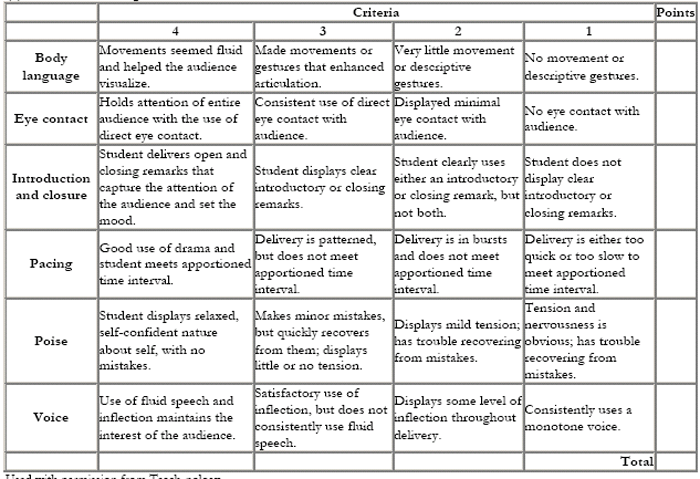
Poster Evaluation:

Conclusion
Through this WebQuest, you and your partner have learned many interesting facts about your planet. However, there is so much left to learn about your planet and the other plantes in our Solar System. There are so many unaswered questions about space and the planets. Now you will take time to reflect on your quest. Think back on what you have learned. Take time to go home and tell someone who isnt' in our class about what you have learned. Based on everything you've learned is it possible for us as human beings to live on another planet other than Earth? Why or why not? What has been your favorite planet based on what you have heard from your classmates? Take a moment to really reflect on your in chair exploration of space.
**After this lesson the you will know the solar system, the order of the planets, scientific facts and should enjoy every moment of it.

Credits
This WebQuest was created by Ms. H.E. Pollan, a second year elementary teacher. The quest was created to meet several of the Mississippi State Standards for Science and English Language Arts.
Science Standard:
EARTH AND SPACE SCIENCE
4. Develop an understanding of the properties of Earth materials, objects in the sky, and changes in Earth and sky.
f. Compare and contrast the physical characteristics of the planets (e.g., mass, surface gravity, distance from the sun, surface characteristics, moons).
English Language Arts:
Key Ideas and Details
RI.5.2 Determine two or more main ideas of a text and explain how they are supported by key details; summarize the text.
Integration of Knowledge and Ideas
RI.5.7 Draw on information from multiple print or digital sources, demonstrating the ability to locate an answer to a question
quickly or to solve a problem efficiently.
RI.5.9 Integrate information from several texts on the same topic in order to write or speak about the subject knowledgeably.
Presentation of Knowledge and Ideas
SL.5.4 Report on a topic or text or present an opinion, sequencing ideas logically and using appropriate facts and relevant, descriptive
details to support main ideas or themes; speak clearly at an understandable pace.
Text Types and Purposes
W.5.2 Write informative/explanatory texts to examine a topic and convey ideas and information clearly.
Research to Build and Present Knowledge
W.5.7 Conduct short research projects that use several sources to build knowledge through investigation of different aspects of a topic.
W.5.8 Recall relevant information from experiences or gather relevant information from print and digital sources; summarize or
paraphrase information in notes and finished work, and provide a list of sources.
Websites Used:
[1] http://solarsystem.nasa.gov/galleries/solar-system-symbols
[3] http://solarsystem.nasa.gov/planets/
[4] http://www.exploratorium.edu/ronh/weight/
[5] http://www.kidsastronomy.com/solar_system.htm
[6] http://photojournal.jpl.nasa.gov/Help/ImageGallery.html
[7] http://www.msnucleus.org/membership/html/k-6/uc/solar_system/5/ucss5_3a…