
Introduction
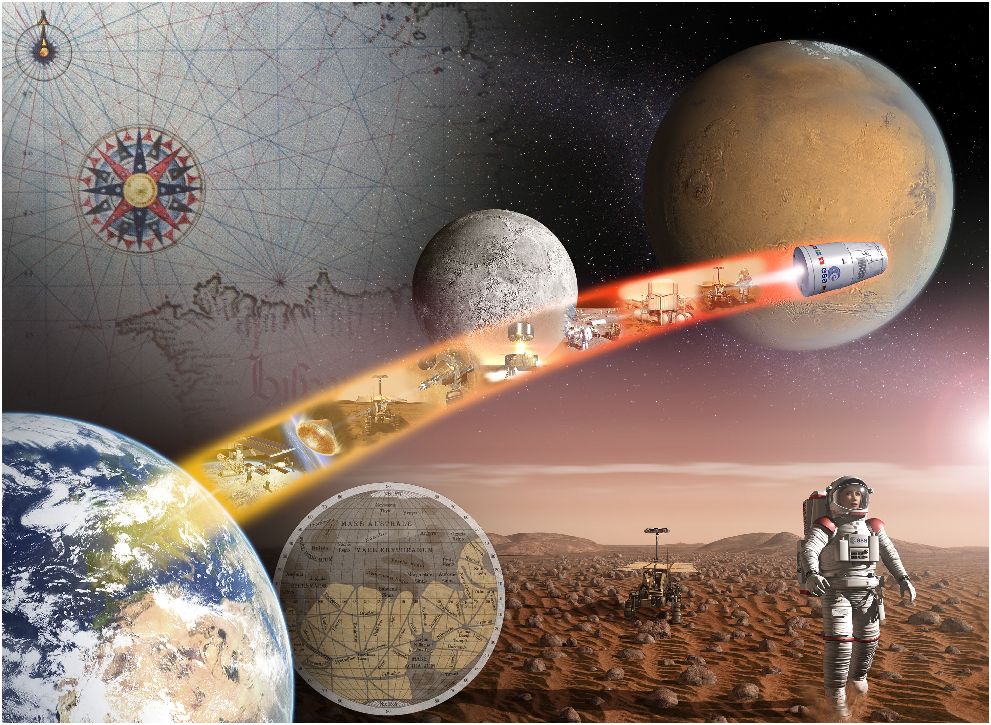
Space exploration is the ongoing discovery and exploration of celestial structures in outer space by means of continuously evolving and growing space technology. While the study of space is carried out mainly by astronomers with telescopes, the physical exploration of space is conducted both by unmanned robotic probes and human spaceflight.
While the observation of objects in space, known as astronomy, predates reliable recorded history, it was the development of large and relatively efficient rockets during the early 20th century that allowed physical space exploration to become a reality. Common rationales for exploring space include advancing scientific research, uniting different nations, ensuring the future survival of humanity and developing military and strategic advantages against other countries.
Space exploration has often been used as a proxy competition for geopolitical rivalries such as the Cold War. The early era of space exploration was driven by a “Space Race” between the Soviet Union and the United States, the launch of the first man-made object to orbit the Earth, the USSR’s Sputnik 1, on 4 October 1957, and the first Moon landing by the American Apollo 11 craft on 20 July 1969 are often taken as landmarks for this initial period. The Soviet space program achieved many of the first milestones, including the first living being in orbit in 1957, the first human spaceflight (Yuri Gagarin aboard Vostok 1) in 1961, the first spacewalk (by Aleksei Leonov) on 18 March 1965, the first automatic landing on another celestial body in 1966, and the launch of the first space station (Salyut 1) in 1971.
After the first 20 years of exploration, focus shifted from one-off flights to renewable hardware, such as the Space Shuttle program, and from competition to cooperation as with the International Space Station (ISS).
With the substantial completion of the ISS following STS-133 in March 2011, plans for space exploration by the USA remain in flux. Constellation, a Bush Administration program for a return to the Moon by 2020 was judged inadequately funded and unrealistic by an expert review panel reporting in 2009. The Obama Administration proposed a revision of Constellation in 2010 to focus on the development of the capability for crewed missions beyond low earth orbit (LEO), envisioning extending the operation of the ISS beyond 2020, transferring the development of launch vehicles for human crews from NASA to the private sector, and developing technology to enable missions to beyond LEO, such as Earth/Moon L1, the Moon, Earth/Sun L2, near-earth asteroids, and Phobos or Mars orbit. As of March 2011, the US Senate and House of Representatives are still working towards a compromise NASA funding bill, which will probably terminate Constellation and fund development of a heavy lift launch vehicle (HLLV).
Task
In order to understand the topic, you need undergo several tasks.
TASK 1:
What is a space probe?
TASK 2:
Differentiate the three types of space probes and give examples each.
TASK 3:
Contributions of the 10 greatest space probes.
TASK 4:
Design a Space Probe
- design a space probe to measure weather on another planet
- sketch and/or build a space probe
- give and get feedback from peer reviewers
- label and provide measurements for the space probe and instruments
Process
These links will help you answer the following tasks:
Evaluation
Use the Space Probe Design Rubric to grade each student's final product, the drawing or model, plus the paragraph description and design review form.
Click the link to assess your work.
http://media.education.nationalgeographic.com:8080/assets/file/0752a_Worksheet.pdf
Conclusion
Unfolding the mysteries of the dark and silent space with no known boundaries has always been a dream of the human race. The desires of man has ultimately been accomplished through the exploration of space using various space launching vehicles, space probes and satellites.
Contributions made by US and USSR in the field of space science is worth mentioning. The satellites monitor weather, establish the communication between people, between different parts of the world and last but not the least they are pouring in more and more information about various celestial objects everyday.
The applications of space technology are expanding at such a pace that the present era can truly be called 'the space age'.
A space probe is an unmanned space mission in which a spacecraft leaves Earth's orbit. The first successful space probe was the Soviet Luna 1, which studied the Moon in 1959. Subsequently, space agencies in the United States, Europe and Japan have flown probes to each of the eight other planets in the solar system and several asteroids and comets.
Many space missions are more suited to unmanned missions rather than manned space missions, due to lower cost and lower risk factors. In addition, some planetary destinations such as Venus or the vicinity of Jupiter are too hostile for human survival, given current technology. Outer planets such as Saturn, Uranus, and Neptune are too distant to reach with current manned spaceflight technology, so unmanned probes are the only way to explore them.
Credits
- http://education.nationalgeographic.org/media/space-probes/
- https://www.newscientist.com/blog/space/2007/11/10-greatest-space-probes-ever-flown.html
-
http://www.nasa.gov/centers/jpl/education/spaceprobe-20100225.html
-
http://education.nationalgeographic.org/activity/design-a-space-probe/
-
http://media.education.nationalgeographic.com:8080/assets/file/0752a_Worksheet.pdf
Teacher Page
Thank you for visiting my Webquest.