
Introduction
This WebQuest is an exploration of the relationship between the earth and the sun. Through this inquiry you will understand what the sun is and what makes it so important to the earth. You will discover how our planet depends on the sun, what resources it relies on from the sun, and how it utilizes these resources.
Task
Your tasks will be to find out everything you can about the sun and the earth's interaction with each other.
1. How big is the sun? How big is the earth?
2. How far apart are the earth and sun?
3. Where are the earth and sun positioned within our solar system?
4. What is the surface of the sun like? In what ways does the sun's surface benefits the earth?
5. In what ways do the earth and sun interact?
6. What parts of the sun does the earth use, and how does it do so?
7. What would happen to the earth if it was one planet closer or farther from the sun?
Process
Begin researching the sun, the center of the solar system. Explore the following links and answer the questions from this page, which align with the tasks section. Record your findings, including any unseen discoveries for each question in your science journal.
How big are the sun and the earth? Are they close in size or very different? Is this typical for other similar types of planets or stars?
http://coolcosmos.ipac.caltech.edu/ask/5-How-large-is-the-Sun-compared-…-
Are the sun neighbors? How close do they live to each other? Is this a good distance?
http://www.space.com/17081-how-far-is-earth-from-the-sun.html
http://earthsky.org/astronomy-essentials/how-far-is-a-light-year
Where do the earth and sun exist within our solar system? Are they alone?
http://solarsystem.nasa.gov/planets/
http://www.kidsastronomy.com/solar_system.htm
Discover the sun, it's surface, and how it benefits all life on earth.
http://www.thesurfaceofthesun.com/
https://www.youtube.com/watch?v=2U3ucaVzRqQ
http://www.space.com/17137-how-hot-is-the-sun.html
http://www.world-builders.org/lessons/less/biomes/SunEnergy.html
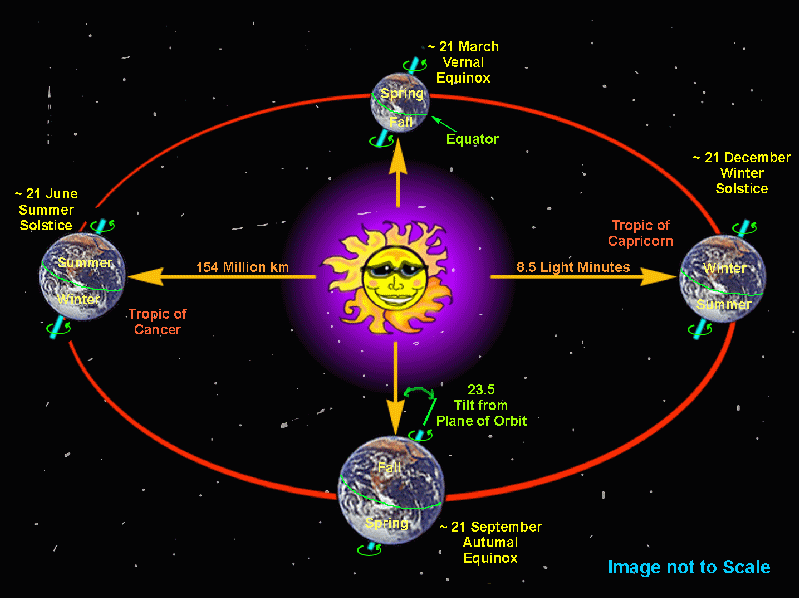
Revolutions, rotations and orbits. What's all the spinning about? What is an axis and what does it have to do with seasons?
http://space-facts.com/the-sun/
http://spaceplace.nasa.gov/seasons/en/
http://education.nationalgeographic.org/encyclopedia/axis/
http://aa.usno.navy.mil/faq/docs/seasons_orbit.php
How does life on earth depend on the sun?
http://www.portageinc.com/community/pp/plant.aspx
Shall we swap places with Mercury, Venus or Mars?
http://www.space.com/28355-living-on-other-planets.html
Once you have collected and recorded all your data, write a one page summary essay on your discoveries, highlighting one or two important aspects about each area of the earth’s and sun’s relationship.
Evaluation
|
Exemplary 20-25 PTS |
Effective 15-20 PTS |
Developing 10-15 PTS |
Needs improvement 5-10 PTS |
Ineffective 0 PTS |
|
|
CONCEPT CLASSIFICATION
|
STUDENT WAS ABLE TO ORGANIZE ALL THE PLANETARY INFORMATION INTO APPROPRIATE CATEGORIES |
STUDENT WAS ABLE TO ORGANIZE MOST OF THE PLANETARY INFORMATION INTO APPROPRIATE CATEGORIES |
STUDENT WAS ABLE TO ORGANIZE SOME OF THE PLANETARY INFORMATION INTO APPROPRIATE CATEGORIES |
STUDENT WAS UNABLE TO ORGANIZE MOST OF THE PLANETARY INFORMATION INTO APPROPRIATE CATEGORIES |
STUDENT DID NOT ORGANIZE THE PLANETARY INFORMATION INTO APPROPRIATE CATEGORIES |
|
COMMUNICATION |
STUDENT COMMUNICATED INFORMATION VERY EFFECTIVELY |
STUDENT COMMUNICATED MOST INFORMATION EFFECTIVELY |
STUDENT COMMUNICATED SOME INFORMATION EFFECTIVELY |
STUDENT WAS UNABLE TO COMMUNICATE MOST INFORMATION EFFECTIVELY |
STUDENT DID NOT COMMUNICATE ANY INFORMATION |
|
ENGAGEMENT
|
STUDENT PARTICIPATED IN ALL ACTIVITIES AND COMPLETED ALL TASKS ON TIME |
STUDENT PARTICIPATED AND COMPLETED ALL TASKS ON TIME |
STUDENT PARTICIPATED SOMEWHAT AND COMPLETED MOST TASKS ON TIME |
STUDENT DID NOT PARTICIPATE WELL OR COMPLETE ALL OF THE TASKS ON TIME |
STUDENT DID NOT PARTICIPATE OR COMPLETE ANY TASKS ON TIME |
|
TECHNOLOGY |
STUDENT SHOWED EXCELLENT USE OF TECHNOLOGY | STUDENT SHOWED EFFECTIVE USE OF TECHNOLOGY | STUDENT SHOWED SOME USE OF TECHNOLOGY | STUDENT SHOWED LITTLE USE OF TECHNOLOGY | STUDENT SHOWED NO USE OF TECHNOLOGY |
Conclusion
During this WebQuest inquiry, you have learned many things about the sun and the earth’s relationship and how the earth and other planets rely on our star, the sun. This WebQuest has only given you fundamental ideas about what exists that creates and sustains life in a small part of the universe. There is still so much more you can learn about the earth, the sun and our solar system.

The next step is to reflect on what you have learned and to share this with your friends and family. Tell them how incredible the sun is, what it does for us and if it’s possible for human to live on another planet.
Credits
Credits
Cool Cosmos (2104). Size of the sun. Retrieved February 3, 2016 from,
http://coolcosmos.ipac.caltech.edu/ask/5-How-large-is-the-Sun-compared-…-
Space.com (2016). Distance between earth and sun. Retrieved February 3, 2016 from,
http://www.space.com/17081-how-far-is-earth-from-the-sun.html
Earth and Sky (2013). Distance of a light year. Retrieved February 3, 2016 from,
http://earthsky.org/astronomy-essentials/how-far-is-a-light-year
NASA (2016). The planets. Retrieved February 3, 2016 from,
http://solarsystem.nasa.gov/planets/
Kids Astronomy (2012). Our solar system. Retrieved February 3, 2016 from,
http://www.kidsastronomy.com/solar_system.htm
Surface of the sun (2014). Aspect of the sun Retrieved February 3, 2016 from,
http://www.thesurfaceofthesun.com/
YouTube (2016.) The sun like you’ve never seen it. Retrieved February 3, 2016 from,
https://www.youtube.com/watch?v=2U3ucaVzRqQ
Space.com (2016). Temperature of the sun. Retrieved February 3, 2016 from,
http://www.space.com/17137-how-hot-is-the-sun.html
World Builders (2013). The suns energy. Retrieved February 3, 2016 from, http://www.world-
builders.org/lessons/less/biomes/SunEnergy.html
Space.com (2016). The sun. Retrieved February 3, 2016 from, http://space-facts.com/the-sun/
NASA (2016). The planets. Retrieved February 3, 2016 from,
http://spaceplace.nasa.gov/seasons/en/
National Geographic. (2011). The Earth’s axis. Retrieved February 3, 2016 from,
http://education.nationalgeographic.org/encyclopedia/axis/
USNO (2010). The earth’s orbit. Retrieved February 3, 2016 from,
http://aa.usno.navy.mil/faq/docs/seasons_orbit.php
Space.com (2016). Life on other planets. Retrieved February 3, 2016 from,
http://www.space.com/28355-living-on-other-planets.html
NHDOE (2006). K-12 Science Literacy New Hampshire Curriculum Framework. Retrieved
February 3, 2016 from, www.ed.state.nh.us/frameworks
Teacher Page
My Name is Lucas Orthmann, I am a graduate student working on an M.Ed. at Franklin Pierce University, earning my first certification in K-8 education.
This WebQuest was developed for a 5th grade science lesson. Students engaged in a web-based science inquiry activity on the topic of the sun and earth’s relationships and effects on our solar system. This inquiry aligns with earth and space science curriculum;
Relevant NHDOE Standards:
612.04 (1) In the area of curriculum and assessment, demonstrate the ability to promote student learning in Earth and Space Science
Science through knowledge and application of:
Basic concepts, structure of knowledge, and history in the 4 domains of science:
(i) Earth and space science;
New Hampshire Science Curriculum Framework
S:ESS2:6:1.2. Recognize that of all the known planets, Earth appears to be somewhat unique; and describe the conditions that exist on Earth that allow it to support life.
S:ESS2:6:2.1. Recognize how the tilt of the Earth’s axis and the Earth’s revolution around the Sun affect seasons and weather patterns.
S:ESS2:6:2.2. Identify and describe seasonal, daylight and weather patterns as they relate to energy.
S:ESS2:8:1.1. Identify the characteristics of the Sun and its position in the universe.
S:ESS2:8:2.1 Describe the Sun as the principle energy source for phenomena on the Earth’s surface.