
Introduction
Water covers most of the Earth’s surface and all living things need it. No organism can live without water for long. For this reason, water is the Earth’s most important resource.
Over 2/3 of the earth's surface is covered in water, about 96% of this is in oceans and seas. The remaining 4% is water vapour in the air around us, in the clouds, in rivers and lakes and in the ground.
Students will be reflecting on the water cycle and urban water cycle before exploring the geography of the Parramatta river. They will learn about the pollution in the river and community groups work on cleaning up the river. Students will investigate and classify natural and exotic wildlife found in and around the river.
This webquest is integrated into the H2.......whered does it gO? unit of work in preparation for a science/geography fieldwork excursion to the Parramatta River where students will engage with the Aboriginal history of Parramatta, making geographical and scientific observations and undertaking water quality experiments
Task
As a school we have made a commitment to use energy efficiently, recycle as much as we can and our school garden produces lots of produce that our Food Tech students use in their cooking! We have recently had solar panels installed and our Yr 11 Agriculture students are keeping our worm farms producing plenty of 'worm wee' for the gardens. We think we are doing well in our school but how is our local environment doing?
Last year you covered the water cycle in the renew or use unit on the earth resources.
You are going to be studying the Parramatta River You will research the native and introduced flora and fauna and use your geography mapping
You will then find out our local catchment area, map it and prepare for our fieldwork excursion!
You will have a virtual fieldwork booklet which will need to be handed in at the end.
You will work in pairs for the virtual fieldwork. Your partner is to be your assigned partner for experimental work in science.
So, if you're not sat next to them already GO! and if you can't remember who it is then hands up, Miss is ready with the list!
Process
Lesson Two of unit
Activity One
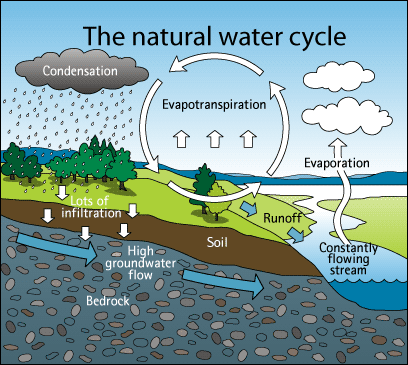
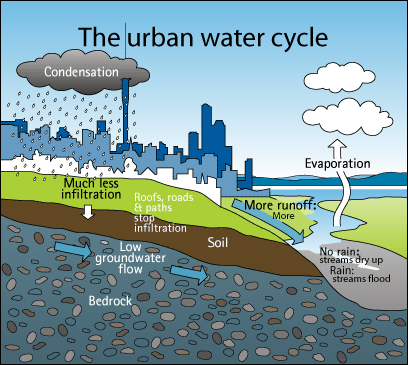
http://www.blueplanet.nsw.edu.au/year-7-and-8-natural-and-urban-water-cycles/.aspx
If you have finished both of these activities and you still have lesson time left think about what could influence the water cycle. What impact would a chemical spill have in the urban water cycle? How would a chemical spill affect the natural water cycle?
Lesson 3 of unit
Open Google Earth
1) Use Google Earth street view and the read attached articles to help you produce annotated sketches of the area of Parramatta River
2) Insert your annotated sketches into workbook as ONE example of PRIMARY research. (You should have others such as photos, a survey, interviews etc as well from your fieldtrip).
For example, you may use your own sketches, your own pictures or Google Earth street view screen shots to show examples of evidence of community in-situ. You may identify street furniture, architecture, signage and/or symbols that reflect your community. Annotate these on your sketch or picture.
Lesson Four of unit
Activity One
Watch the following video and answer the questions in your booklet
[video:https://www.youtube.com/watch?v=qX-0KLE9jYM&feature=youtu.be]
Activity Two
Using these websites answer the questions in your booklet
http://www.ourlivingriver.com.au/our-mission/
Activity Three
Think about what the Parramatta River means to you and your family...... Have you been to a family party at Artillery Wharf? Have you ever travelled on the Parramatta ferry? Maybe you've walked along the river to get to school today? Have you ever thrown bread to ducks that live on the river?
Now you've seen how we are all damaging the river through how we use it, consider how your use may have impacted on the river. Discuss with your partner and critically analyse how your activities may be contributing to the pollution problem of the Parramatta River. Write your answers in your workbook.
Lesson Eight of unit
In the Unit 'identifying the difference' you recently did you were introduced to keys and using keys to classify animals. Today we will be using virtual fieldwork to see what animals live in or around the Parramatta River and classifying them using a key
Activity One
Complete the activity in your work book.
Activity Two
Complete the activity in your work book.
Activity Three
Watch the videos and note down what animals you see. When you have watched the videos use your key to classify each animal as mammal, reptile, amphibian or bird.
[video:https://youtu.be/xzvdE-LbKcw]
{http://www.ourlivingriver.com.au/media/1102/prcg_fauna_habitat_lowres_p… -read report and either insert pictures and names of animals identified in study or set up on external website for students to look at}
{insert some fieldwork videos taken on Parramatta River to showcase diversity of wildlfe students may see on their excursion}
Evaluation
Conclusion
Well done on completing your webquest. You are now ready to go on our excursion to Parramatta River
Make sure you take lots of notes and use cameras to record anything you want to look at later. Remember not to take anything away from the site but your memories and notes and not to leave anything there except your footprints.
Have fun!