
Process
Now that students have been taught the information about water availability, management and pollution, they will begin a three day investigation to further enhance and apply their knowledge. This will a self paced activity with the requirement to complete at least one activity per chapter section and two additional activities
11.1
- Ogallala point of view activity- choose five roles to read and complete the student work sheet for each of those roles
https://www.plt.org/places-we-live-activity-8---regional-community-issues--the-ogallala-aquifer
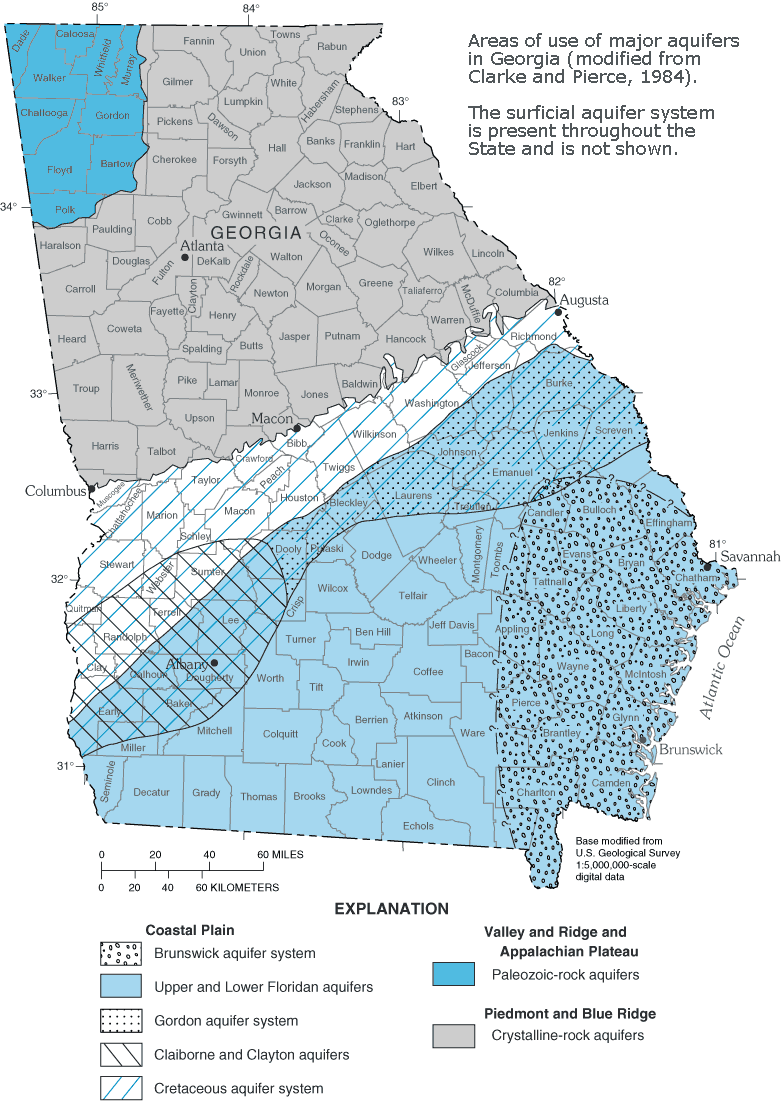
- Using the watershed, river basin (first two pages of link below) and aquifer maps (http://pubs.usgs.gov/sir/2005/5065/images/Intro_aquifer_map.gif ), create a map of Georgia that combines the three different maps into one map. Then use a basic map (http://www.netstate.com/states/geography/mapcom/ga_mapscom.htm ) to locate Atlanta, Savannah, Columbus, Augusta, Macon, Valdosta and Gray. Write a paragraph to explain the relationship between the combined map and the location of the large cities in Georgia.
http://www.georgiaadoptastream.com/Manuals_etc/Watershed/Watershed.pdf?15-0909
11.2
- Using the internet, research hydroelectric dams in Georgia by going to the link below. Create a list of hydroelectric dams, including the rivers that they are located on. Using the map of Georgia rivers and lakes, locate each of the dams you have identified. Use the link Hydro Projects to find information about Wallace Dam and write a summary of this information- must include location, amount of power generated, reservoirs surrounding the dam, information from the timeline of Wallace Dam.
https://www.georgiapower.com/about-energy/energy-sources/hydro-power/home.cshtml
- Use the following link to estimate your personal or family water usage. Find some areas of usage where you or your family could decrease your usage. Write a conservation plan for your family including which person or persons is responsible for each of the steps included.
http://www.waterconservationschool.com/watercalculator.htm
- Use your book to read about the 3 gorges dam project in China, then use the internet to find current information about the environmental impact and water distribution impact of the project. Prepare to debate a classmate on Thursday. The debate topic will be, is the 3 gorges dam a successful project or not- come see Mrs. Aubry to determine if you will be for or against
- Dams have been used in almost every part of the world to regulate river flow for agricultural and residential/commercial uses. However, they have also impacted migratory fish runs that lead to freshwater spawning sites. Use the internet to research methods that have been utilized to provide fish passage for adult fish returning to spawn and small fish (called frye) going to the ocean.
- Explore the process of desalination as a means of gaining freshwater supplies. Use the materials provided to find out how this process is used. After watching the video, compare the desalination process to the process for treating surface water (illustrated in your book). What are the similarities and what are the differences?
https://www.youtube.com/watch?v=mZ7bgkFgqJQ
Now watch these two videos.
https://www.youtube.com/watch?v=djOX_GZmJ6s
https://www.youtube.com/watch?v=KMXLhMtb5AQ
How does the process described here compare to traditional desalination processes? If either of these processes became readily available for use, how would that impact the world’s current water crisis?
11.3
- Compare the process used to treat sewage waste water (diagram in book) to the process used by a septic system (pictured below or https://www.youtube.com/watch?v=i6yFtzkV34Q ). Create a graphic organizer that outlines the similarities and differences. Write a paragraph explaining why large populations of people do not commonly use septic systems.
- Use the internet to find companies that using new technologies to recycle waste water for redistribution instead of treating it and releasing it back into rivers. Briefly summarize three of the techniques that you find. How would common use of these technologies affect the current water crisis. Are there any countries that seem to be more interested in developing these technologies than other countries, why is this?
- Several US laws have been passed to ensure water conservation and quality. Choose three laws from the list provided in your text and provide a brief written summary of each. Find one international law that governs water use, conservation or quality. Which countries are part of this agreement. What are the associated punishments for non-compliance?