
Introduction
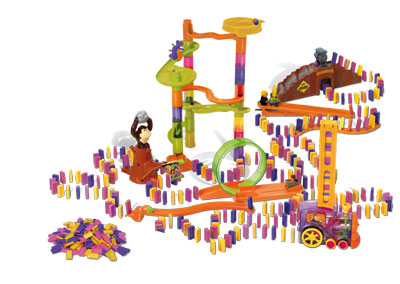
I suppose you've seen the TV show "El Hormiguero" any time and you have seen the butterfly effect or effects chains. The task is to create a chain reaction machine, these are prototypes that from something as simple as the fall of a marble or a domino token, triggers a series of events in form of moving mechanisms, engines that set in motion, spinning wheels, light bulbs, balloons explode ... etc.
Thus, a chain reaction machine is a device in which two or more effects occur, these effects occur in succession, one after the other, according to a certain sequence. The effects take place automatically, that is, once that happens the first no manual intervention is required for the other. Also, a phase can activate one or more effects.
Feel like to build one?
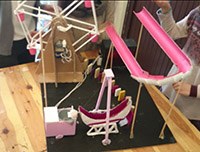
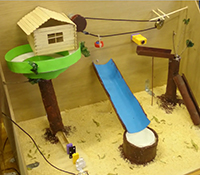
Here you have some examples from previous years.

Task

Design and build a chain reaction machine starting from one of the following ways:
- By droppinga marble or toy car down a ramp.
- By pushing a domino, etc.
And end when it meets the following conditions:
- The machine will have at least two effects chains for each student.
- The machine has two or more endpoints. For example, a bulb lights up and a buzzer sounds at the same time.
- The machine will be in operation for at least 20 seconds.
- The machine will have to have some of the mechanisms of the theme: Machine and mechanisms of your textbook, such as levers, pulleys, gears, cams, connecting rods, etc.
In the following link you will find resources that will give you an idea about some effects that you could include in your machine:
http://www.aulataller.es/proyectos-tecnologia-ESO/efectos-encadenados-tecnologia-eso.html
Here you have some extra videos which will help you a little bit
How to make a mini water pump?
How to Make an Electric Table Fan using Bottle?
Process
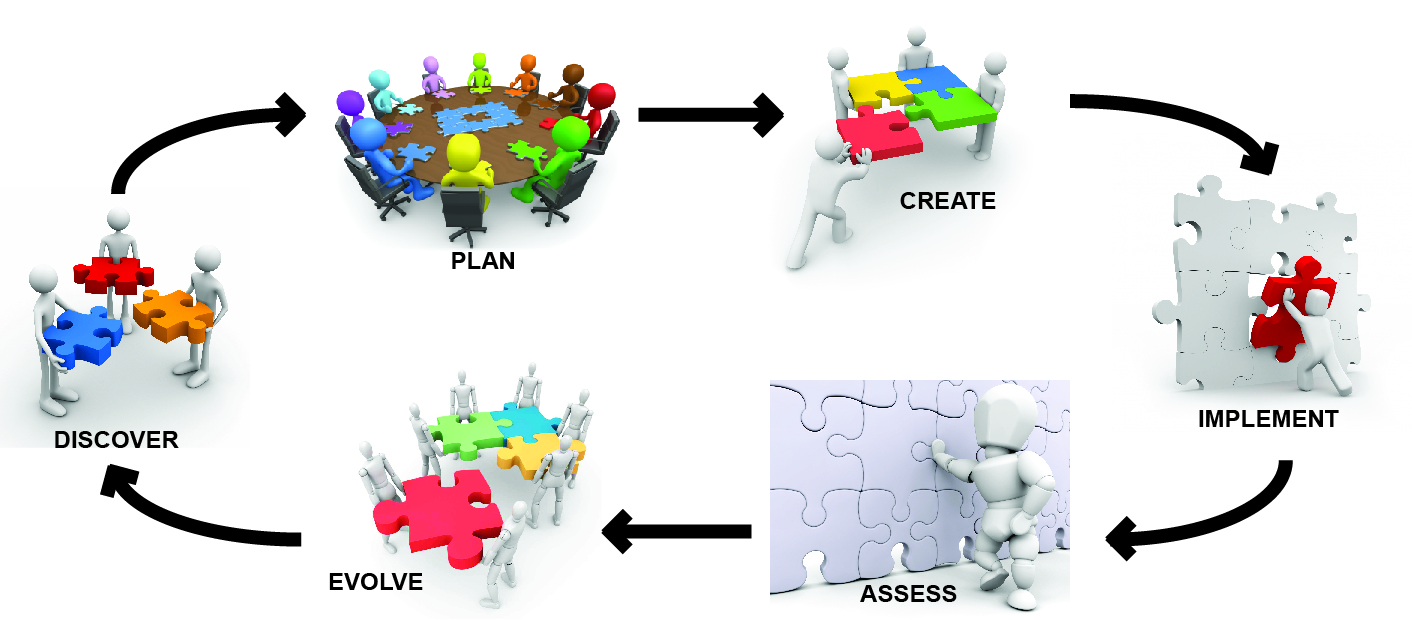
Once built the machine, fulfilling the conditions described in the previous section, each group will submit a report similar to this, with the following sections:
In a separate cover sheet you will put:
-the title of the project
-the number of your group within the classroom-workshop
-Students who participated indicating name and order number list
-the course and group.
CONTENT: On a separate sheet you will enumerate all sections that appear in the report and on what page they are.
PROJECT DESCRIPTION: It has two sections:
3A.- PROPOSAL: Here you will copy the instructions and requirements that have been given in class for the project.
3B. -DESCRIPTION: Here you will describe in words how the proposal will be materialized on an object that meets the requirements.
CONSTRUCTIVELY: This section shows step by step how you got to realize the project, the problems encountered during the project and how you solved them.
MATERIALS AND TOOLS: You make two tables.
-In The first, you will indicate the materials you used in a column, and another for what you used.
-In the second, you will do the same with the tools.
SKETCH: On a separate sheet you do a drawing of the complete project, freehand and respecting the proportions of its parts. Normally you do several sketches for the project. In the report you present the last sketch, where the project appears as such has been finally.
DISTRIBUTION OF WORK: On another sheet you'll include this section. You only have to include this section when is a group wok. In a two-column table you will tell which percentage of each job have done each member of the group. You do not have to state the daily work of each member.
This section has to be very clear, because although it’s a group work, the qualification depends on the degree of participation of each member, so if everyone have participated in a similar way, they have the same note. Otherwise, the grade will be proportional to the work done. Remember that the sum of % of all members is always 100%.
In the following link you will find resources that will give you an idea about some effects that you could include in your machine:
http://www.aulataller.es/proyectos-tecnologia-ESO/efectos-encadenados-tecnologia-eso.html
Evaluation

The evaluation criteria to be considered in the chained effects machine will be:
- Appropriateness of the techniques used by students in solving problems and performing tasks that arise during the development of the construction of the machine.
- Successful completion of the construction phases of a project.
- Performance, originality, aesthetics, etc. of the built prototype.
- Respect for all class members.
- Respect for tools and materials for classroom-workshop.
- Positive attitude to the problems.
- Presentation and development of the project report (written).
| 0 points | 4 points | 7 points | 10 points | |
| CONTENT | The work does not have the content set in the conditions of the task | The work has the content set in the conditions of the task but with errors | The work is well resolved with the contents of the unit | The work has more effects than those required |
| TEAMWORK | The students are not capable to work as a team | The students work as a team but with a lot of difficulties. | The students work as a team without problems | The students work as a cohesive team and help other students even from other team. |
| PRESENTATION | The presentation both, work and dossier are wrong | Only one, the work or presentation are good | The presentation both work and dossier are good | The presentation both work and dossier are excellent |
| ATTITUDE | Students are not interested in the task. | Students are interested in the task but they have wasted time | Students have a positive attitude and have used the available time to do the task. | Students have a positive attitude and have used the available time to do the task. They have helped to create a good atmosphere in class. |
Conclusion

With the completion of this activity, the students develop their creative abilities and skills that will enable both the understanding of technical objects and intervention on them, either modifying or creating them, encouraging innovative skills in finding solutions to existing problems
Likewise, students have to use the information technology and communications as a tool to locate, create, analyze, exchange and present information both in conducting the practical part as the theoretical (memory), with which implements the learning skills.