Introduction

Chemistry isn't just funny colored liquids, smells and math. Chemistry has been instrumental in shaping the world as it is today. Some industrial processes helped shape world, and changed the living conditions for all.
One of the best examples of this is the Haber process, named after its inventor Fritz Haber.
A relatively simple process of creating ammonia, this invention changed the course of World War 1, and is largely credited for the the dramatic increase in the world's population over the past century.
This webquest will help you to understand not just the chemistry of the process, but the history around it, and the impact it has had on society.
Task
 This webquest will teach you about chemistry of the Haber process, the historical context surrounding its discovery, and the impact it had on society. Working in a group of three, you will prepare a short presentation using Prezi or Google Slides, with each of you taking on one part of the presentation.
To do this, you will look through each provided resources, find other resources, and gain an understanding of your selected area.
Your group will produce a clear presentation which will be evaluated by the class and me.
Each class member will evaluate their own group and the presentations of others.
You are responsible for the information in the presentations and will take a quiz at the end of the project.
Process
Historical Context
At the beginning of the 20th century, many scientists were struggling to develop a way to produce ammonia from atmospheric nitrogen.
A German chemist named Fritz Haber, developed a way to synthesize ammonia from nitrogen and hydrogen in 1908.
History of the Haber process (EasyChem)
Biography of Fritz Haber (Nobel Prize Official)
Your section should give a general overview of what the world was like prior to the discovery of the Haber Process. Remember to use information from the resources provided and your own knowledge.
The world was a very different place than it is today, and many of the things we expect and take for granted simply didn't exist.
This process also changed methods of warefare for Germany, which was an important part of the first half of the 20th century
Chemistry
In the Haber process, the nitrogen, hydrogen and ammonia are in equilibrium and the equilibrium position depends on the reaction conditions. Use your knowledge of the gas laws.
Chemical Equilibriums and the Haber process (BBC)
Your classmates are at the same level as you in chemistry, so make sure you understand what you are saying!
You will need to cover both the theoretical chemical process, and the physical limitations on this.
You do not need to go too far into the exact engineering implementation of the solution, just what has to be done.
Societal Impact
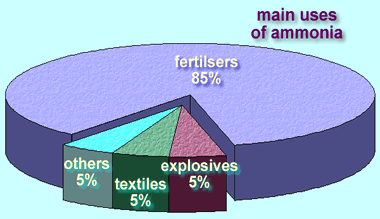
The Haber process has its many positive and negative effects on the environment and in today's society. These effects may cause small damage or may be extremely damaging to the environment.
Environmental / Social effects (The Compost Gardener)
Because the Haber process is so important, you will have a large range of things to talk about.
A good place to start would be the immediate benefits for Germany in 1913, and how those same benefits apply today.
One of the other most visible effects is that of population growth, statistics for that are very useful and easy to understand.
Other good resources
The Effect of the Haber Process on Fertilizers
Fertilizer History
Fritz Haber-The politics of Science
The Haber Process
Collecting Sections
After getting all your information from the three sections (history, chemistry and societal effects), combine your information together with other members of your group.
What were your findings?
Were there any unexpected results?
You will make a group presentation of your findings, you must all collaborate to make a cohesive presentation.
This means make sure fonts, colors, themes are all consistent throughout. Also have appropriate transitions between each of the sections.
Evaluation
Your group presentation will be evaluated as follows:
The presentation is well put together with appropriate images and cohesive color schemes (10 pts)
There are no grammar or spelling errors (10 pts)
The presentation is in your own words not copied and pasted from sources (10 pts)
All members of the group were working during the activity. If members of the group are off task during class time, points will be deducted from the group grade.(10 pts)
All areas are covered, the chemistry, history and societal impact of the Haber process. Use your knowledge of world history to put things into context. (10 pts)
Sources are cited. (10 pts)
Individual Evaluation
You will evaluate the other group’s presentations and give them a grade based on the above. This will be done using a google form. (20 pts)
A quiz on the Haber Process, this will be posted the last day of the project - February 2nd. (10 pts)
Your work during the class periods. If you are not working, you will lose points, both individually and for your group. (20 pts)
Off Task Behaviors include:
- Phone use
- Websites and videos unrelated to the project
- Inapproprate language
- Not working on the project
- Doing work for other classes
Each of these will lose points for the group and individual
Conclusion
As you have now learned, the Haber process is complex and significant.
But there's always more to learn!
As the year goes on, we will take time to look at other industrial processes and their impact on society