
Introduction
There are all types of poems and all types of poets. We have learned about Walt Whitman, Robert Frost, Edgar Allan Poe, and Sylvia Plath to name a few. We have learned that there are poems in Free Verse, Rhymes, Haiku, Limericks, etc. We have explored what makes these authors and poets write so well. Who are the people behnd the written works? What influenced the subects they chose to write about. Enough exploring other creators, you shall explore your creative and artistic side. You shall become your very own poem. The exploration of Acrostic poems begin here. By the end of this webquest you should be ready to create your own acrostic poem. You will be able to create an express yourself through an acrostic poem effectively. 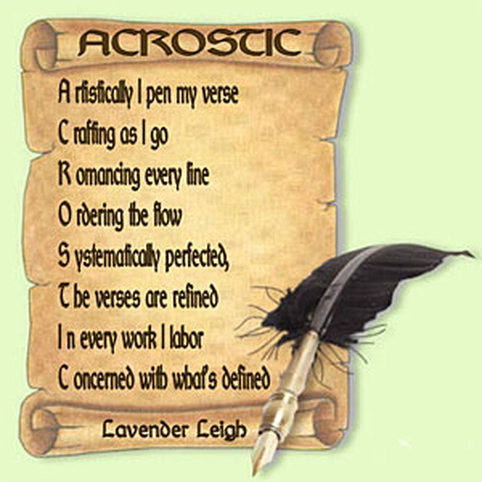
Task
- The task you will complete is to visit the sites below and learn about Acrostic Poetry
- Read and scan the sites for information that explain what an acrostic poem is and how they are created, takes notes on what you have learned.
- Search for an acrostic poem generator, put the necessary information in, print the results as an example.
- Answer the following questions that reflect and incorporate what you have read and how you will use the information to create your own poem.
- Create your acrostic poem
Process
- Visit the first 3 sites above and read about Acrostic Poems. Take notes on the important information as to how to create one.
- Create a thinking map of your choice that provokes brainstorming about various topic you would like to write about.
- Explore the idea of a few topic you have decided on. Narrow it down to one topic only
- Explore additional sources of information on this page
- Explore the various sites about being a good writer, effectively expressing, and grammar tips.
- Answer the following questions to reflect on your learning:
A. What are the letters in a topic used for when creating an acrostic poem?
B. Are people’s names the only letters you can use in an acrostic poem?
C. What is an Alphabetical Acrostic poem?
D. What Lewis Carrol acrostic poem was included in this lesson? What was the full-name used in the poem?
E. In at least 3 sentences describe the content of the site “Poetry Soup”.
- CREATE your poem.
RESOURCES
http://www.readwritethink.org/files/resources/interactives/acrostic/
http://www.poetry4kids.com/blog/lessons/how-to-write-an-acrostic-poem/
http://outstandingwriting.com/acrostic-the-many-pleasures-of-acrostic-poetry/
http://www.eapoe.org/works/poems/acrstca.htm
http://www.writingforward.com/poetry-writing/breaking-grammar-rules-in-poetry-writing
http://www.poetrysoup.com/famous/poems/acrostic
http://www.poetryfoundation.org/learning/glossary-term/acrostic
Evaluation
Student must cross-reference their work with the grading rubric provided below. Student will be individually graded for originality, grade level vocabulary, grammar, and form.
| CATEGORY | 4 | 3 | 2 | 1 |
| Meaning and Originality | Poem is creative and meaningful. It is evident that the poet put thought into their words and uniquely conveyed their ideas and emotions. | Poem is thoughtful and creative. A couple of phrases or ideas may be revisited, but the overall product is carefully written. | Most of the poem is creative, but appears to rushed. | Poem appears to be thoughtless and rushed. Work is very repetitive and ideas are unoriginal. |
| Sensory Details | Vivid, detailed images and intensily felt emotions make the poem come alive. | Clear sensory images are used to portray ideas and emotions. | Some use of imagery or emotion. | Difficult to visualize images or emotion. |
| Form | The poem is alive and follows its intended form. | The poem is written in its proper form with a few mistakes. | The poem is somewhat written in its proper form. | The poem is not written in its proper form. |
| Word usage | It is evident that the poet's use of vocabulary is precise, vivid, and paints a strong and complete picture in the reader's mind. | The poet's use of vocabulary is routine and workable. | Some use of vocabulary. | The poet's use of vocabulary is very basic. |
Conclusion
Now that you have completed this webquest you should be very knowledgeable about Acrostic Poems. You should have reflected on what it takes to make a poem effectively vivid and interesting to your readers. You should be able to apply all that you have learned from the various website links and be able to answer questions during whole class instruction as well as illustrate your mastery of the learning objective through your creation of an acrostic poem. Be ready to present your poem orally as well as it being presentable and pleasing to the eye.
Credits
Thank you to the following organizations: their resarchers, students, and webmasters.
Read, Write, Think http://www.readwritethink.org/files/resources/interactives/acrostic/
Poetry Soup http://www.poetrysoup.com/
Wikipedia https://en.wikipedia.org/wiki/Acrostic