
Introduction
Mythology has been used across the centuries and around the world to explain the creation of the world and the universe, to explain the human condition, to explain nature,
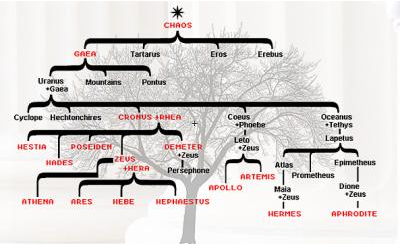 to explain the nature of the gods and goddesses, to explain the meanings behind religious rituals, to explain historical events, and to teach moral lessons. Across cultures and time periods, myths have certain similar elements. In this WebQuest, you will research the places, events, creatures, and items from the mythologies of different cultures. You will then weave these elements together into an original myth of your own.
Task
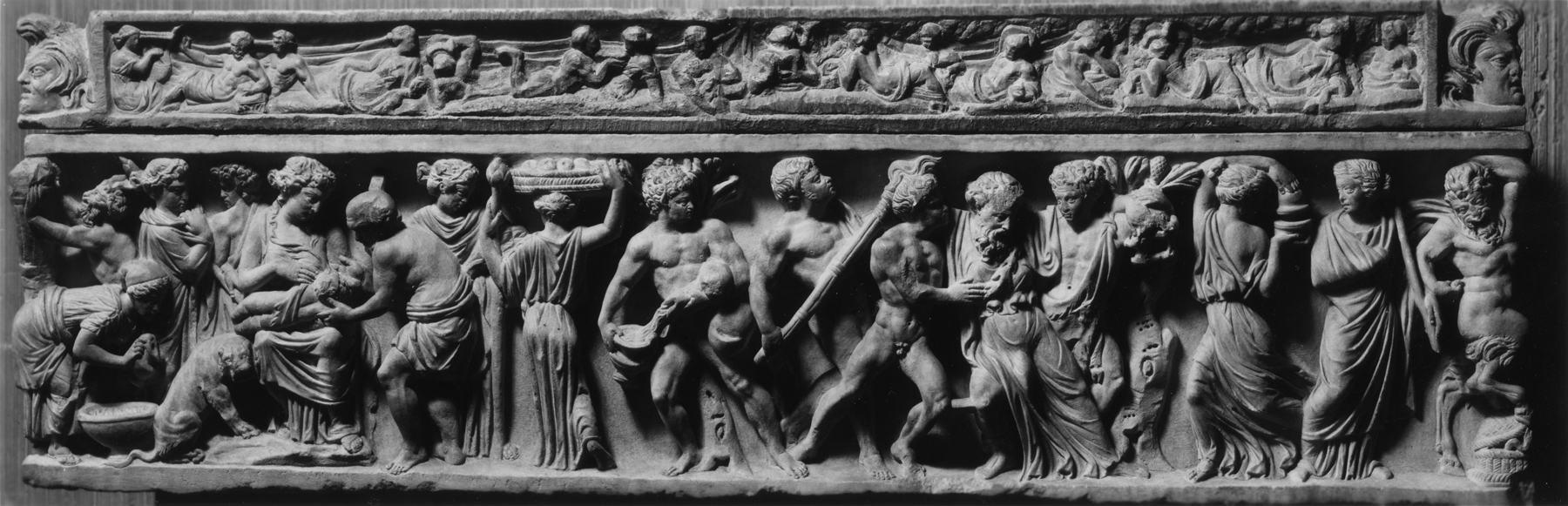
The class will be divided into groups of four and one group of five. Each group will have one "expert" in each of the following areas: places, events, creatures, and items. You will take the their knowledge of these particular elements of the mythology of various cultures and create your own myth.
Process

Step 1: Break into groups of four. Each group member should be assigned an aspect to concentrate on: places, events, creatures, or items.
Step 2: The experts from each of the groups should assemble and research your specific aspect of the mythology of each of the following cultures: Greek/Roman, Egyptian, Norse, Chinese, Celtic, Japanese, Aztec, Mayan, African, and Navajo. Keep track of what you find in common among the various cultures. You will be required to submit your notes over the elements of the various cultures.An excellent place to begin your research is the Encyclopedia Mythica. This website breaks down myths by region, then by culture, and covers the globe.Anne Zeise's page on mythology is also good, but does not contain as much information. Christopher B. Siren's page has a lot fo information, but is a little but more difficult to navigate. There are also many more mythology cites on the web that can be found with an effective Google search.The places experts should be able to answer the following questions as well as provide an idea of how each of the different cultures viewed their environment:
- Do gods and heroes live amongst everyday people, or do they have their own realm?
- Is there one world with some extraordinary places or several worlds?
- Can ordinary people reach these extraordinary places? If so, how?
The events expert should be able to identify the creation and ending myths of different cultures, as well as any important godly battles and empires/ruling groups.The creatures expert should find a variety of creatures from each culture, from the nearly-ordinary to the completely unnatural. You should approach your groupings in two ways: creatures that are based on the same animal, and creatures that have the same special ability or job.The items expert should look for magical items, especially gifts from the gods. You should track how they are obtained, what abilities they bestow, and how they are used. Take note of which items are retained by the heroes, and which they must return - or lose (and how).Step 3: Once research has been finished, each of the specialists will return to their original groups. The group will choose a setting for the myth, a hero or heroes to write about, an event or task for the heroes to experience, and the creatures and items the heroes will come across along the way. Be creative in how you combine myths; the more cultures you incorporate the better. Your myth should be 300 - 500 words long with a beginning, middle, and end. It should also satisfy one of the seven functions of mythology we have discussed in class.Step 4: Create 2 out of the following list of visuals to illustrate your myth. You may use any medium or software you'd like.
- A map or diagram of the world and locations included in the story
- An original illustration of a creature featured in the story
- An original illustration of the hero(s) using an item(s) from the story
- A collage or illustration depicting the events of the story
Evaluation
| Evaluation Rubric | ||||||||||||||||||||||||||||||||||||
|
|
||||||||||||||||||||||||||||||||||||
|
Conclusion
Hopefully now you will be able to see the ways that mythology across different cultures is similar but also different. Now you can see the relationship between mythology and religion and both of their roles in our everyday life. Isn't it interesting how similar characters and themes come up in the stories of 2 completely different cultures from different time periods. What are some of the myths and folktales of our current culture? How are they similar to the stories that you have researched? What elements of the different mythologies you've seen still exist in our stories today?
Credits
Standards
| 9-10 Common Core Standards RL.9-10.6 Analyze a particular point of view or cultural experience reflected in a work of literature from outside the United States, drawing on a wide reading of world literature. W.9-10.3 Write narratives to develop real or imagined experiences or events using effective technique, well-chosen details, and well-structured event sequences. W.9-10.3a Engage and orient the reader by setting out a problem, situation, or observation, establishing one or multiple point(s) of view, and introducing a narrator and/or characters; create a smooth progression of experiences or events. W.9-10.3b Use narrative techniques, such as dialogue, pacing, description, reflection, and multiple plot lines, to develop experiences, events, and/or characters. W.9-10.3c Use a variety of techniques to sequence events so that they build on one another to create a coherent whole. W.9-10.3d Use precise words and phrases, telling details, and sensory language to convey a vivid picture of the experiences, events, setting, and/or characters. W.9-10.3e Provide a conclusion that follows from and reflects on what is experienced, observed, or resolved over the course of the narrative. W.9-10.4 Produce clear and coherent writing in which the development, organization, and style are appropriate to task, purpose, and audience .W.9-10.6 Use technology, including the Internet, to produce, publish, and update individual or shared writing products, taking advantage of technology’s capacity to link to other information and to display information flexibly and dynamically. .W.9-10.7 Conduct short as well as more sustained research projects to answer a question (including a self-generated question) or solve a problem; narrow or broaden the inquiry when appropriate; synthesize multiple sources on the subject, demonstrating understanding of the subject under investigation. W.9-10.8 Gather relevant information from multiple authoritative print and digital sources, using advanced searches effectively; assess the usefulness of each source in answering the research question; integrate information into the text selectively to maintain the flow of ideas, avoiding plagiarism and following a standard format for citation. |
Adapted from a WebQuest by Victoria McKeon, NYU-Steinhardt http://questgarden.com/137/26/7/111214194507/index.htm.
Adapted from a webquest created by dbeck@mendotahs.org
Teacher Page
[img_assist|nid=31912|title=Percy Jackson|desc=|link=none|align=center|width=283|height=230]
Hope you enjoyed your World Mythology MIAD with Miss Rood!
I enjoyed having you and look forward to our next session!