
Introduction
Welcome to the Crash webquest!
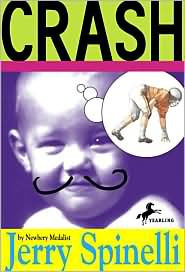
Crash is a novel about a 7th grade football player jock who bullies his dorky neighbor Penn Webb. Crash is his nickname, and his real name is John Coogan. He teams up with his best friend, Mike, to pick on Penn. Nonetheless, Penn tries countless times to befriend Crash. Will Crash ever change his ways and befriend his neighbor?
I know reading through this novel I had some questions that came to mind.Why would someone be mean to a person he just met? What is a Quaker? Why would somebody want to eat an Oatburger? Who would ever want wild creatures in their backyard? If I had questions like these, I thought you might have some similar ones. So I made this WebQuest to help you research topics that might help you make connections to and understand better the characters in this book. Begin taking this "crash" course now that will give you some background on the various topics mentioned in this story.
Task

By completing this WebQuest you will build and expand your background knowledge to help you understand the characters and problems presented in Jerry Spinelli's book, Crash. You will be collaborating with three to five students in a group to create a newsletter that will provide information researched by your group. Topics covered will be as follows: Quakers, bullying, vegetarians, and backyard habitats. Your newsletter will be created using the template provided in this WebQuest.
Process
Step One:
First, you should have your completed anticipation guide (that we did as bell work). The purpose was to get you thinking about how much you know about Quakers, bullies, backyard habitats, and vegetarians. Recalling what you know and sharing these ideas will help you organize the prior knowledge that you possess and which will expand as you research the topics presented in the story.
In your small groups, complete the steps below.
Step Two:
A. During this task and subsequent tasks you will use

the note organizer provided on your handout. This is a required organizer that you will use to take notes and record your thoughts on your chosen topic. As you access websites, you will complete one note organizer per webpage researched. Each completed note organizer will help you to earn participation points (see the rubric listed under "Evaluation" at left). Your notes will be used to write a newsletter article on the topic you chose. (Tip: the more notes you take, the easier it will be to write your article).
B.
With your assigned group visit at least one website from each of the assigned categories. You will be given one class period to investigate these websites. Each member of your group will then choose a category to research for the development of a group newsletter. All of the following categories need to be included in your newsletter.


Bully Habitats Vegetarian Quakers
http://questgarden.com/29/10/4/060713160054/files/Bully_Web_Pages_sept_…
http://questgarden.com/29/10/4/060713160054/files/Habitat_Web_Pages_sep…
http://questgarden.com/29/10/4/060713160054/files/Vegetarian_Web_Pages_…
http://questgarden.com/29/10/4/060713160054/files/Quaker_Web_Pages_Sept…
 C. Once each person in your group has selected a topic/category to research, you will have two class periods to visit at least two of the websites listed under the category to gather information in order to write an article for your group's newsletter. Use your note organizers to record and analyze information you find. (Tip: the more websites you visit, the more information you might find on your topic.)
Step Three:
A. After researching the websites for your category, you will meet with your group again to discuss and share the information you wrote on your note organizer.
- Are the facts that you found on the topic new to you?
- Do these facts support your prior knowledge about the topic?
- How do the other students in your group feel about the information you presented to them?
- Which facts will you use in your article to inform your readers about the topic and keep them interested?Use this time to have your group brainstorm ideas with you and help choose facts that you should use in your article
 .
.
B. Next, you will organize the newsletter (decide the placement and length of each article, icons used, etc.) with your group using the format provided below.
http://questgarden.com/29/10/4/060713160054/files/newslettertemplate-5…
C. When plans have been decided for your articles, make anappointment with your instructor to conference about your articles and newsletter layout.
D. Begin writing a rough draft for your article. It should be double-spaced using only one side of the paper and can be handwritten or typed. We are in the computer lab Tuesday, Wednesday, and Thursday. That is it, so use your time wisely.
Continue using the Writing Process (revise, edit, etc.). A Peer Review Checklist (use link below) must be completed by each member of your group for your paper. Make any necessary corrections and then attach the peer review checklists to the back of the final draft of your writing.
Writing Process Sheet: http://www.angelfire.com/wi/writingprocess
Peer Review Sheet: http://questgarden.com/29/10/4/060713160054/files/Peer_Review_Checklist…
Evaluation
Click on the link below for your evaluation form.
http://questgarden.com/29/10/4/060713160054/files/Evaluation_guide_fina…
Conclusion

Your Due Date: Friday, November 13, 2015
Your next step is to pick up the book Crash by Jerry Spinelli and read! Make predictions about what will happen, visualize how people and places look, and try to connect personally to the characters. As you read, refresh your memory about the topics you researched by referring back to your newsletters and also check out some of the websites you didn't get a chance to look at. Putting the background information that you now have together with the facts presented in the story should help you to infer the ideas that the author wanted you to understand. It's like putting the pieces of a puzzle together. Having more background knowledge about the topics in a story will help you see the bigger picture. So what are you waiting for? Pick up that book and read!
Credits
Credits
Strangman, N., & Hall, T. (2004). Background knowledge. Wakefield, MA: National Center on Accessing the General Curriculum. Retrieved July 30, 2006 fromhttp://www.cast.org/publications/ncac/ncac_backknowledge.html
Clip art licensed from the Clip Art Gallery on DiscoverySchool.com
Some Clip Art Provided by School-Clip-Art.com
Some clip art images provided by GraphicsFactory.com
Clip art provided by office.microsoft.com
This work is licensed under the Creative Commons Attribution-NonCommercial-ShareAlike 2.5 License. To view a copy of this license, visithttp://creativecommons.org/licenses/by-nc-sa/2.5 or send a letter to Creative Commons, 543 Howard Street, 5th Floor, San Francisco, California, 94105, USA.