
Introduction
In this WebQuest, we will explore the water cycle.
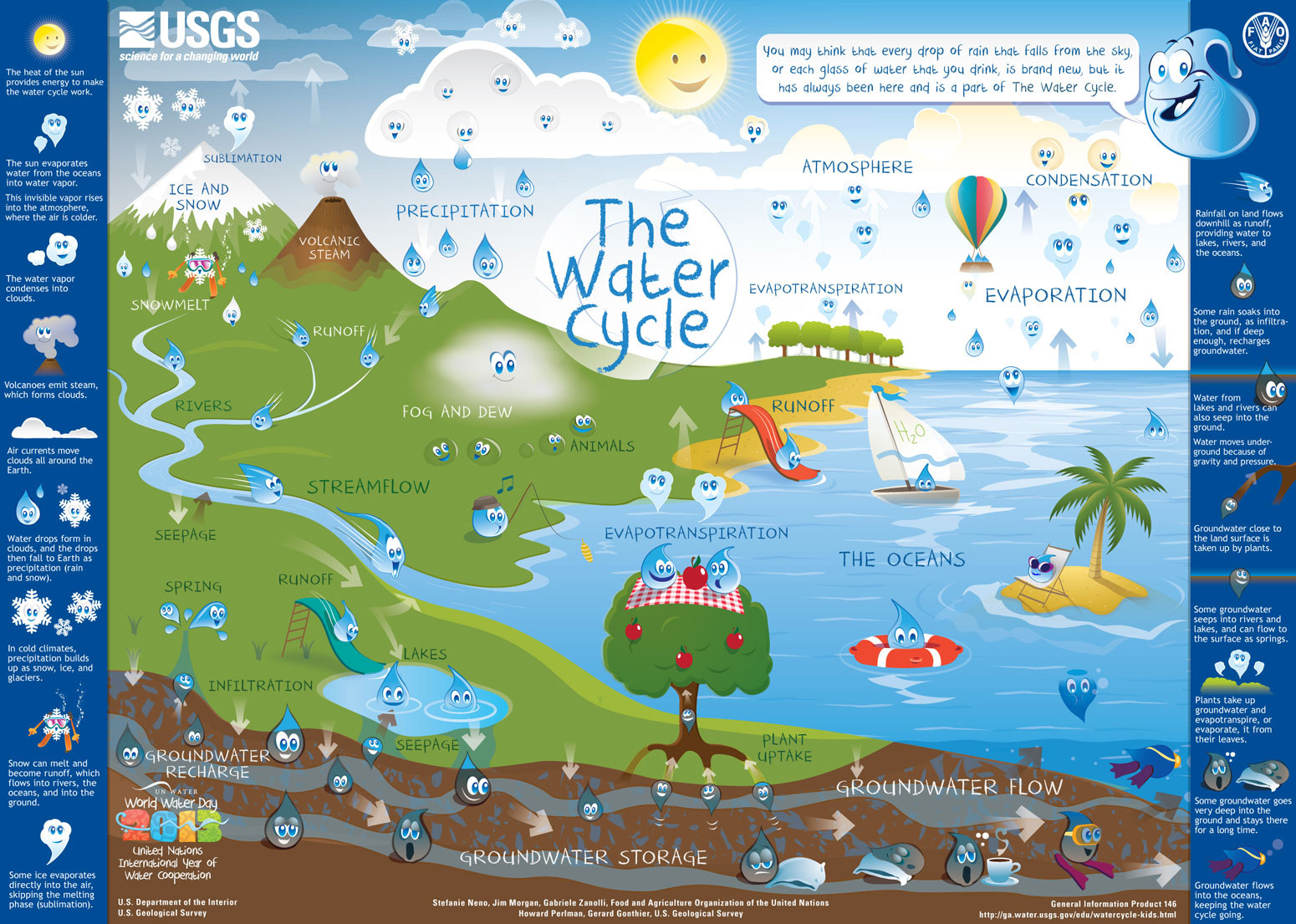
The earth has a limited amount of water. That water keeps going around and around in what we call the water cycle.
Imagine you went to your kitchen right now and poured yourself a glass of water. As you look at the water in the glass, can you tell how old your water is? Probably not. The water in your glass may have fallen last week from the sky as rain, or even two weeks ago, but, the water itself has been around as long as the earth has. When the first fish crawled out of the ocean and onto land, your glass of water was part of that same ocean. How is that possible you ask? Well in this WebQuest, you will find the answers to this question and many more.
The water cycle is made up of a few components: Evaporation (and transpiration), Condensation, Precipitation, and Collection. The image above illustrates how the process works.
Evaporation: Evaporation is when the sun heats up water in rivers or lakes or the ocean and turns it into vapor or steam. The water vapor or steam leaves the river, lake or ocean and goes into the air.
Transpiration: Do plants sweat? Well, people perspire (sweat), and plants transpire. Transpiration is the process by which Plants lose water out of their leaves. Transpirations gives evaporation a bit of a hand in getting the water vapor back up into the air.
Condensation: Water vapor in the air gets cold and changes back into liquid, forming clouds. This is called condensation.
Precipitation: Precipitation occurs when so much water has condensed that the air cannot hold it anymore. The clouds get heavy and water falls back to the earth in the form of rain, hail, sleet or snow.
Collection: When water falls back to earth as precipitation, it may fall back in the oceans, lakes or rivers or it may end up on land. When it ends up on land, it will either soak into the earth and become part of the “ground water” that plants and animals use to drink or it may run over the soil and collect in the oceans, lakes or rivers where the cycle starts all over again.
Below are links for additional information and resources:
http://www.discoverwater.org/water-cycle/
http://www.sciencekids.co.nz/sciencefacts/weather/thewatercycle.html
http://thewaterproject.org/resources/the_water_cycle_presentation
Task
Using different resources (text book, internet, etc.), and in collaborative groups of 4, you will form teams of water experts.
Each member of the team will be responsible for researching a specific part of the water cycle. Together with your team, you will create a travel journal of your simulated adventures through the water cycle. Your journal will include information you gathered while exploring one of the four stages of the water cycle. Once your adventure through the water cycle is done, your team will present to the class what your journey consisted of and what you learned. After all teams have presented, the class will have a better understanding of the water cycle.
Process
STEP 1:
Your journey through the water cycle has now begun.
As part of the water expert team each member will be assigned a role.
1- Evaporation/Transpiration Expert
2- Condensation Expert
3- Precipitation Expert
4 - Collection Expert
Now that the team of experts have been established, here is a detail of what the experts should acquire.
The job of the Evaporation Experts:
- Use the internet, or other resource, to find information about evaporation and its role in the water cycle. This includes finding information about what specifically happens during evaporation as well as specific examples.
- Write a detailed description of your journey as if you are a drop of water who has experienced evaporation.
- Work with your team of experts to create a presentation (PowerPoint, Prezi, Poster, Play, etc.) to describe your journey through the water cycle to the class.
The job of the Condensation Expert:
- Use the internet, or other resource, to find information about condensation and its role in the water cycle. This includes finding information about what specifically happens during condensation as well as specific examples.
- Write a detailed description of your journey as if you are a drop of water who has experienced condensation.
- Work with your team of experts to create a presentation (PowerPoint, Prezi, Poster, Play, etc.) to describe your journey through the water cycle to the class.
The job of the Precipitation Expert:
- Use the internet, or other resource, to find information about precipitation and its role in the water cycle. This includes finding information about what specifically happens during precipitation as well as specific examples.
- Write a detailed description of your journey as if you are a drop of water who has experienced precipitation.
- Work with your team of experts to create a presentation (PowerPoint, Prezi, Poster, Play, etc.) to describe your journey through the water cycle to the class.
The job of the Collection Expert:
- Use the internet, or other resource, to find information about collection and its role in the water cycle. This includes finding information about what specifically happens during collection as well as specific examples.
- Write a detailed description of your journey as if you are a drop of water who has experienced collection.
- Work with your team of experts to create a presentation (PowerPoint, Prezi, Poster, Play, etc.) to describe your journey through the water cycle to the class.
Each team will be responsible for gathering information on their area of expertise in the water cycle. Please be specific when you provide examples of each stage. This part includes putting the information together in a fun and interesting presentation.
STEP 2:
Complete the following activity.
SIMULATING THE WATER CYCLE
Name ___________________________________
Date_____________
Purpose: To simulate and observe the water cycle
Materials: large wide-mouth jar, small beaker, salt, sand, small paper cup, plastic wrap, large rubber band, small rock, spoon
Procedure:
1. Stir salt into the small beaker filled with water until no more salt will dissolve.
Pour a one centimeter deep layer of the salt water into the large mouthed jar.
2. Place a paper cup half filled with sand in the center of the jar.
3. Loosely cover the jar’s mouth. Seal the wrap around the jar’s side using a rubber band.
4. Place a small rock or weight on the plastic wrap directly over the paper cup.
5. Place the jar in direct sunlight. (Or use a bright light or sun lamp.)
6. After several hours, observe. Record your observations.
Observations: Sketch the jar and list what you observe below.
|
|
1. _____________________________________
2. _____________________________________
3. _____________________________________
4. _____________________________________
5. _____________________________________
6. _____________________________________
STEP 3:
Now that you have done your research and lab activity, it is time for the presentation.
Each team of experts will present to the class. The presentation should be creative and interesting.
Evaluation
Evaluation
|
|
Beginning 1 |
Developing 2 |
Accomplished 3 |
Exemplary 4 |
Score |
|
Content of Team's Travel Journal |
Gave few detailed facts about assigned stage in water cycle and lacked specific examples. |
Gave some detailed facts about assigned stage in water cycle and few specific examples. |
Gave many detailed facts about assigned stage in water cycle and many specific examples. |
Gave most if not all detailed facts about assigned stage in water cycle and most if not all specific examples. |
|
|
Job Performance: Evaporation Expert Condensation Expert Precipitation Expert Collection Expert |
Used one resource to obtain information for individual travel journal on assigned stage and displayed little or no information on assigned stage. |
Used few resources to obtain information for individual travel journal on assigned stage and displayed limited information on assigned stage. |
Used many resources to obtain information for individual travel journal on assigned stage and displayed various forms of information on assigned stage.
|
Used unlimited resources to obtain information for individual travel journal on assigned stage and displayed vast knowledge on assigned stage. |
|
|
Presentation |
Demonstrated little if any knowledge of the water cycle as a continuous process. |
Demonstrated some knowledge of the water cycle as a continuous process. |
Demonstrated most knowledge of the water cycle as a continuous process. |
Demonstrated vast knowledge of the water cycle as a continuous process. |
|
|
Collaboration with Group Members |
Poor team member, failed to actively contribute to the group. |
Average team member, actively contributed little to the group. |
Good team member, actively contributed frequently to the group. |
Great team member, always actively contributed to the group. |
|
|
Spelling |
Abundant spelling errors. |
Many spelling errors. |
Few spelling errors. |
Little or no spelling errors. |
|
|
Grammar |
Abundant grammar errors. |
Many grammar errors. |
Few grammar errors. |
Little or no grammar errors. |
Conclusion
Welcome back from your adventure through the water cycle. Now that you, as experts, have conducted research, document information, and presented what you learned to the class, let's test our knowledge with the following quiz.The Water Cycle Quiz
On your own sheet of paper, select the correct answer and submit when done.
Question: 1 of 12
|
Question: 2 of 12
|
Question: 3 of 12
|
Question: 4 of 12
|
Question: 5 of 12
|
Question: 6 of 12
|
Question: 7 of 12
|
Question: 8 of 12
|
Question: 9 of 12
|
Question: 10 of 12
|
Question: 11 of 12
|
Question: 12 of 12
|
Credits
The following websites were used as resources to create this WebQuest:
http://www.discoverwater.org/water-cycle/
http://www.sciencekids.co.nz/sciencefacts/weather/thewatercycle.html
http://thewaterproject.org/resources/the_water_cycle_presentation
http://webquest.org/search/index.php
http://www.softschools.com/quizzes/science/water/quiz316.html
Strategies for ELL/ESE students:
Speak slowly, distinctly, and write down key terms.
Emphasize visual literacy
Group project and cooperative learning
Encourage participation
Use clear procedural steps
Model laboratory activity
Teacher Page
SC.5.E.7.2 : Recognize that the ocean is an integral part of the water cycle and is connected to all of Earth's water reservoirs via evaporation and precipitation processes.
SC.5.E.7.1 Create a model to explain the parts of the water cycle. Water can be a gas, a liquid, or a solid and can go back and forth from one state to another.
SC.5.E.7.4 Distinguish among the various forms of precipitation (rain, snow, sleet, and hail), making connections to the weather in a particular place and time.
Stategies for ELL/ESE students:
Speak slowly, distinctly, and write down key terms.
Emphasize visual literacy
Group project and cooperative learning
Encourage participation
Use clear procedural steps
Model laboratory activiy