
Introduction
During this WebQuest you will learn what autism is, you will learn the three core symptoms of autism and you will create a picture exchange communication system to use with children that have autism.
Introduction
One in 68 children are now being diagnosed with autism. Complete the following activity to learn the true meaning of autism, the core symptoms that a child with autism may have and how to help a child with autism to communicate.
Task
Task

You are on a journey of discovery of a disability called "Autism". You are going to find out the definition of Autism and about the three core symptoms there are associated with autism. You also have a student with autism that is nonverbal and you have to find out about “picture exchange communication system.” Your ending product will be a picture communication exchange system for a child who is non verbal and has been diagnosed with autism.
Process
Process
The first thing that you will need to do is to come up with a definition for the word "Autism". Here are some links to use to get your definition.
https://www.nichd.nih.gov/health/topics/autism/conditioninfo/Pages/symptoms.aspx
http://www.emedicinehealth.com/autism/article_em.htm
https://www.autismspeaks.org/what-autism/facts-about-
http://www.ninds.nih.gov/disorders/autism/detail_autism.htm
[video:https://www.youtube.com/watch?v=wKlMcLTqRLs]
Once you have a definition of autism it is time to move on to the three core symptoms of autism. These can be found on the following sites.
https://www.autismspeaks.org/what-autism/treatment/medicines-treating-core-symptoms
http://www.emedicinehealth.com/autism/page3_em.htm
Teaching children with ASD how to communicate is essential in helping them reach their full potential. There are many different approaches to improve communication skills. The best treatment program begins early, during the preschool years, and is tailored to the child’s age and interests. It also will address both the child’s behavior and communication skills and offer regular reinforcement of positive actions.
People that have autism can benefit from visuals. Read on the link below to find out about this.
http://www.angelfire.com/ky/touristinfo/index5.html
http://www.hanen.org/Helpful-Info/Autism-Corner.aspx
http://autismum.com/2012/05/07/10-tips-on-how-to-communicate-with-autistic-people/

You need to be thinking about the information that you have gathered and how you are going to use it to complete your final project in the third process.
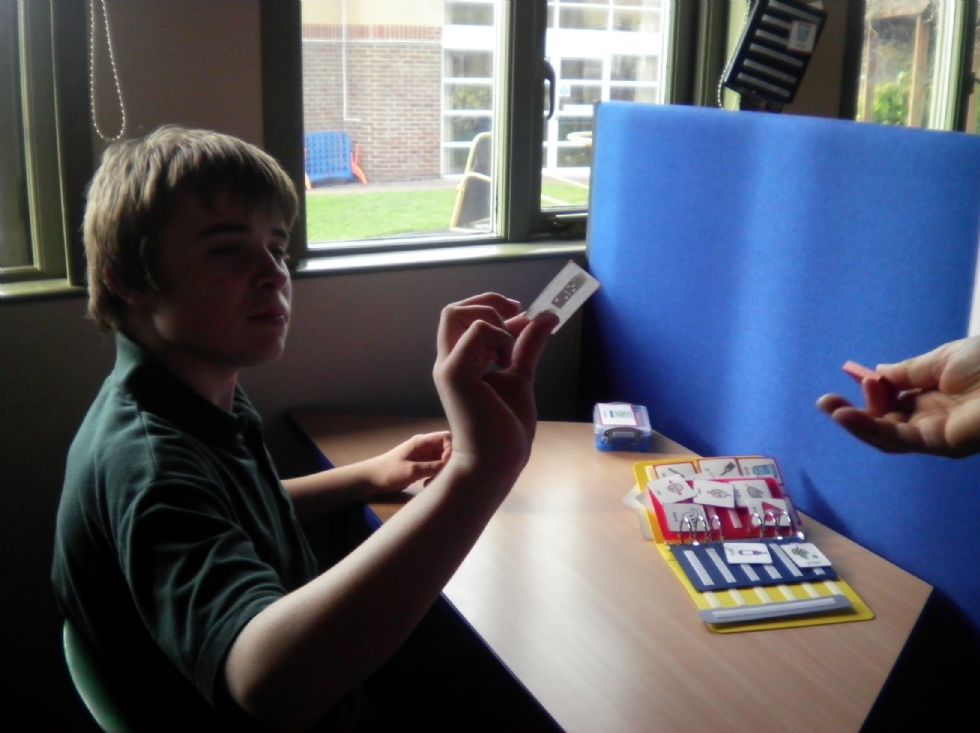
Now that you have done the research, define autism and fully explain the three core symptoms of autism in a one page paper. To go with this paper you need to come up with a picture exchange communication system that a nonverbal student can use and explain what the student can request with the cards or what the visual helps the child with. The Picture Exchange Communication System, or PECS, allows children with autism who have little or no communication abilities, a means of communicating non-verbally. Children using PECS are taught to approach another person and give them a picture of a desired item in exchange for that item. By doing so, the child is able to initiate communication. The child with autism can use PECS to communicate a request, a thought, or anything that can reasonably be displayed or symbolized on a picture card.
http://www.nationalautismresources.com/picture-exchange-communication-system.html
http://www.pvmhmr.org/20-autism/article/8786-picture-exchange-communication-system-pecs
http://sitemaker.umich.edu/356.kobza/pecs__picture_exchange_communication_system

Evaluation
Evaluation
|
Beginning 1 |
Developing 2 |
Accomplished 3 |
Exemplary 4 |
Score |
|
|---|---|---|---|---|---|
|
Description of the Spectrum
|
Description that mentions autism. |
Description that starts to explain the definition of autism. | Description that explains autism. | Well stated description that explains autism using correct punctuation and grammar. | |
|
Description of core symptoms.
|
Description that mentions core symptoms. | Description that starts to explain the core symptoms. | Description that explains core symptoms. | Well stated description that explains the core symptoms completely using correct punctuation and grammar. | |
|
PECs setup
|
One step cards set up. | Two step cards but not set up to be used. | Usable two step cards with no description on how to use them. | Usable two or more step cards with description on how to use them using correct punctuation and grammar. |
Conclusion
Conclusion
The next step in the training process is to teach the children to use phrases, rather than just one symbol, in order to communicate (Bondy & Frost, 2001). This is accomplished through the use of sentence strips, on which something such as “I want_____” is written. Children are taught to find the correct sentence, attach it to a Velcro strip in their PECS book, and then to attach the correct symbol to the sentence strip (Bondy & Frost, 2001). After the child does this, the communicative partner faces the strip towards the child and reads it back to them, while delivering the item (Bondy & Frost, 2001). After this stage, the child is able to create and understand simple sentences. PECS communication is gradually becoming more and more consistent with typical verbal communication.As you can see, PECS can be a very functional communication system for children who are not able to acquire speech in the typical way. Because PECS mimics the development of speech in typical children, it can also be used as a bridge to verbal language for many children with autism. To learn more about this form of communication, visit the following website:
http://sitemaker.umich.edu/356.kobza/pecs__picture_exchange_communication_system

Teacher Page
During this WebQuest you are going to learn the definition of autism, the three core symptoms of autism and a picture exchange communication system to use with children that have autism.
Teacher Introduction
Teachers you can use this WebQuest to help students to better understand autism. This can be used to help in the classroom with your aides to educate them about the students that they are working with.